Typophile

Does a type designers handwriting influence the typefaces they produce?

Alex Kaczun

I would be very interested in seeing samples of type designers handwriting and comparing them to some of the typefaces that they have created.

My own handwriting, if you can call it that, is terrible. But, I pride myself on producing very legible fonts.

It would be interesting to hear what others have to say on the subject.

Send in your penmanship and font samples.

It might prove interesting.

It's interesting that you mentioned this, because recently there was so many people saying that my handwriting is terrible, even though they are complementing my calligraphy peaces and typeface designs. I'm now working on my handwriting to improve it and I find it very hard to restrict myself to so many regulations which other people have in their handwritings and makes them beautiful. anyway I found so many features in their characters that brought ideas to me to design new typefaces.

Okay... I googled the question, and found an interesting post:

http://www.themaninblue.com/articles/handwritten_typographers/

Interesting, Mark Simonson's handwriting looks just like his "Felt Tip Roman" font.

But the best one is the last sample by Mirian Bantjes, three distinct handwriting styles... very different indeed. Split personalities?

I've never seen anyone write with so many different penmanship styles. Intriguing.

However, everyones handwriting is still better then mine :(

Alex,

Don't be so quick to claim the crown. Long ago, I abandoned cursive writing in favor of printing because I couldn't even decipher the former as practiced by me. And, except for a few distinctive features, I rarely sign my name the same each time I am required to do so. Now, that's bad penmanship…

Interesting, Mark Simonson's handwriting looks just like his "Felt Tip Roman" font.

I think that's the other way around! :-)

I'd rather prefer to say that a person's 'hand' (or authorship) is evident in both their handwriting and the type designs they create (revivals aside).

How many of us would even know? I for one hardly ever write anything by hand any more.

The "R" over there to the left is a sample of my handwriting, but I wrote a dozen of them to get one I liked.

I've recently heard that some schools in the USA have eliminated or are going to drop penmanship, or cursive writing, from the school curriculum.

Cursive handwriting is on its way out in our computer-focused society.

It's not needed anymore. Young students do not write anymore.

I find this disturbing. Add to this, that all these young people have their own language (LOL, etc.) and no one writes out complete words or sentences anymore. No one knows when to use "I" or "me" properly. No one reads books anymore and I could go on-and-on.

WHAT THE HELL IS GOING ON??? Are we all going to get stupider?

I guess that the only solution is to keep making more new fonts.

More beautiful fonts will make the world communicate better. A better place.

I'm being sarcastic.

But, I do see that since no one will write anymore. They can just choose a font as their personal penmanship style.

Certainly almost enough fonts to do that, or soon will be ;-)

I'm going to start working on improving my penmanship again.

When I was a student I got A+ in cursive writing. I don't know what happened. Now, I can hardly even read my own handwriting.

New Years Resolution (Improve my writing skills)... I'm a type designer for Christ's sake!

My pathetic handwriting only serves to mark up proofs for correction.

@ Nick,

I wonder if most type designers have bad handwriting?

I too, can hardly ever sign my name the same way.

Funny story:

I was at a bank recently trying to access my safe deposit box.

I had to sign in and the person behind the desk informed me that the signature did not match.

To "try again".

Well, I must have spent over an hour sitting there trying to sign my name different ways.

Finally, hit on something that looked vaguely similar and the guy said "close enough" and let me proceed.

Pretty pathetic. And scary.

Maybe I should just use a big "X", as the cowboys did in the good old days :-)

I learned cursive in second and third grade and haven't used it since except to sign things. By fifth grade or so, most of my teachers were expecting typed papers and for my own use, I much preferred to avoid cursive. To me cursive has always been a sort of compromise: faster writing times for slower reading times. Since I can write fast enough without cursive, I never saw the need to hinder my future reading of what I'd written...

http://typophile.com/node/19878
http://www.themaninblue.com/articles/handwritten_typographers/

My handwriting is quite nice (when I want).
But I haven’t made a font out of it yet.
In answer to the OP’s question, I can write in the style of several of my type designs*, which is the other way around from Mark’s Felt Tip—although I suspect he could write in the style of Lakeside, for instance.

* e.g. Panoptica Script

I wish. :-) I can draw better than I can write.

I find I have different styles depending on the implement.
I have produced four scripts; ITC Dartangnon (pencil), Gizmo (Staedtler Brush Pen), Olicana (steel nib and ink) and Rollerscript (Pentel green rollerball thingy), and they all look fairly different to each other.
Whether my handwriting affects my sans or serif designs is another matter, it may do on a subconscious level - but I don't know.

@ Nick Cooke

You truly have beautiful penmanship. I especially like your "Rollerscript" style. I'm jealous.

I also like the "lumpy" bits, as you call them. It gives a natural quality to the overall freehand script style. Great work.

If you still need a name for your script... "Sgraffito".

http://www.handbuiltpotteryonline.net/sgraffito-–-strange-name-beautiful-technique/

@ riccardo

Thanks for the link. It was interesting to view development of Nick's script.

Well, thanks Alex, but I don't really have beautiful penmanship. I do not at all consider myself a calligrapher. Those fonts derive from writing pages and pages of pangrams and snatches of conversation heard on the radio, most of it of the most appalling quality, selecting the best looking bits and sticking them together until they look like good handwriting. Plus a lot of programming of course.

I am sticking with Rollerscript, I don't think it's too bad a name afterall.

Edit. I hadn't clicked on Riccardo's link - it's just coincidence that I followed that post. Thanks Riccardo.

I too am disturbed that cursive may no longer be taught to schoolchildren. Apparently we can assume all have access to computer keyboards and that is the standard method.

I just read a blog post by a father who heard his high school son complain of difficulty reading italic text. Italic! Cause of course - the letterforms are based on classic hand lettering.

Where is this going? I can imagine:

a detective finding a handwritten note at a crime scene...is it a suicide note or a grocery list? He can't read it, so has to pass it on to a cursive writing specialist for analysis (maybe this already happens).

He can't read a letter from 1976 in a police file, or one received from his grandmother (who has beautiful handwriting).

Can't write a love note to his darling unless he has access to a suitable font and printer, before slipping it under her pillow. If they are out at a romantic lakeside cabin with no computer equipment, he tries to laboriously print the note but decides to just text it to her cellphone. Figures she can't read or write cursive either.

I'm prejudiced I guess because I love beautiful hand scripts and other forms of handlettering. But I agree crappy handwriting is irritating to look at.

An analogy can be made to singing. A lot of people are very bad at singing or even tone deaf. Does that mean kids shouldn't be taught singing or playing instruments, because obviously recorded music sounds better (yeah, I know), so why not rely on a collection of that and not try to do it yourself half-assed?

My handwriting has influenced all of my typeface designs insofar as I have terrible handwriting and type design is a kind of compensation, allowing me to express ideas about visible language that I cannot express by hand.

_____

Dina, some of the hypothetical situations you describe have existing parallels whenever older or regional forms of writing are encountered by people who have not been trained to read them. I have a whole collection of books whose purpose is to provide pedagogical examples of handwriting from different periods and countries, to assist people in deciphering documents such as old birth certificates, property deeds, etc..

John,
I understand any educated person who's not an expert would need assistance deciphering handwriting from earlier centuries or foreign cultures - but one's own contemporary culture or just a few decades past, and still in use?

Not exactly handwriting, but I've always wanted to be a calligrapher, but Arabic calligraphy is so complex that it takes many years of a really talented person to master it, something I could not afford. When I learnt about digital type, the first thought I had was "may be I can get this computer thing to do calligraphy for me" :)

Dina: ...but one's own contemporary culture or just a few decades past, and still in use?

The parallel I suggested, though, is in ways of writing ceasing to belong to contemporary culture, falling out of use, and then how we have to relate to them. Sutterlin script was the dominant model of cursive handwriting taught in German schools in the first half of the 20th Century, and disappeared within 'a few decades', between two generations, such that very few people can now read it, let along write it with any competence. Should it surprise us that in a culture of rapid change, this process might occur more quickly?

John,
You may be right, but I still find it disturbing. A generational concern, maybe. (I'm a boomer and have studied pen & ink hand-lettering - enough to recognize the artistry of it.)

Will even typographic scripts be in use much longer? They are hugely popular and diverse in style, if you look at MyFonts sales records, for instance. And in a few decades they'll all be illegible to the younger half of the population?

And in a few decades they'll all be illegible to the younger half of the population?

It is already the case that very few people can actually write in the manner of these script types, and most bear no relationship to lettering taught in schools at any period, but writing and reading are different abilities. So called 'wedding script' types are endlessly popular, but represent styles of writing that have not been systematically taught for almost two hundred years. They persist in use because they are fashionably associated with certain cultural phenomena (wedding invitations, wine labels, some book or music packaging), and bear systematic relationships to other more common styles of typographic letters (italics), and hence they remain readable despite the fact that no one is taught how to write them.

I'm sure that there are some type designers who design typefaces starting from their own calligraphy, thus leading to faces which do reflect their writing hand - if not their normal handwriting.

Several type designers have a consistent "feel" to their typefaces which suggests that they had done this. Frederic W. Goudy comes to mind as a possible example.

John,
Thanks for the comments - food for thought.

A consistent "feeling" in one's œuvre doesn't have to
have anything to do with handwriting. Let the poor old
hag die in peace.

hhp

Calligraphy is far different than handwriting. When using calligraphy, we have chosen to write beautifully as the name says. This is a conscious effort. Handwriting is another beast. Most of us just write notes to ourselves or family members--we know what that chicken scratch is supposed to say ;-)

Several type designers have a consistent "feel" to their typefaces which suggests that they had done this. Frederic W. Goudy comes to mind as a possible example.

Goudy's types are among the most truly free of chirographic influence: they're pure drawing, and the frequent 'wandering lumpiness' of the outlines produce relationships between inner and outer forms that are alien to anything informed by the stroke of the pen. At their best, Goudy's types demonstrate how stable forms can be derived independently of written models; more often -- let's remember just how many types he designed -- they demonstrate the difficulty of achieving such stability and the arbitrariness of the drawn outline.

Thanks for posing this question, Alex! I would love to see some other examples on this subject as well.

In my case, yes - my handwriting has had a big impact on my typeface designs.

On another note, I am currently teaching a typography class and recently took an informal poll of my students as to who was taught cursive in school. Pretty much everyone over 40 had, 30 somethings where 50/50 and just about everyone under 30 had not. In conversations I've had with friends who have school aged children, not one of them have been taught cursive.

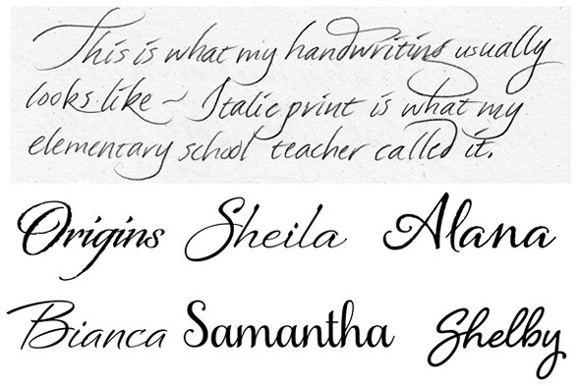
Anyway, here is an example of my handwriting, along with my typefaces that most closely resemble my writing style.

Wow, we have my fellow Washington State resident Laura Worthington chiming in.

I have several of your fonts and want ALL of them! Sheila is like candy to me...

The handwriting style you show would've likely been frowned upon in my elementary school (ages ago). It was supposed to resemble the slanted Palmer script with connected letters and many loops - actually much more difficult for the teacher to read, I would think.

Today I do an upright semi-connected hand, and I am often attracted to upright scripts like Samantha because of that, maybe.

@ Laura Worthington

I'm a big fan of your script work and calligraphy. Bianca and Origins among my favorites.

Very similar to your beautiful handwriting.

I would give my right hand to be able to write like you.

But, then I wouldn't have a hand to write with :-)

I'm actually half way through designing a wedding script for my son, Michael, and his upcoming wedding to Susanne Bamberger, she's an art director at More magazine. So it has to be really unique and different.

What I have so far she likes, but it's not easy work for me... not being a calligrapher and all. But, I will give it my best shot.

Anyway, thanks for your reply. This is exactly what I was hoping to see from other type designers.

Looking forward to other great scripts. Keep them coming.

Dina: The handwriting style you show would've likely been frowned upon in my elementary school (ages ago). It was supposed to resemble the slanted Palmer script with connected letters and many loops...

What kind of pen were you given or required to use? I was surprised, when I came to Canada aged 10, to discover that kids here were taught to write a hand derived from English roundhand models -- a relative of Palmer script, I reckon -- but using poor quality ballpoint pens, rather than the split nib pen for which these styles had been invented. At my previous school, in Wales, fountain pens had been compulsory, and something like an italic running hand had been required.

John: good question.
I remember using a fountain pen at an old-fashioned U.S. school in 1960 when I first learned cursive. We did exercises to practice round and angular shapes before making letters.

"Round-round-round-round--ready--touch!
ONE, two, three, four, five six, seven, eight,
TWO, two, three, four, five,six, seven eight..."

That sticks in my mind, but I can't remember where I put my glasses 10 minutes ago.

Probably cheap ball point pens came into favor for schoolkids in the mid-sixties.

It seems to me that one can trace changes in the teaching of handwriting relative to what secretaries are doing at any given time. In societies with low levels of literacy, in which even rulers may be illiterate, professional scribes emerge as record keepers, amanuenses, letter writers: the birth of the secretarial profession. This profession exists parallel to that of the scribe who is a copier of books, and it requires a different kind of script: something faster to write than formal book hand. And so demotic, cursive scripts evolve, displaying the characteristics of speed: abbreviation of forms, joining of letters, horizontal compression, and slant. Because these are professional scripts, they are refined as a means of controlling entry to the profession, and hence another new profession emerges, especially as literacy increases: the writing master. The writing masters teach secretarial hands, and mercantile capitalism and the development of international trade produce a large market for the skills they advertise, and this market drives the development of a new kind of publication: the writing manual. Meanwhile, the secretaries are busy and, between Arrighi et al publishing italic writing manuals and Barbedor his les écritures financière, they abandon the broad nib quill and reed, and start writing with pointed, split nib steel pens. This new tool drives the development of new scripts, based on pressure rather than nib angle, and the steel pen and its associated scripts remain in professional use through to the early 20th Century. Meanwhile, with the spread of school-based education and further increases in literacy, the teaching of writing has moved from the domain of private writing masters into something resembling our own education system. But it is still contemporary secretarial hands that provide the models. In the second half of the 19th Century, standardised and in some respects simplified models are proposed to aid the teaching of writing -- a subtle change: the goal is no longer competence in the secretarial hands per se, but pedagogical efficiency --, and hence Palmer and others. Meanwhile the secretaries, although still writing a lot by hand, have started to use typewriters, and that is going to have a profound effect on the teaching of handwriting in the 20th Century, long before it was suggested that the computer makes the teaching of handwriting unnecessary. Gradually, the secretarial profession ceases to provide a stable model for writing. Alongside the typewriter, new kinds of pens are being invented: fountain pens with built-in reservoirs, round nibs producing monoline strokes, the first rolling ball nibs, etc.. Writing implements become a matter of personal choice rather than professional determination. Since the secretaries, whose professional prestige -- so long founded on fine handwriting -- has been completely demolished by the speed of the typist, are no longer committed to a particular tool or, indeed, to particular styles of writing, the schools too start accepting new kinds of pens, eventually making decisions on budgetary grounds, whence cheap ballpoints. But they continue to teach, long past their sell-by date, the last models -- however degraded -- that they received from the secretarial hands in the late 19th Century, because no one has come along with a new secretarial hand in the meantime. In Britain, and among some educators elsewhere, the gradual degradation of the various 'copperplate' models and their patent unsuitability to the new pens prompts a crisis, which is met by fleeing to the past and rediscovering the typical script of long, long dead Italian secretaries. Hence, a depressing amount of the debate about the teaching of handwriting -- even as the personal computer took hold in the workplace, the home and the classroom --, has been about whether it should be based on 15th or 18th century models. A few individuals have sought to provide new models, better suited to modern writing implements, but despite their virtues these tend not to be widely adopted. Why not? Because secretaries don't need them, and when it comes to writing, what secretaries don't need, no one else needs. Handwriting is on the way out because there is no professional epistolary culture either driving the development of new styles nor providing a milieu within which to employ such styles. And this has been the case for about a century. What we're seeing isn't something that has been brought about by the computer, but the tail end of a long process.

I think you are mistaken about the dominance of the secretarial model.
For instance, in the early 20th century my grandmother, age 20, kept an “autograph” book, in which her friends and relatives each entered a piece, usually a sentimental poem, in their own hand. There is a great variety of styles, and all of superb technique and fine-detailed precision.
From this, I conclude that writing was approached as a sophisticated skill and means of self-expression.
Although certain styles were standardized for business, people wrote a lot of personal letters to one another.
These letters ranged from those to lovers and close family, to formal invitations to social events.
If one knew the correct form to address a potential employer, why would one use the same style to address one’s sweetheart?

But I like your long-termism—it seems to me that cheap long-distance phone calls have diminished letter-writing, and hence handwriting. Why write a letter to someone when you can call them up?

I don’t think the absence of a professional epistolatory culture means that handwriting has atrophied.
Just because common handwriting today is casual and often crude doesn’t mean that it isn't a distinct cultural style.

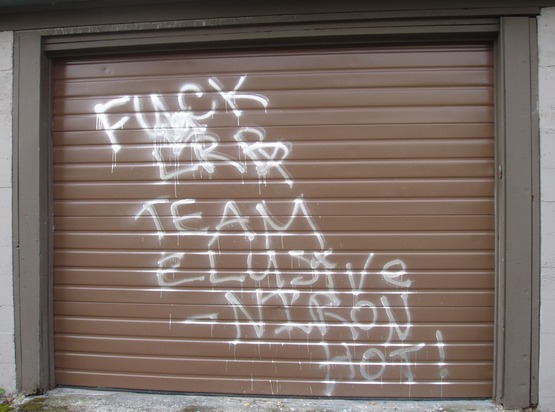
Hey, no computer or ball-point pen can create THIS:

I guess this is the definitive 21st century hand-written expression (one of many discovered decorating our property from time to time).

Skype has better handwriting than I do ;-)

You know, I do not think anyone is opposed to change, or progress.

Out with the old and in with the new. Evolving culture is a good thing.

But, seriously, children not needing to learn long-hand or cursive writing.

Print if you have to, but at least know how to write.

Learn proper grammar, learn when to use "I" as opposed to "me". Even the news reporters are getting it wrong.

Everyone is using "I" all the time, because they are not sure.

So, eventually the culture changes and "me" is dropped from the English language.

Know how to do everyday arithmetic, long-division, fractions... how to figure out the tip on a bill. Practical stuff.

You know how many times I've been at a cash register and I given the kid $10.25 for a $4.21 item and they cannot figure out the change back.

What happens when a solar flair wipes out all satellites and global tele-communicates some day.

Your cell phones, your computers, your calculators, your "Gragon Dictate" (talking-writing) speech recognition software doesn't work anymore. Yes, even FontLab is not working. Oh me, oh my...

And things are down 6-months or longer. Do we all slip back into the dark ages.

Grunt and grown like cave people. I know I'm over-dramatizing. But, I'm trying to make a point.

As a society, we should be very careful what we decide to do away with and what we keep.

How about some common sense.

And, I'd like to break every little finger in the kids hand that defaced public property as shown above.

Better yet, take away the spray paint, put a pen in their hand and make them learn proper cursive writing.

Even better yet, force them to become a type designer. That will teach them ;-)

> Practical stuff.

Exactly.
Writing by hand is less so each passing day.
It's just common sense.
Cloying nostalgia is the bane of progress.

hhp

Evolving culture is a good thing.

Are we not men?

Not exactly... Nick.

I count 14 men and 2 women...

;-)

Nick, that's a fair point about personal epistolary style, but I think that is another product of the situations I describe: rising literacy rates, the spread of systematic education including the teaching of handwriting, and the introduction of new writing tools at a time when the dominance of secretarial models was waning due to increased use of the typewriter. As the choice of writing implement became a matter of personal preference, greater individuality becomes evident in writing. The fact that so much of the writing remained of such high quality, even as it departed from the taught models, indicates that the manual skills developed in learning to write 'a fair hand' are transferable.

This is where I do think the loss of handwriting as a taught skill is problematic -- has been problematic in my own life --: not in the disappearance of handwriting per se, but the disappearance of the transferable fine motor skills.

Those who tell us their handwriting is illegible and ugly no matter how they try, help me out - I am puzzled about this:

The same folks often have no trouble with the dexterity required for speedy touch-typing - something I never learned as a youth (cause I was on the academic track, not "secretarial"). I type with two fingers - and I've written 7 books that way.

I suppose I COULD learn touch-typing, though it would feel unbearably clumsy at first. But I don't WANT to go through that learning curve. Maybe it's something you ideally should learn at a young age, like piano.

Could it be that the sloppy writers don't WANT to tediously practice like elementary school kids until they improve? Cause unless they have a hand-eye coordination disability, I don't see that it would be impossible to learn.

After all, type designers must be skilled with drawing implements, whether manual or computerized. Why is writing by hand a sticking point for some?

~~~~~~~~~~~~~~~~~~~~
By the way Alex, I agree that we shouldn't assume the computer tools we take for granted now will always be cheap and available at will. We hear that peak oil, climate change disasters, and resource wars may be our future. I can imagine younger people would truly be at a disadvantage if they know no other ways to communicate.

Could it be that the sloppy writers don't WANT to tediously practice like elementary school kids until they improve?

In my case, it is a combination of lack of will and lack of time: if I had more time, likely I wouldn't mind the prospect of tedious practice. Improving my handwriting isn't something I can prioritise, which takes me back to the point I made above about need. I would like to have better handwriting, but I don't need better handwriting, and hence there isn't a lot of impetus to devote time and effort to improving it. There are other things that I want to be better at too -- singing, cooking, woodworking --, and all of those have more practical application in my life than having nice handwriting, so they get priority in my leisure time.

John,
That makes sense...it's a cultural thing. In the past...say it's 1895, and you want to impress a young lady you're courting with romantic letters. If your handwriting is crappy, she'll be disappointed, even decide you're too uneducated or vulgar. Then you'd be likely be motivated to practice and improve your penmanship. Right?

The way I see it, there are transferable and particular skills. Handwriting is a particular skill, and it is one that isn't culturally useful where we are at the moment, hence fewer people develop the skill. The interesting questions, I think, are a) whether there are transferable skills (fine manual motor skills) involved in handwriting that can also be developed in other ways and, b) whether those skills are transferable to something that is culturally useful. I don't know the answer to those questions, but I would be glad of suggestions. It may be the case that the skills involved in handwriting are highly specialised, and not significantly transferable.

Maybe we should eat everything with chopsticks.

John,
Handwriting dexterity is similar to drawing, seems to me. Fine manual motor skills (as you say) combined with an eye for design, composition, visual impact.

Is drawing useful? If you could make your living from drawing, it's very useful. But aside from that - it's an art. Art isn't necessarily "useful" culturally or otherwise, but it is a form of expression and creativity that is meaningful to many people.

You mentioned singing. Most people who sing (I do) will never even attempt to become professional singers. So - limited usefulness. But it's gratifying anyway, to improve your singing performance and have others appreciate it. A social purpose, then.

I also like hand-addressing envelopes and writing notecards, feeling that the beauty of the writing will be noticed and appreciated.

I had very good handwriting in grammar school. By the time I had finished college (and written 100 exam essays in blue books in 2 hours or less), my handwriting turned to speed writing scrawl. I am of the age when boys were not taught to type so I can't type the proper way either! I started "typing at age 40, when I got my first computer. I type badly and slowly. It has nothing to do with laziness. My hands can't keep up with my brain so I just would rather not loose a train of thought just to make my handwriting better. When I send written things to others, I either type it or occasionally use Calligraphy. The message and audience chooses the medium. I am the only one who has to read my handwriting so it does not matter.

That's my point!

We should learn all these skills at an early age... when the mind is young... and it's easy.

The older we get the more difficult it is to adapt.

Who wants to learn, after the age of 40, how to type properly (with all ten little fingers) and so on...

I do not want to "beat an old horse with a stick"... but, does anyone else agree?

Yeah, we should definitely force our kids to learn something
they won't need in the least by the time they're adults.

hhp

@ hrant

I respect your point-of-view. I get it.

All I can say is that "I've already forgotten more than you know".

If you live long enough, you'll know what I mean. This is not a put-down, but a fact.

Sooner or later, no matter what you learn, it will have to be forgotten, unlearned, and a new approach taken to continue and stay competitive and productive. That's a fact of life.

Don't be too quick to throw out the "basic tools" premise or monkey wrench.

You may need it again some day. A good carpenter takes good care of his tools.

You know, initially I got upset at your condescending tone, but
when I took into account that you have yet to write anything on
Typophile that has caused me to think I realized it's not worth
the trouble. If you have the desire and ability to engage in more
than old-timer drivel, I would ask that you try harder; I'm sure
there's something in your experience that can benefit more than
the mere neophyte.

hhp

Has there been any other time in history when a seemingly "conventional" practice has been overtaken by a new technology? Do you need to milk your cows, feed and water your horses, or even mail that letter!? These are VERY volitile times. The "need" of legible handwriting is slowly becoming less and less "needful". Not to say that I enjoy seeing that happen; I am 31 and a lot more will change in the next 31 years, and sometimes all you can do is sit back and watch. Pretty fascinating really...

Damn. where is the nearest blacksmith shop?
Right next door to the Phototypesetting shop.

Damn. where is the nearest blacksmith shop?

Just ask Siri ;-)

Siri-usly? ;-)

Just don't ask it where to get an abortion:
http://www.bbc.co.uk/news/technology-15982466

hhp

I was waiting for you, Hrant ;-)

Turtletype says "these are very volatile times" due to the breathtaking speed of technological progress, and everyone agrees. Yes, we are spoiled.

No one has addressed my earlier suggestion that techno-progress may reverse, due to peak oil, energy deficits, climate disasters, and resource wars. We may not have our little techno-gadgets chirping at our fingertips. "Old-timer drivel" may seem useful then.

I don't think I'd do well. I hate roughing it, I won't even go camping. I'm a vegetarian, raw meat disgusts me. I don't want to kill animals and eat them to survive. I have no idea how to milk a goat, if I were lucky enough to acquire one (it has to be a female, I know that much). Endless hours of canning after boiling foodstuff over an open fire would be a drag.

I've always liked to read at night, that's kinda hard by candlelight.

My fashionable wardrobe would be impractical to say the least. I'd have to clomp around in rubber boots and thick wool socks most of the year. If someone didn't steal them. Laundering clothes would be difficult. The nearest river is real polluted. Everybody would smell.

But I WOULD remember how to write by hand. That would be a useful skill.

But I WOULD remember how to write by hand. That would be a useful skill.

I don't think you'd have time, what with all that other stuff you'd be doing.

Just for the record, I don't own/use a cellphone.
To me none of this is about relishing technology,
it's about common sense.

> I don't want to kill animals and eat them to survive.

You'd make a lousy animal.

BTW, if a vegan is an extreme vegetarian, I'd like to
figure out a term for an extreme meat-eater: somebody
who only eats the meat of carnivorous animals. :-)

> That would be a useful skill.

I'm sorry, but that's ridiculous. And I have to
add that this sort of expression is typical of
delusional handwriting-junkies.

hhp

hrant,
Why would I make a lousy animal? I'd make a good elephant. Intelligent, powerful, take no shit, nurture their young, sociable, matriarchal, and herbivorous, that's an animal I admire. Well, except for the males going nuts during musth. That's kinda harsh.

As for a term for people who eat only other carnivores, how 'bout Inuit (Eskimos). They have no choice, they live on whale and seal meat.

So it's ridiculous that writing would be a useful skill when the techno-gadgets lose their power. You're right, we could rely on smoke signals to send messages.

"Handwriting-junkie." Now there's a term that is truly original! At least, I've never heard it before. Oooh, the thumb-typing huuurts...I'm desperate....give me a pencil and paper, someone...

Watch what the big alpha male (in total control since the start)
does in the end: http://www.bbc.co.uk/nature/15385364
(The "panicked"/"luck" bit is, pardon the pun, bull.)

hhp

Dinazina, I read a book by Seth Godin recently, We Are All Weird which makes the case that the world is moving in a direction of specialization (hence this forum) and the "weirdos" who actually "enjoy" things like horseback riding or calligraphy will still be around; I just won't need to look over Adrian Frutiger's shoulder to learn to appreciate typography.

Speaking of techno-progress here is a Dilbert episode that shows what would happen if our satellite system went down.

Turtle,
The Dilbert thing was hilarious, thanks. I'll check out the book.

Can't watch the video. I fast-forwarded to the end. The ravenous-wolf-pack-pursuing-and-tearing-the-throat-out-of-a-large-animal imagery isn't for me, even if it contains a useful lesson related to typography or whatever.

You clearly didn't watch the end (or any part of it).
But you also clearly had the time, since you did watch
(or at least claim to have watched) a 22-minute cartoon.
A lack of respect for content is one other characteristic
of delusional handwriting-junkies. Anybody looking for
a feel-good vent-friendly retirement home should really
try Typo-L instead.

> even if it contains a useful lesson related to typography

Which would be quite unlike your posts.

hhp

Hrant: A lack of respect for content is one other characteristic of delusional handwriting-junkies.

Hrant, this doesn't strike me as either fair or helpful comment. If someone who is a vegetarian, who is disgusted by the thought of raw meat, doesn't want to watch a video of an animal being killed -- even by other animals --, I don't think that constitutes 'lack of respect for content'. I might as easily and as unfairly suggest that your individual interpretation of that content re. the actions of the bull bison -- contra David Attenborough's commentary -- constitutes a lack of respect for content. [Personally, I think it would have been better if the commentary made explicit what is in fact the case: that we don't know whether the bull taking down the calf was accidental or deliberate.]

And I say this as someone who thinks having nice handwriting will not, in fact, be a useful skill to possess if the various apocalyptic options listed by Dina pile on. If she is genuinely concerned about these things, she should start learning how to forage, learn what vegetables grow natively in her local environment, learn how to distinguish edible and poisonous mushrooms, etc.. While she's about it, she might want to read Lierre Kieth's The Vegetarian Myth and make a reckoning of just how many billions of animals are killed every year to support non-meat diets.

> I don't think that constitutes 'lack of respect for content'.

I agree. I was talking about pretending to have paid attention.
Somebody who does that typically believes that the content is
irrelevant, that the only important thing is what they feel. And
feeling is the only thing handwriting has left; which isn't bad
of itself, but expecting others -and even everybody- to share
one's feelings is deluded.

hhp

Ideally, I believe, education should positively expose children to possibilities, some of which will appeal to them as individuals, and which they should then be encouraged to pursue. This is the context in which handwriting can be learned as something pleasurable, in which a person can take pride of accomplishment, as well as having some practical applications. An education system that takes an all or nothing approach -- handwriting must be taught to everyone vs. handwriting is pointless to teach to anyone -- has so many inbuilt problems that debating this one issue seems as pointless to me as debating whether handwriting should be based on 15th or 18th Century models.

I get the feeling from reading this thread that cursive writing has become a rather secure means of communicating. Maybe it's time I used more cursive and less print hand? Hmm... lern meself Sütterlin?

>Ideally, I believe, education should positively expose children to possibilities, some of which will appeal to them as individuals, and which they should then be encouraged to pursue.

Ideal is right. I wouldn't give public schools much credit beyond teaching kids how to fill in bubble sheets! That's one reason my wife (teacher) moved to a charter school. Even then my wife says they teach only an italic type of handwriting, however she said out of her whole class there was one boy that took the time with his penmanship...the rest could care less. There is one model I wish we had from the 15th century. Apprenticeships! What if printing and type was what you breathed since you were fourteen or so? How do you think the workforce would be? Instead of brainless, shut-up and sit-down classrooms where we are taught to be mindless skilled workers! Sorry, this topic just hits a nerve with me.

Hmm... lern meself Sütterlin?

Go for it. Then maybe you will come out with something even wilder than a “didone Fraktur-Uncial”!* ;-)

* http://typophile.com/node/87771#comment-485668

/me groans...

Aside: If you go to http://www.operina.com, you will find there an e-book named Handwriting Models. The hand I learned in school is roughly that on pages 12 and 14.

Hrant,
I am puzzled about your hostility toward vegetarians and "handwriting junkies". Or maybe just me.

I expressed some questions I had about the future with the smart people here - with humor (maybe I didn't add a smiley face?) I haven't insulted carnivores or non-writers. You're defensive, as if I had. Is anyone else pissed off?

I don't go out of my way to watch videos of killing. That is why I watched the Dilbert cartoon and not more than a few seconds of the killing video. Too bad if you find that contemptible.

I never asserted that "nice handwriting" would be a useful skill in the dystopian future. I thought it was clear I meant ANY handwriting. No electronic keyboards working, y'know.

That's my last word, flame away if you enjoy it.

Dina: I never asserted that "nice handwriting" would be a useful skill in the dystopian future. I thought it was clear I meant ANY handwriting. No electronic keyboards working, y'know.

Fair enough. But so far as I know, no one is suggesting that people cease to be taught to write by hand, such that they will be incapable in the absence of electronic keyboards. What is being phased out is the teaching of cursive writing based on historical models.

Now, if people in the future rediscover a need to write a lot of stuff for other people to read and to write it quickly, then they will reinvent cursive writing, because that's what epistolary societies do. Today, if we want to generate a lot of text in a hurry, we type it. If at some point we can no longer use this technology, we'll start writing fluidly again. In the meantime, anything we need to write by hand is typically short and either doesn't require speed or doesn't require care.

Dina,

This PBS radio broadcast may be of interest to you:

http://www.radioopensource.org/curtains-for-cursive/

Dina, I am hostile towards junkies of any flavor. In the context of type,
handwriting-junkies deserve special hostility because they keep type
in the dark ages. I am not hostile towards vegetarians at all. However
I have noticed that many vegetarians suffer from the same problem that
handwriting-junkies suffer from: denial. I hate denial. It doesn't make
a person bad, but it very much deserves derision.

There was no gore in the video. You were not honest about how much of
it you watched. There was the specter of death in the video, but death
is part of life, and I don't like weaklings who look away. If you look
back at how this started, you might realize that I was half-joking.
But there is still the other half.

> I never asserted that "nice handwriting" would
> be a useful skill in the dystopian future.

But do you not believe that?

And more than that, this juvenile fantasizing about keyboards no
longer working and everything else still being so OK that people
have the time/need/inclination to write (did you pay attention to
what Nick wrote?) is simply annoying. It is motivated by a self-
involved desire to justify an arbitrary preference for a marking
method. Nevermind that most people who don't believe that
handwriting remains important have totally legible handwriting.

hhp

Fy fan, @hrant! You're so violent, I'm beginning to think you're a vegan!

@dinazina - Will tech. progress reverse? Not until post-apocalypse. Slow down? Very likely. There are limits to everything, after all.

"Suppose in the future there is a movement to ban the color yellow. Proposals to paint anything yellow are denounced as "yellowist", as is anyone suspected of liking the color. People who like orange are tolerated but viewed with suspicion. Suppose you realize there is nothing wrong with yellow. If you go around saying this, you'll be denounced as a yellowist too, and you'll find yourself having a lot of arguments with anti-yellowists. If your aim in life is to rehabilitate the color yellow, that may be what you want. But if you're mostly interested in other questions, being labelled as a yellowist will just be a distraction. Argue with idiots, and you become an idiot."...

Food for thought:

http://www.paulgraham.com/say.html

So you don't believe enough in handwriting to fight for it.
But what do you fight for? What are the "other questions"
that deserve expounding and defending, here on Typophile?
I myself, strangely enough, fight for type.

Escapism is the sister of denial. And some of us argue
not to defeat others, but to become better by defeating
our own failings. There is no better way to refine one's
thoughts than thinking out-loud and as a consequence
have to defend them.

hhp

Hrant, I wonder if type is something that needs to be fought for, or if fighting for something is just your way of being?

This thread just got interesting.

John, clearly both.

"Conflict is the father of all things." -Heraclitus
We can discuss who the mother is.

hhp

"Pro" and "Con" are the various "good" and "bad" points of an idea. Say a manufacturer wants to build a new factory in town. The pros are more jobs, and increased tax revenue for the town. The cons are pollution and a high noise factor.

What are the "pros" and "cons" of teaching cursive writing? Read on...

http://teacherleaders.typepad.com/tln_teacher_voices/2006/10/the_pros_an...

http://www.welltrainedmind.com/forums/showthread.php?t=106011

http://www.cursivewriting.org/

http://www.writtenbyhand.com/colophon.html

http://www.thebehaviorsolution.com/cursive-writing-and-child-development/

http://www.blog.montessoriforeveryone.com/cursive-vs-printing-is-one-bet...

Hrant: clearly both

Well, if (b), then you would say (a).

Somehow, I don't think Heraclitus, in developing his primitive dialectics, was advocating going out and stirring up conflict.

The mother of all things? If conflict is the father, then it stands to reason that conflict resolution -- or maybe mutual aid -- is the mother, since otherwise there would only be conflict, and no creation of mutually beneficial and enriching peace, however fragile and conditional.

There was no gore in the video. [Dina was] not honest about how much of
it [she] watched. There was the specter of death in the video, but death
is part of life, and I don't like weaklings who look away.

I'm not going to speak for Dina, who could best represent her reasons should she choose to. But I want to take issue with the notion that choosing to look away from depictions of killing -- even if no visceral gore is involved -- constitutes weakness. It speaks to me rather of the comparative ease -- especially in our society, where so few people provide for their own nutrition -- to empathise with the panicked terror of the prey animal, contra the more complex sympathy required to identify with the need of the wolves. To celebrate the kill, because of what it means for the life of the predator, is more a more distant emotional response for most people than pity and horror at what the prey goes through as it is hunted down. I don't think that has anything to do with being a 'weakling', any more than being able to appreciate the deadly beauty of the wolves makes us strongmen.

> going out and stirring up conflict.

I didn't go out. I've been here ~12 years. It came to me.

> Well, if (b), then you would say (a).

Not to be even more (b), but: not necessarily. :-)
I can think of things that are worth fighting for,
but I won't be the one doing the fighting; and there
are things not worth fighting for, but I'm still (b).

The mother of all things: it doesn't feel right for it to be the
exact opposite of Conflict. Maybe the mother is Comfort.

--

There's certainly too much macho "appreciation" of killing,
at least where I live. But my reason for somebody like Dina
to watch the video isn't that she should enjoy it - quite the
contrary; my point is that avoidance of content (i.e. reality)
that makes one uncomfortable constitutes weakness.

Have you been in a room where a baby is being delivered?
Some people find it quite unpleasant. But it's important to
overcome the desire for Comfort and embrace the Conflict,
whether you believe the end-result will be horrid or wondrous.

--

BTW, in case it's unclear: the reason I pointed out that video
is that I was trying to show that even herbivores kill animals,
sometimes even one of the their own family members. There
is in fact a species of monkey where members gang up on one
of their own and kill it out of nothing more than boredom.
And humans are nothing more than animals.

hhp

> There is in fact a species of monkey where members gang up . . .

And I bet you can’t read their handwriting either. ;-)

LOL!!!

Captured from web.archive.org on 12 Oct 2013. view this capture