Typophile

Removing languages

Core0

My recent work on Bot Mono began with Deja Vu, which includes a huge array of extra signs and languages. Of course I can remove individual glyphs by deleting them. But how do I remove whole sets of languages, or extra arrays of special characters?

My second question is about which sets I should include. Latin is a natural choice, as well as the basic arrays of Baltic languages and Greek. But this is a font for code, for programming and the computer shell. I understand there is no such thing as “one standard set of characters” — you can make your font as large or small you want. What I’m looking for is a good common ground, a set that would be useful in daily work (coding) with non-asian, non-african, European languages.

I forgot to add I’m working in Fontlab Studio 5.1 on Mac OS 10.10.

I think that WGL4 would allow most Europeans to comment their code in their own language.

http://en.wikipedia.org/wiki/Windows_Glyph_List_4

Thank you, Té Rowan, but that is not answering my first question. “WGL4” is also not a language choice in Fontlab.

What exactly do you mean by 'language choice in FontLab' (i.e. to which panel and/or menu are you referring?)

Andre

Don't know about removing, but this could be of interest: http://www.thomasphinney.com/2014/03/fontlab-latin-encoding/

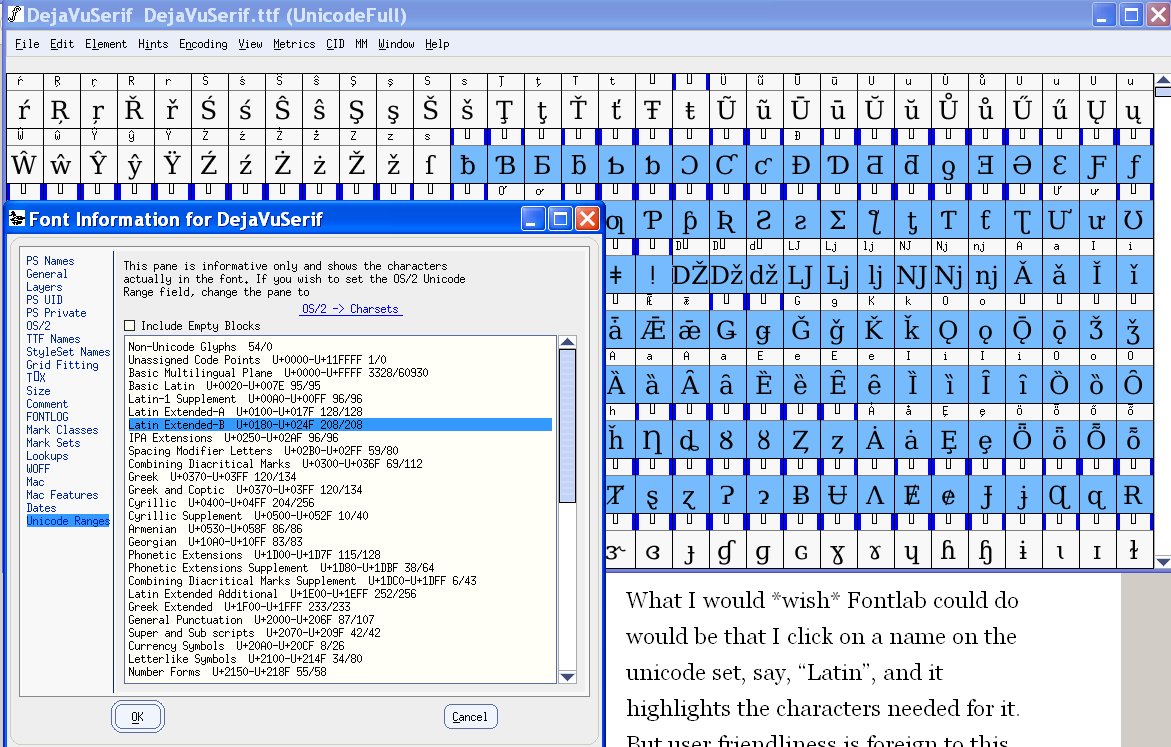
@agisaak: It’s referring to “Encoding and Unicoding” as well as “Unicode Ranges” in the Font Info panel.

Neither of those sections are of much relevance to what you're asking. The 'unicode ranges' are used to set flags in the font which indicate which unicode blocks contain characters -- while some blocks are named for languages, it's unicode blocks that are being referred to here, and while unicode has been expanded to include many new blocks, new flags haven't been added for all of these.

The encodings section again doesn't refer to languages, but to codepages which are largely obsolete since they are only really used by pre-unicode applications.

If you're starting from an existing font there really isn't any way to tell FontLan that you want to delete all characters used by (e.g.) Hausa other than to delete the unwanted characters, and then let FontLab automatically recalculate the two font info panels you mention above.

Andre

Thanks for your explanation, agisaak. The problem I have is that I don’t know which characters belong to which unicode set. I started off with Deja Vu, which has an extremely wide array of unicode sets.

How do I know which characters/glyphs to remove, so I leave a unicode set complete? Looking up a reference and comparing them one by one, with roughly 2700 glyphs?

You asked how to remove characters in a certain language, but what you really want is the opposite, isn't it? That is, you wouldn't want to remove a character because it's used in a Slavic language, if it is also used in Western European languages.

I think Té is on the right track. It's easy enough to write a Python script that says "if glyph is not in (said list of glyph names), then delete it". Using the WGL4 list is probably a good start for that.

I don't know Fontlab, I only downloaded a trial version years ago (the files are dated 2012) to have a look and I can see in /library/Application Support/FontLab/Encoding/OT special a file named ot_lcg_wgl.enc with the header

%%FONTLAB ENCODING: 20000925; OpenType LatCyrGrk WGL4
%%GROUP:OpenType
%%Source: Fontlab Ltd.
%%Release: 2010-06-06

The file contains a list of 659 unicode characters plus 11 variants. There are 74 Greek characters 95 Cyrillic characters. I however have no idea how it is to be used in Fontlab.

On the other hand, I would personally also look at the unicode characters figuring in Source Code Pro (sources and latest updates on github)

Thanks for your explanation, agisaak. The problem I have is that I don’t know which characters belong to which unicode set. I started off with Deja Vu, which has an extremely wide array of unicode sets.

How do I know which characters/glyphs to remove, so I leave a unicode set complete? Looking up a reference and comparing them one by one, with roughly 2700 glyphs?

I'm not really sure what you mean by unicode 'sets'. Unicode ranges are in many cases fairly arbitrary collections of characters and there's no real need to ensure that any of them remain complete.

You mention you want to include Latin, Baltic (which is part of Latin) and Greek.

Here's a brute force approach you might consider:

Open DejaVu in unicode ranges mode, then mark all of the glyphs in the following ranges: Basic Latin, Latin 1 supplement, Latin-Extended A.

In addition to the above, mark the following characters: 018F, 019F, 01FA-01FF, 0218-021B, 0237, 0259, 0275 and possibly 01C4-01CC and 01F1-01F3.

Next, switch to codepages mode and mark all of the characters in MacOS Roman and Windows Greek. (many of these will already be marked).

Next, look through the font and mark any additional characters that you want, such as mathematical characters etc.

Finally, select all unmarked characters and delete them. You should have a reasonable character set for Latin and monotonic Greek.

In the event that you meant 'Cyrillic' rather than Baltic (since Baltic was a bit redundant, it dawned on me that this may have been a mistake) you should also select MacCyrillic while in codrpages mode. That will give you a fairly minimal cyrillic set suitable for the major Slavic languages spoken in Europe.

Andre

"I leave a unicode set complete?"
There are special "Unicode" fonts with full support - not intended for everyday use. One of them is merged-unifont-mono.ttf 15.300 glyphs. (made in FontForge; I suppose it would be a problem to do it in FontLab)

You may want to include this set of glyphs (from http://www.impallari.com/testing/ )

"Diacritics for all the 104 Latin Languages
À Á Â Ã Ä Å Ā Ă Ą Ǻ Ȁ Ȃ Æ Ǽ Ć Ç Ĉ Ċ Č Ď Đ Ð Ḍ DZ Dz DŽ Dž È É Ê Ë Ē Ĕ Ė Ę Ẽ Ě Ẹ Ȅ Ȇ Ə Ǵ Ĝ Ğ Ġ Ģ Ĥ Ħ Ḥ Ĭ Ì Í Î Ï İ Ĩ Ī Į Ị Ȉ Ȋ IJ Ĵ Ķ Ĺ Ļ Ľ Ŀ Ł LJ Lj Ñ Ń Ņ Ň Ṅ Ŋ NJ Nj Ò Ó Ô Õ Ö Ō Ŏ Ő Ø Ǿ Ǫ Ọ Ȍ Ȏ Œ Þ Ŕ Ŗ Ř Ṛ Ȑ Ȓ Ś Ŝ Š Ș Ş Ṣ Ŧ Ť Ț Ţ Ṭ Ù Ú Û Ü Ũ Ū Ŭ Ů Ű Ų Ụ Ȕ Ȗ Ẁ Ẃ Ẅ Ŵ Ý Ŷ Ÿ Ỳ Ỹ Ź Ż Ž Ẓ

à á â ã ä å ā ă ą ǻ ȁ ȃ æ ǽ ć ç ĉ ċ č ď đ ð ḍ dz dž è é ê ë ē ĕ ė ę ě ẽ ẹ ȅ ȇ ə ǵ ĝ ğ ġ ģ ĥ ħ ḥ ì í î ï ĩ ī į ĭ ị ȉ ȋ ij ĵ ķ ĸ ĺ ļ ľ ŀ ł lj ń ʼn ņ ň ñ ṅ ŋ nj ò ó ô õ ö ø ō ŏ ő ǿ ǫ ọ ȍ ȏ œ þ ŕ ŗ ř ṛ ȑ ȓ ś ŝ š ș ş ṣ ß ŧ ť ț ţ ṭ ù ú û ü ũ ū ŭ ů ű ų ụ ȕ ȗ µ μ ẁ ẃ ẅ ŵ ý ÿ ŷ ỳ ỹ ź ż ž ẓ"

What are the 104 Latin Languages? I'm pretty sure there are more than that...

Thanks for all your answers. There is a high level of knowledge here and I hope you bear with me that I am in many ways a beginner. I design fonts, but I come from the design side, not the programming side. I haven’t learned writing scripts in Python.

Additionally, I don’t know the correct terminology for many things in font design. It’s a huge field with an iceberg consisting of a broad variety of technologies and different approaches, and I understand that there are a lot of methods involved, ways some consider best practice and others decline in order to implement their own method. What I am looking for here is to learn how to find my own way, based on the expertise I get from you guys.

Let me lay out where I’m coming from:

I began my work on Bot Mono with the Deja Vu set. It’s based on Vera, but a lot of designers contributed a lot of characters, covering a number of unicode glyphs, of which I am sure many cover “standard characters” known in various language applications, ranging from basic latin to those including diacritics covering all of Europe, plus Greek, plus Cyrillic. I haven’t seen combinations that are exclusive to, say, Celtic or Walisian, or maybe Old Greek – but what do I know? This is at the root of my problem, to find a *good measure*, to figure out the balance of which characters I should include to satisfy the needs of a lot of people, while I am sure I can never satisfy *all* user’s needs.

Because Deja Vu contains a huge array of characters, I am overwhelmed with the decision of which I should remove. If I remove one that is also relevant for a different language, will I hurt that language “set” by leaving it incomplete? To follow agisaak’s method to clean the arrays of glyphs up: how do I decide which character to remove, if I don’t know what language it is used in?

What I would *wish* Fontlab could do would be that I click on a name on the unicode set, say, “Latin”, and it highlights the characters needed for it. But user friendliness is foreign to this application, as wonderful its capabilities are.

What I would hope to end up with, after going through the school of learning it here, is that I can create *templates* for myself, which would include the “good measure” of covering languages I mentioned above, so I could make a decision like: “This font is more for programming and mathematics, so it should include this and that, but not this”…

I hope this makes my dilemma and possible solutions more transparent.

One resource you might want to look at is

http://www.eki.ee/letter/

The approach which you suggest isn't offered by any program that I'm aware of. While it would be convenient, it would be more difficult than it sounds because even determining which characters are needed for which languages are problematic. For example, which accented characters are required for English? None is the usual answer, despite the fact that words like 'résumé' etc. do occur in English texts, and some people still prefer older spellings such as 'coöperation". Similar issues arise in other languages, which is why the site above talks about 'necessary' chaeacters vs. 'important' characters' among other categories.

Andre

Not especially informative:


It is better when you need glyphs for Cham or Meetei Mayek or Chakma...
[FontForge]

Again, thanks for your support and advice! This was particularly helpful: http://www.eki.ee/letter/ — It’s going to be a lot of work to go through all glyphs manually, so I think I will start from scratch and transfer the characters to a new, fresh document. That way I have more control over setting up the ranges of unicode.

"I suppose it would be a problem to do it in FontLab"

No, FontLab Studio and TypeTool can handle up to 64K glyphs.

"What I would *wish* Fontlab could do would be that I click on a name on the unicode set, say, “Latin”, and it highlights the characters needed for it."

It does not do that for Unicode ranges... but it *does* do that for encodings.

So it is pretty darn easy to select an encoding, color all the glyphs for that encoding, and then do that repeatedly across several encodings you want to cover.

NOTE that in the current app version, this is driven by glyph name rather than Unicode value, so when glyph names are other than what the encoding file expects, there will be misses. But otherwise, it's a fairly quick way to do some things.

This is very helpful, Thomas, thanks a lot!

when glyph names are other than what the encoding file expects, there will be misses

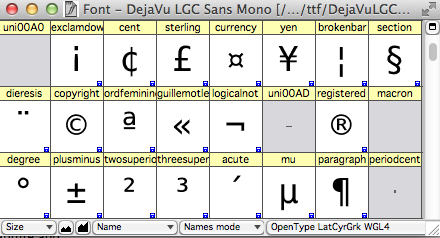
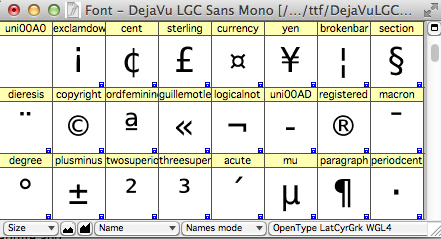
Thomas, I am puzzled by the way Fontlab is working (or not working) in that respect. I just downloaded dejavu-lgc-fonts-ttf-2.34.zip from http://dejavu-fonts.org/wiki/Download and opened DejaVu Sans Mono with the Fontlab Studio demo app. If I display directly with "Name mode" and the encoding "OpenType LatCyrGrk WGL4" here is what I see, with "macron" and "periodcentered" greyed yet those characters bear those names in the font.


If I recode using "Glyph > Glyph Names > Generate names..." with the Recommended (no afiiXXX) names and "try to keep existing glyph names", the only greyed characters left are those that are actually not in the font. Fine, but why the problem with "macron" and "periodcentered" before recoding?

Question
Afar, Afrikaans, Albanian, Azerbaijani, Basque, Belarusian, Bislama, Bosnian, Breton, Catalan, Chamorro, Chichewa, Comorian, Croatian, Czech, Danish, Dutch, English, Esperanto, Estonian, Faroese, Fijian, Filipino/Tagalog, Finnish, Flemish, French, Gaelic (Irish / Manx / Scottish), Gagauz, German, Gikuyu, Gilbertese/Kiribati, Greenlandic, Guarani, Haitian_Creole, Hawaiian, Hungarian, Icelandic, Igo/Igbo, Indonesian, Irish, Italian, Javanese, Kashubian, Kinyarwanda, Kirundi, Latin, Latvian, Lithuanian, Luba/Ciluba/Kasai, Luxembourgish, Malagasy, Malay, Maltese, Maori, Marquesan, Marshallese, Moldovan/Moldovian/Romanian, Montenegrin, Nauruan, Ndebele, Norwegian, Oromo, Palauan/Belauan, Polish, Portuguese, Quechua, Romanian, Romansh, Sami, Samoan, Sango, Serbian, Sesotho, Setswana/Sitswana/Tswana, Seychellois_Creole, SiSwati/Swati/Swazi, Silesian, Slovak, Slovenian, Somali, Sorbian, Sotho, Spanish, Swahili, Swedish, Tahitian, Tetum, Tok_Pisin, Tongan, Tsonga, Tswana, Tuareg/Berber, Turkish, Turkmen, Tuvaluan, Uzbek/Usbek, Wallisian, Walloon, Welsh, Xhosa, Yoruba, Zulu.
(https://github.com/impallari/Encode-Sans)
plus many American Indians languages.

In the omniglot list http://www.omniglot.com/writing/langalph.htm#latin I count 454 languages using the latin script (very few being latin languages).

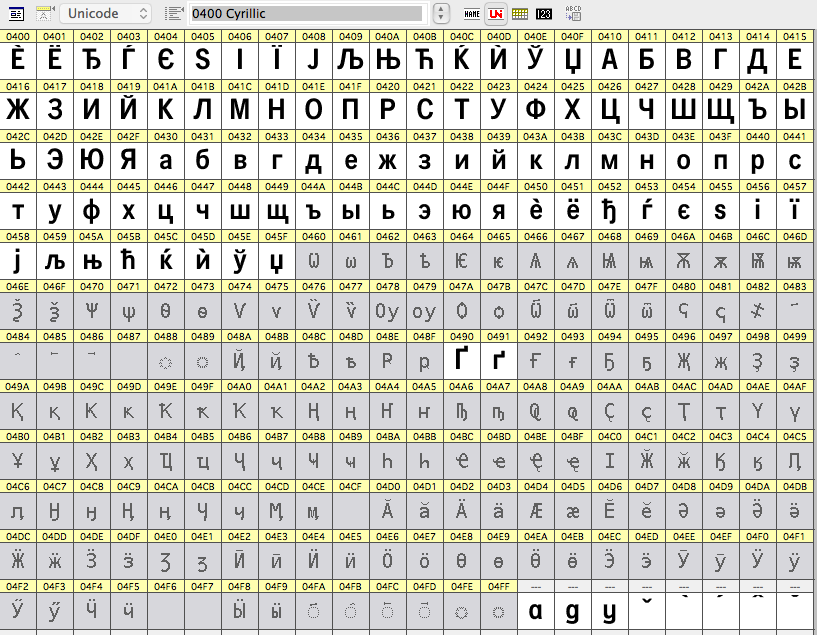
Have you tried clicking on that little red UNI button in the FL Font window and then scrolling through to see the various blocks of related glyphs? See attached:

That file from Underware.nl is interesting. If I add the missing tabs in the list of characters associated to each language and make the reverse table, I get this.

U+00C0   À   Latin capital letter a with grave.
   Alsatian, Aranese, Breton, Cape Verdean Creole, Catalan, Corsican, Delaware, French, Friulian, Genoese, German, Gooniyandi, Gwich’in, Haitian Creole, Irish, Italian, Kala Lagaw Ya, Ladin, Lombard, Maasai, Makhuwa, Maltese, Neapolitan, Norwegian, Occitan, Piedmontese, Portuguese, Romansh, Sardinian, Scottish Gaelic, Sicilian, Swedish, Venetian, Welsh, Wolof.
U+00C1   Á   Latin capital letter a with acute.
   Aragonese, Aranese, Arvanitic (Latin), Asturian, Cape Verdean Creole, Chickasaw, Czech, Danish, Dawan, Dutch, English, Faroese, Friulian, Galician, Genoese, Greenlandic (Kalaallisut), Haitian Creole, Hungarian, Icelandic, Irish, Italian, Kaingang, Kala Lagaw Ya, Ladin, Lombard, Maasai, Maltese, Marquesan, Mirandese, Neapolitan, Occidental, Occitan, Old Icelandic, Old Norse, Portuguese, Rarotongan, Sami (Inari Sami), Sami (Lule Sami), Sami (Northern Sami), Slovak, Spanish, Swedish, Venetian, Welsh, Zapotec.
U+00C2   Â   Latin capital letter a with circumflex.
   Aromanian, Breton, Cape Verdean Creole, Chamorro, Corsican, Dutch, Folkspraak, French, Frisian, Friulian, Genoese, Greenlandic (Kalaallisut), Jèrriais, Kaingang, Ladin, Luxembourgish, Maasai, Maltese, Moldovan, Montagnais, Portuguese, Romanian, Sami (Inari Sami), Sango, Turkish, Walloon, Welsh.
U+00C3   Ã   Latin capital letter a with tilde.
   Aromanian, Cape Verdean Creole, Greenlandic (Kalaallisut), Kashubian, Portuguese, Wolof, Xavante.
U+00C4   Ä   Latin capital letter a with diaeresis.
   Alsatian, Arvanitic (Latin), Aymara, Azerbaijani, Bashkir (Latin), Cimbrian, Dutch, Estonian, Finnish, Frisian, Gagauz (Latin), Genoese, German, Gooniyandi, Hän, Kala Lagaw Ya, Kaqchikel, Karelian (Latin), Low Saxon, Luxembourgish, Norwegian, Ossetian (Latin), Piedmontese, Sami (Inari Sami), Sami (Lule Sami), Sami (Northern Sami), Sami (Southern Sami), Sango, Slovak, Slovenian, Swedish, Turkmen (Latin), Vepsian, Volapük, Võro, Welsh, Yapese.
U+00C5   Å   Latin capital letter a with ring above.
   Chamorro, Danish, Faroese, Finnish, Greenlandic (Kalaallisut), Gwich’in, Istro-Romanian, Norwegian, Sami (Inari Sami), Sami (Lule Sami), Sami (Northern Sami), Sami (Southern Sami), Swedish, Walloon.
U+00C6   Æ   Latin capital letter ae.
   Breton, Danish, English, Faroese, Finnish, French, Genoese, Greenlandic (Kalaallisut), Icelandic, Norwegian, Old Icelandic, Old Norse, Ossetian (Latin), Sami (Northern Sami), Sami (Southern Sami).
U+00C7   Ç   Latin capital letter c with cedilla.
   Albanian, Aranese, Arvanitic (Latin), Azerbaijani, Bashkir (Latin), Breton, Cape Verdean Creole, Catalan, Crimean Tatar (Latin), English, French, Friulian, Gagauz (Latin), Jèrriais, Kurdish (Latin), Mirandese, Occitan, Portuguese, Sardinian, Turkish, Turkmen (Latin), Venetian, Walloon, Zazaki.
U+00C8   È   Latin capital letter e with grave.
   Afrikaans, Aranese, Arvanitic (Latin), Breton, Cape Verdean Creole, Catalan, Corsican, Delaware, Dutch, English, French, Friulian, Genoese, Guadeloupean Creole, Gwich’in, Haitian Creole, Irish, Italian, Jèrriais, Kala Lagaw Ya, Ladin, Lombard, Luxembourgish, Maasai, Makhuwa, Maltese, Neapolitan, Occitan, Papiamento, Piedmontese, Portuguese, Potawatomi, Romansh, Sardinian, Scottish Gaelic, Sicilian, Venetian, Walloon, Welsh.
U+00C9   É   Latin capital letter e with acute.
   Afrikaans, Alsatian, Aragonese, Aranese, Arvanitic (Latin), Asturian, Breton, Cape Verdean Creole, Catalan, Chickasaw, Czech, Danish, Dawan, Dutch, English, French, Frisian, Galician, Genoese, German, Gooniyandi, Guadeloupean Creole, Gwich’in, Haitian Creole, Hungarian, Icelandic, Indonesian, Irish, Italian, Jèrriais, Kaingang, Kala Lagaw Ya, Kashubian, Kurdish (Latin), Ladin, Lombard, Luxembourgish, Maasai, Maltese, Marquesan, Mirandese, Neapolitan, Norwegian, Occidental, Occitan, Old Icelandic, Old Norse, Portuguese, Rarotongan, Romansh, Scottish Gaelic, Slovak, Spanish, Swedish, Venetian, Walloon, Welsh, Wolof, Xavante.
U+00CA   Ê   Latin capital letter e with circumflex.
   Afrikaans, Breton, Cape Verdean Creole, Dawan, Dutch, English, Folkspraak, French, Frisian, Friulian, Gagauz (Latin), Genoese, Greenlandic (Kalaallisut), Jèrriais, Kurdish (Latin), Ladin, Luxembourgish, Maasai, Maltese, Mirandese, Norwegian, Portuguese, Sango, Sotho (Northern), Tswana, Walloon, Welsh, Zazaki.
U+00CB   Ë   Latin capital letter e with diaeresis.
   Afrikaans, Albanian, Arvanitic (Latin), Breton, Delaware, Drehu, Dutch, English, French, Frisian, Genoese, Hän, Kala Lagaw Ya, Kaqchikel, Kashubian, Ladin, Low Saxon, Luxembourgish, Occitan, Piedmontese, Sango, Swedish, Welsh, Wolof, Yapese.
U+00CC   Ì   Latin capital letter i with grave.
   Alsatian, Corsican, Delaware, Friulian, Genoese, Gwich’in, Irish, Italian, Kala Lagaw Ya, Ladin, Lombard, Maasai, Makhuwa, Maltese, Meriam Mir, Neapolitan, Piedmontese, Romansh, Sardinian, Scottish Gaelic, Sicilian, Venetian, Welsh.
U+00CD   Í   Latin capital letter i with acute.
   Aragonese, Aranese, Arvanitic (Latin), Asturian, Cape Verdean Creole, Catalan, Chickasaw, Czech, Danish, Dawan, Dutch, Faroese, Galician, Genoese, Greenlandic (Kalaallisut), Gwich’in, Hungarian, Icelandic, Irish, Italian, Kala Lagaw Ya, Kurdish (Latin), Lombard, Maasai, Maltese, Marquesan, Mirandese, Neapolitan, Occidental, Occitan, Old Icelandic, Old Norse, Portuguese, Rarotongan, Slovak, Spanish, Venetian, Welsh.
U+00CE   Î   Latin capital letter i with circumflex.
   Afrikaans, Breton, Folkspraak, French, Frisian, Friulian, Genoese, Greenlandic (Kalaallisut), Italian, Jèrriais, Kurdish (Latin), Ladin, Luxembourgish, Maasai, Maltese, Moldovan, Montagnais, Romanian, Romansh, Sango, Turkish, Walloon, Welsh.
U+00CF   Ï   Latin capital letter i with diaeresis.
   Afrikaans, Aranese, Arvanitic (Latin), Aymara, Breton, Catalan, Dutch, English, French, Frisian, Genoese, Italian, Kala Lagaw Ya, Kaqchikel, Low Saxon, Occitan, Piedmontese, Sami (Southern Sami), Sango, Welsh.
U+00D0   Ð   Latin capital letter eth.
   Faroese, Icelandic, Old Icelandic, Old Norse.
U+00D1   Ñ   Latin capital letter n with tilde.
   Aragonese, Asturian, Aymara, Basque, Breton, Catalan, Chamorro, Chavacano, Cofán, Crimean Tatar (Latin), English, Filipino, Galician, Igbo, Quechua, Sami (Lule Sami), Spanish, Tetum, Waray-Waray, Wayuu, Wolof, Zapotec.
U+00D2   Ò   Latin capital letter o with grave.
   Aranese, Cape Verdean Creole, Catalan, Corsican, Delaware, Friulian, Genoese, Guadeloupean Creole, Gwich’in, Haitian Creole, Irish, Italian, Kala Lagaw Ya, Kashubian, Ladin, Lombard, Maasai, Makhuwa, Maltese, Meriam Mir, Neapolitan, Norwegian, Occitan, Papiamento, Piedmontese, Portuguese, Romansh, Sardinian, Scottish Gaelic, Sicilian, Venetian, Welsh.
U+00D3   Ó   Latin capital letter o with acute.
   Aragonese, Aranese, Arvanitic (Latin), Asturian, Cape Verdean Creole, Catalan, Chickasaw, Czech, Danish, Dawan, Dutch, Faroese, Galician, Genoese, Gwich’in, Haitian Creole, Hungarian, Icelandic, Irish, Italian, Kaingang, Kala Lagaw Ya, Kashubian, Ladin, Lombard, Maasai, Maltese, Marquesan, Mirandese, Neapolitan, Norwegian, Occidental, Occitan, Old Icelandic, Old Norse, Polish, Portuguese, Rarotongan, Scottish Gaelic, Slovak, Sorbian (Lower Sorbian), Sorbian (Upper Sorbian), Spanish, Venetian, Welsh, Wolof.
U+00D4   Ô   Latin capital letter o with circumflex.
   Abenaki, Afrikaans, Breton, Cape Verdean Creole, Dutch, English, Folkspraak, French, Frisian, Friulian, Genoese, Greenlandic (Kalaallisut), Jèrriais, Kashubian, Ladin, Lombard, Luxembourgish, Maasai, Maltese, Mirandese, Norwegian, Portuguese, Sango, Slovak, Sotho (Northern), Tswana, Walloon, Welsh, Xavante.
U+00D5   Õ   Latin capital letter o with tilde.
   Cape Verdean Creole, Estonian, Finnish, Portuguese, Võro, Xavante.
U+00D6   Ö   Latin capital letter o with diaeresis.
   Alsatian, Arvanitic (Latin), Azerbaijani, Bashkir (Latin), Cimbrian, Crimean Tatar (Latin), Drehu, Dutch, English, Estonian, Faroese, Finnish, Frisian, Gagauz (Latin), Genoese, German, Gooniyandi, Hungarian, Icelandic, Kala Lagaw Ya, Kaqchikel, Karelian (Latin), Ladin, Low Saxon, Luxembourgish, Norwegian, Old Icelandic, Piedmontese, Sami (Inari Sami), Sami (Lule Sami), Sami (Northern Sami), Sami (Southern Sami), Sango, Saramaccan, Seri, Slovenian, Swedish, Turkish, Turkmen (Latin), Vepsian, Volapük, Võro, Welsh, Xavante, Yapese.
U+00D8   Ø   Latin capital letter o with stroke.
   Danish, Faroese, Finnish, Greenlandic (Kalaallisut), Lombard, Norwegian, Old Icelandic, Old Norse, Sami (Northern Sami), Sami (Southern Sami).
U+00D9   Ù   Latin capital letter u with grave.
   Alsatian, Breton, Corsican, Delaware, French, Friulian, Genoese, Gwich’in, Irish, Italian, Kala Lagaw Ya, Kashubian, Ladin, Lombard, Maasai, Makhuwa, Maltese, Meriam Mir, Neapolitan, Piedmontese, Romansh, Sardinian, Scottish Gaelic, Sicilian, Venetian, Welsh.
U+00DA   Ú   Latin capital letter u with acute.
   Aragonese, Aranese, Arvanitic (Latin), Asturian, Cape Verdean Creole, Catalan, Chickasaw, Czech, Danish, Dawan, Dutch, Faroese, Frisian, Galician, Genoese, Greenlandic (Kalaallisut), Gwich’in, Hungarian, Icelandic, Irish, Italian, Kala Lagaw Ya, Kurdish (Latin), Maasai, Maltese, Marquesan, Mirandese, Neapolitan, Occidental, Occitan, Old Icelandic, Old Norse, Portuguese, Rarotongan, Slovak, Spanish, Welsh.
U+00DB   Û   Latin capital letter u with circumflex.
   Afrikaans, Breton, Cofán, Dawan, Dutch, Folkspraak, French, Frisian, Friulian, Greenlandic (Kalaallisut), Jèrriais, Kurdish (Latin), Ladin, Luxembourgish, Maasai, Maltese, Montagnais, Sango, Turkish, Walloon, Welsh.
U+00DC   Ü   Latin capital letter u with diaeresis.
   Alsatian, Aranese, Arvanitic (Latin), Asturian, Aymara, Azerbaijani, Bashkir (Latin), Basque, Breton, Cape Verdean Creole, Catalan, Chamorro, Cimbrian, Cornish, Crimean Tatar (Latin), Dutch, Estonian, Finnish, French, Frisian, Gagauz (Latin), Galician, German, Gooniyandi, Hungarian, Kala Lagaw Ya, Kaqchikel, Ladin, Lombard, Low Saxon, Luxembourgish, Nahuatl, Norwegian, Occitan, Piedmontese, Portuguese, Romansh, Sango, Slovenian, Spanish, Swedish, Turkish, Turkmen (Latin), Vepsian, Volapük, Võro, Wayuu, Welsh, Zazaki.
U+00DD   Ý   Latin capital letter y with acute.
   Arvanitic (Latin), Czech, Danish, Faroese, Icelandic, Old Icelandic, Old Norse, Slovak, Turkmen (Latin), Turkmen (Latin), Welsh.
U+00DE   Þ   Latin capital letter thorn.
   Icelandic, Old Icelandic.
U+00DF   ß   Latin small letter sharp s.
   German, Gooniyandi, Low Saxon, Luxembourgish.
U+00E0   à   Latin small letter a with grave.
   Alsatian, Aranese, Breton, Cape Verdean Creole, Catalan, Corsican, Delaware, French, Friulian, Genoese, German, Gooniyandi, Gwich’in, Haitian Creole, Irish, Italian, Kala Lagaw Ya, Ladin, Lombard, Maasai, Makhuwa, Maltese, Neapolitan, Norwegian, Occitan, Piedmontese, Portuguese, Romansh, Sardinian, Scottish Gaelic, Sicilian, Swedish, Venetian, Welsh, Wolof.
U+00E1   á   Latin small letter a with acute.
   Aragonese, Aranese, Arvanitic (Latin), Asturian, Cape Verdean Creole, Chickasaw, Czech, Danish, Dawan, Dutch, English, Faroese, Friulian, Galician, Genoese, Greenlandic (Kalaallisut), Haitian Creole, Hungarian, Icelandic, Irish, Italian, Kaingang, Kala Lagaw Ya, Ladin, Lombard, Maasai, Maltese, Marquesan, Mirandese, Neapolitan, Occidental, Occitan, Old Icelandic, Old Norse, Portuguese, Rarotongan, Sami (Inari Sami), Sami (Lule Sami), Sami (Northern Sami), Slovak, Spanish, Swedish, Venetian, Welsh, Zapotec.
U+00E2   â   Latin small letter a with circumflex.
   Aromanian, Breton, Cape Verdean Creole, Chamorro, Corsican, Dutch, Folkspraak, French, Frisian, Friulian, Genoese, Greenlandic (Kalaallisut), Jèrriais, Kaingang, Ladin, Luxembourgish, Maasai, Maltese, Moldovan, Montagnais, Portuguese, Romanian, Sami (Inari Sami), Sango, Turkish, Walloon, Welsh.
U+00E3   ã   Latin small letter a with tilde.
   Aromanian, Cape Verdean Creole, Greenlandic (Kalaallisut), Kashubian, Portuguese, Wolof, Xavante.
U+00E4   ä   Latin small letter a with diaeresis.
   Alsatian, Arvanitic (Latin), Aymara, Azerbaijani, Bashkir (Latin), Cimbrian, Dutch, Estonian, Finnish, Frisian, Gagauz (Latin), Genoese, German, Gooniyandi, Hän, Kala Lagaw Ya, Kaqchikel, Karelian (Latin), Low Saxon, Luxembourgish, Norwegian, Ossetian (Latin), Piedmontese, Sami (Inari Sami), Sami (Lule Sami), Sami (Northern Sami), Sami (Southern Sami), Sango, Slovak, Slovenian, Swedish, Turkmen (Latin), Vepsian, Volapük, Võro, Welsh, Yapese.
U+00E5   å   Latin small letter a with ring above.
   Chamorro, Danish, Faroese, Finnish, Greenlandic (Kalaallisut), Gwich’in, Istro-Romanian, Norwegian, Sami (Inari Sami), Sami (Lule Sami), Sami (Northern Sami), Sami (Southern Sami), Swedish, Walloon.
U+00E6   æ   Latin small letter ae.
   Breton, Danish, English, Faroese, Finnish, French, Genoese, Greenlandic (Kalaallisut), Icelandic, Norwegian, Old Icelandic, Old Norse, Ossetian (Latin), Sami (Northern Sami), Sami (Southern Sami).
U+00E7   ç   Latin small letter c with cedilla.
   Albanian, Aranese, Arvanitic (Latin), Azerbaijani, Bashkir (Latin), Breton, Cape Verdean Creole, Catalan, Crimean Tatar (Latin), English, French, Friulian, Gagauz (Latin), Jèrriais, Kurdish (Latin), Mirandese, Occitan, Portuguese, Sardinian, Turkish, Turkmen (Latin), Venetian, Walloon, Zazaki.
U+00E8   è   Latin small letter e with grave.
   Afrikaans, Aranese, Arvanitic (Latin), Breton, Cape Verdean Creole, Catalan, Corsican, Delaware, Dutch, English, French, Friulian, Genoese, Guadeloupean Creole, Gwich’in, Haitian Creole, Irish, Italian, Jèrriais, Kala Lagaw Ya, Ladin, Lombard, Luxembourgish, Maasai, Makhuwa, Maltese, Neapolitan, Occitan, Papiamento, Piedmontese, Portuguese, Potawatomi, Romansh, Sardinian, Scottish Gaelic, Sicilian, Venetian, Walloon, Welsh.
U+00E9   é   Latin small letter e with acute.
   Afrikaans, Alsatian, Aragonese, Aranese, Arvanitic (Latin), Asturian, Breton, Cape Verdean Creole, Catalan, Chickasaw, Czech, Danish, Dawan, Dutch, English, French, Frisian, Galician, Genoese, German, Gooniyandi, Guadeloupean Creole, Gwich’in, Haitian Creole, Hungarian, Icelandic, Indonesian, Irish, Italian, Jèrriais, Kaingang, Kala Lagaw Ya, Kashubian, Kurdish (Latin), Ladin, Lombard, Luxembourgish, Maasai, Maltese, Marquesan, Mirandese, Neapolitan, Norwegian, Occidental, Occitan, Old Icelandic, Old Norse, Portuguese, Rarotongan, Romansh, Scottish Gaelic, Slovak, Spanish, Swedish, Venetian, Walloon, Welsh, Wolof, Xavante.
U+00EA   ê   Latin small letter e with circumflex.
   Afrikaans, Breton, Cape Verdean Creole, Dawan, Dutch, English, Folkspraak, French, Frisian, Friulian, Gagauz (Latin), Genoese, Greenlandic (Kalaallisut), Jèrriais, Kurdish (Latin), Ladin, Luxembourgish, Maasai, Maltese, Mirandese, Norwegian, Portuguese, Sango, Sotho (Northern), Tswana, Walloon, Welsh, Zazaki.
U+00EB   ë   Latin small letter e with diaeresis.
   Afrikaans, Albanian, Arvanitic (Latin), Breton, Delaware, Drehu, Dutch, English, French, Frisian, Genoese, Hän, Kala Lagaw Ya, Kaqchikel, Kashubian, Ladin, Low Saxon, Luxembourgish, Occitan, Piedmontese, Sango, Swedish, Welsh, Wolof, Yapese.
U+00EC   ì   Latin small letter i with grave.
   Alsatian, Corsican, Delaware, Friulian, Genoese, Gwich’in, Irish, Italian, Kala Lagaw Ya, Ladin, Lombard, Maasai, Makhuwa, Maltese, Meriam Mir, Neapolitan, Piedmontese, Romansh, Sardinian, Scottish Gaelic, Sicilian, Venetian, Welsh.
U+00ED   í   Latin small letter i with acute.
   Aragonese, Aranese, Arvanitic (Latin), Asturian, Cape Verdean Creole, Catalan, Chickasaw, Czech, Danish, Dawan, Dutch, Faroese, Galician, Genoese, Greenlandic (Kalaallisut), Gwich’in, Hungarian, Icelandic, Irish, Italian, Kala Lagaw Ya, Kurdish (Latin), Lombard, Maasai, Maltese, Marquesan, Mirandese, Neapolitan, Occidental, Occitan, Old Icelandic, Old Norse, Portuguese, Rarotongan, Slovak, Spanish, Venetian, Welsh.
U+00EE   î   Latin small letter i with circumflex.
   Afrikaans, Breton, Folkspraak, French, Frisian, Friulian, Genoese, Greenlandic (Kalaallisut), Italian, Jèrriais, Kurdish (Latin), Ladin, Luxembourgish, Maasai, Maltese, Moldovan, Montagnais, Romanian, Romansh, Sango, Turkish, Walloon, Welsh.
U+00EF   ï   Latin small letter i with diaeresis.
   Afrikaans, Aranese, Arvanitic (Latin), Aymara, Breton, Catalan, Dutch, English, French, Frisian, Genoese, Italian, Kala Lagaw Ya, Kaqchikel, Low Saxon, Occitan, Piedmontese, Sami (Southern Sami), Sango, Welsh.
U+00F0   ð   Latin small letter eth.
   Faroese, Icelandic, Old Icelandic, Old Norse.
U+00F1   ñ   Latin small letter n with tilde.
   Aragonese, Asturian, Aymara, Basque, Breton, Catalan, Chamorro, Chavacano, Cofán, Crimean Tatar (Latin), English, Filipino, Galician, Igbo, Quechua, Sami (Lule Sami), Spanish, Tetum, Waray-Waray, Wayuu, Wolof, Zapotec.
U+00F2   ò   Latin small letter o with grave.
   Aranese, Cape Verdean Creole, Catalan, Corsican, Delaware, Friulian, Genoese, Guadeloupean Creole, Gwich’in, Haitian Creole, Irish, Italian, Kala Lagaw Ya, Kashubian, Ladin, Lombard, Maasai, Makhuwa, Maltese, Meriam Mir, Neapolitan, Norwegian, Occitan, Papiamento, Piedmontese, Portuguese, Romansh, Sardinian, Scottish Gaelic, Sicilian, Venetian, Welsh.
U+00F3   ó   Latin small letter o with acute.
   Aragonese, Aranese, Arvanitic (Latin), Asturian, Cape Verdean Creole, Catalan, Chickasaw, Czech, Danish, Dawan, Dutch, Faroese, Galician, Genoese, Gwich’in, Haitian Creole, Hungarian, Icelandic, Irish, Italian, Kaingang, Kala Lagaw Ya, Kashubian, Ladin, Lombard, Maasai, Maltese, Marquesan, Mirandese, Neapolitan, Norwegian, Occidental, Occitan, Old Icelandic, Old Norse, Polish, Portuguese, Rarotongan, Scottish Gaelic, Slovak, Sorbian (Lower Sorbian), Sorbian (Upper Sorbian), Spanish, Venetian, Welsh, Wolof.
U+00F4   ô   Latin small letter o with circumflex.
   Abenaki, Afrikaans, Breton, Cape Verdean Creole, Dutch, English, Folkspraak, French, Frisian, Friulian, Genoese, Greenlandic (Kalaallisut), Jèrriais, Kashubian, Ladin, Lombard, Luxembourgish, Maasai, Maltese, Mirandese, Norwegian, Portuguese, Sango, Slovak, Sotho (Northern), Tswana, Walloon, Welsh, Xavante.
U+00F5   õ   Latin small letter o with tilde.
   Cape Verdean Creole, Estonian, Finnish, Portuguese, Võro, Xavante.
U+00F6   ö   Latin small letter o with diaeresis.
   Alsatian, Arvanitic (Latin), Azerbaijani, Bashkir (Latin), Cimbrian, Crimean Tatar (Latin), Drehu, Dutch, English, Estonian, Faroese, Finnish, Frisian, Gagauz (Latin), Genoese, German, Gooniyandi, Hungarian, Icelandic, Kala Lagaw Ya, Kaqchikel, Karelian (Latin), Ladin, Low Saxon, Luxembourgish, Norwegian, Old Icelandic, Piedmontese, Sami (Inari Sami), Sami (Lule Sami), Sami (Northern Sami), Sami (Southern Sami), Sango, Saramaccan, Seri, Slovenian, Swedish, Turkish, Turkmen (Latin), Vepsian, Volapük, Võro, Welsh, Xavante, Yapese.
U+00F8   ø   Latin small letter o with stroke.
   Danish, Faroese, Finnish, Greenlandic (Kalaallisut), Lombard, Norwegian, Old Icelandic, Old Norse, Sami (Northern Sami), Sami (Southern Sami).
U+00F9   ù   Latin small letter u with grave.
   Alsatian, Breton, Corsican, Delaware, French, Friulian, Genoese, Gwich’in, Irish, Italian, Kala Lagaw Ya, Kashubian, Ladin, Lombard, Maasai, Makhuwa, Maltese, Meriam Mir, Neapolitan, Piedmontese, Romansh, Sardinian, Scottish Gaelic, Sicilian, Venetian, Welsh.
U+00FA   ú   Latin small letter u with acute.
   Aragonese, Aranese, Arvanitic (Latin), Asturian, Cape Verdean Creole, Catalan, Chickasaw, Czech, Danish, Dawan, Dutch, Faroese, Frisian, Galician, Genoese, Greenlandic (Kalaallisut), Gwich’in, Hungarian, Icelandic, Irish, Italian, Kala Lagaw Ya, Kurdish (Latin), Maasai, Maltese, Marquesan, Mirandese, Neapolitan, Occidental, Occitan, Old Icelandic, Old Norse, Portuguese, Rarotongan, Slovak, Spanish, Welsh.
U+00FB   û   Latin small letter u with circumflex.
   Afrikaans, Breton, Cofán, Dawan, Dutch, Folkspraak, French, Frisian, Friulian, Greenlandic (Kalaallisut), Jèrriais, Kurdish (Latin), Ladin, Luxembourgish, Maasai, Maltese, Montagnais, Sango, Turkish, Walloon, Welsh.
U+00FC   ü   Latin small letter u with diaeresis.
   Alsatian, Aranese, Arvanitic (Latin), Asturian, Aymara, Azerbaijani, Bashkir (Latin), Basque, Breton, Cape Verdean Creole, Catalan, Chamorro, Cimbrian, Cornish, Crimean Tatar (Latin), Dutch, Estonian, Finnish, French, Frisian, Gagauz (Latin), Galician, German, Gooniyandi, Hungarian, Kala Lagaw Ya, Kaqchikel, Ladin, Lombard, Low Saxon, Luxembourgish, Nahuatl, Norwegian, Occitan, Piedmontese, Portuguese, Romansh, Sango, Slovenian, Spanish, Swedish, Turkish, Turkmen (Latin), Vepsian, Volapük, Võro, Wayuu, Welsh, Zazaki.
U+00FD   ý   Latin small letter y with acute.
   Arvanitic (Latin), Czech, Danish, Faroese, Icelandic, Old Icelandic, Old Norse, Slovak, Welsh.
U+00FE   þ   Latin small letter thorn.
   Icelandic, Old Icelandic.
U+00FF   ÿ   Latin small letter y with diaeresis.
   Breton, French, Welsh.
U+0100   Ā   Latin capital letter a with macron.
   Cornish, Hawaiian, Kurdish (Latin), Latvian, Māori, Nahuatl, Niuean, Noongar, Tahitian, Tongan, Tuvaluan, Wallisian.
U+0101   ā   Latin small letter a with macron.
   Cornish, Hawaiian, Kurdish (Latin), Latvian, Māori, Nahuatl, Niuean, Noongar, Tahitian, Tongan, Tuvaluan, Wallisian.
U+0102   Ă   Latin capital letter a with breve.
   Aromanian, Istro-Romanian, Kurdish (Latin), Megleno-Romanian, Moldovan, Romanian.
U+0103   ă   Latin small letter a with breve.
   Aromanian, Istro-Romanian, Kurdish (Latin), Megleno-Romanian, Moldovan, Romanian.
U+0104   Ą   Latin capital letter a with ogonek.
   Hotcąk (Latin), Kashubian, Lithuanian, Polish.
U+0105   ą   Latin small letter a with ogonek.
   Hotcąk (Latin), Kashubian, Lithuanian, Polish.
U+0106   Ć   Latin capital letter c with acute.
   Belarusian (Latin), Bosnian, Cimbrian, Croatian, Ladin, Montenegrin, Polish, Serbian (Latin), Silesian, Slovenian, Sorbian (Lower Sorbian), Sorbian (Upper Sorbian).
U+0107   ć   Latin small letter c with acute.
   Belarusian (Latin), Bosnian, Cimbrian, Croatian, Ladin, Montenegrin, Polish, Serbian (Latin), Silesian, Slovenian, Sorbian (Lower Sorbian), Sorbian (Upper Sorbian).
U+0108   Ĉ   Latin capital letter c with circumflex.
   Esperanto.
U+0109   ĉ   Latin small letter c with circumflex.
   Esperanto.
U+010A   Ċ   Latin capital letter c with dot above.
   Maltese.
U+010B   ċ   Latin small letter c with dot above.
   Maltese.
U+010C   Č   Latin capital letter c with caron.
   Bashkir (Latin), Belarusian (Latin), Bosnian, Croatian, Czech, Karelian (Latin), Latvian, Lithuanian, Montenegrin, Ossetian (Latin), Sami (Inari Sami), Sami (Northern Sami), Serbian (Latin), Silesian, Slovak, Slovenian, Sorbian (Lower Sorbian), Sorbian (Upper Sorbian), Vepsian.
U+010D   č   Latin small letter c with caron.
   Bashkir (Latin), Belarusian (Latin), Bosnian, Croatian, Czech, Karelian (Latin), Latvian, Lithuanian, Montenegrin, Ossetian (Latin), Sami (Inari Sami), Sami (Northern Sami), Serbian (Latin), Silesian, Slovak, Slovenian, Sorbian (Lower Sorbian), Sorbian (Upper Sorbian), Vepsian.
U+010E   Ď   Latin capital letter d with caron.
   Czech, Slovak.
U+010F   ď   Latin small letter d with caron.
   Czech, Slovak.
U+0110   Đ   Latin capital letter d with stroke.
   Bosnian, Croatian, Montenegrin, Sami (Inari Sami), Sami (Northern Sami), Serbian (Latin), Slovenian.
U+0111   đ   Latin small letter d with stroke.
   Bosnian, Croatian, Montenegrin, Sami (Inari Sami), Sami (Northern Sami), Serbian (Latin), Slovenian.
U+0112   Ē   Latin capital letter e with macron.
   Cornish, Creek, Hawaiian, Kurdish (Latin), Latvian, Māori, Nahuatl, Niuean, Noongar, Tahitian, Tongan, Tuvaluan, Wallisian.
U+0113   ē   Latin small letter e with macron.
   Cornish, Creek, Hawaiian, Kurdish (Latin), Latvian, Māori, Nahuatl, Niuean, Noongar, Tahitian, Tongan, Tuvaluan, Wallisian.
U+0114   Ĕ   Latin capital letter e with breve.
   Kurdish (Latin), Onĕipŏt.
U+0115   ĕ   Latin small letter e with breve.
   Kurdish (Latin), Onĕipŏt.
U+0116   Ė   Latin capital letter e with dot above.
   Lithuanian.
U+0117   ė   Latin small letter e with dot above.
   Lithuanian.
U+0118   Ę   Latin capital letter e with ogonek.
   Kashubian, Lithuanian, Polish.
U+0119   ę   Latin small letter e with ogonek.
   Kashubian, Lithuanian, Polish.
U+011A   Ě   Latin capital letter e with caron.
   Czech, Sorbian (Lower Sorbian), Sorbian (Upper Sorbian).
U+011B   ě   Latin small letter e with caron.
   Czech, Sorbian (Lower Sorbian), Sorbian (Upper Sorbian).
U+011C   Ĝ   Latin capital letter g with circumflex.
   Esperanto.
U+011D   ĝ   Latin small letter g with circumflex.
   Esperanto.
U+011E   Ğ   Latin capital letter g with breve.
   Azerbaijani, Bashkir (Latin), Crimean Tatar (Latin), Gagauz (Latin), Hotcąk (Latin), Turkish.
U+011F   ğ   Latin small letter g with breve.
   Azerbaijani, Bashkir (Latin), Crimean Tatar (Latin), Gagauz (Latin), Hotcąk (Latin), Turkish.
U+0120   Ġ   Latin capital letter g with dot above.
   Maltese.
U+0121   ġ   Latin small letter g with dot above.
   Maltese.
U+0122   Ģ   Latin capital letter g with cedilla.
   Latvian.
U+0123   ģ   Latin small letter g with cedilla.
   Latvian.
U+0124   Ĥ   Latin capital letter h with circumflex.
   Esperanto.
U+0125   ĥ   Latin small letter h with circumflex.
   Esperanto.
U+0126   Ħ   Latin capital letter h with stroke.
   Maltese.
U+0127   ħ   Latin small letter h with stroke.
   Maltese.
U+0128   Ĩ   Latin capital letter i with tilde.
   Breton, Gikuyu, Greenlandic (Kalaallisut), Kaingang, Xavante.
U+0129   ĩ   Latin small letter i with tilde.
   Breton, Gikuyu, Greenlandic (Kalaallisut), Kaingang, Xavante.
U+012A   Ī   Latin capital letter i with macron.
   Cornish, Hawaiian, Kurdish (Latin), Latvian, Māori, Nahuatl, Niuean, Noongar, Tahitian, Tongan, Tuvaluan, Wallisian.
U+012B   ī   Latin small letter i with macron.
   Cornish, Hawaiian, Kurdish (Latin), Latvian, Māori, Nahuatl, Niuean, Noongar, Tahitian, Tongan, Tuvaluan, Wallisian.
U+012C   Ĭ   Latin capital letter i with breve.
   Kurdish (Latin).
U+012D   ĭ   Latin small letter i with breve.
   Kurdish (Latin).
U+012E   Į   Latin capital letter i with ogonek.
   Hotcąk (Latin), Lithuanian.
U+012F   į   Latin small letter i with ogonek.
   Hotcąk (Latin), Lithuanian.
U+0130   İ   Latin capital letter i with dot above.
   Azerbaijani, Bashkir (Latin), Gagauz (Latin), Karakalpak (Latin), Turkish, Zazaki.
U+0131   ı   Latin small letter dotless i.
   Azerbaijani, Bashkir (Latin), Gagauz (Latin), Karakalpak (Latin), Turkish, Zazaki.
U+0132   IJ   Latin capital ligature ij.
   Dutch.
U+0133   ij   Latin small ligature ij.
   Dutch.
U+0134   Ĵ   Latin capital letter j with circumflex.
   Esperanto.
U+0135   ĵ   Latin small letter j with circumflex.
   Esperanto.
U+0136   Ķ   Latin capital letter k with cedilla.
   Bashkir (Latin), Latvian.
U+0137   ķ   Latin small letter k with cedilla.
   Bashkir (Latin), Latvian.
U+0138   ĸ   Latin small letter kra.
   Greenlandic (Kalaallisut).
U+0139   Ĺ   Latin capital letter l with acute.
   Slovak.
U+013A   ĺ   Latin small letter l with acute.
   Slovak.
U+013B   Ļ   Latin capital letter l with cedilla.
   Latvian.
U+013C   ļ   Latin small letter l with cedilla.
   Latvian.
U+013D   Ľ   Latin capital letter l with caron.
   Istro-Romanian, Megleno-Romanian, Slovak.
U+013E   ľ   Latin small letter l with caron.
   Istro-Romanian, Megleno-Romanian, Slovak.
U+013F   Ŀ   Latin capital letter l with middle dot.
   Catalan.
U+0140   ŀ   Latin small letter l with middle dot.
   Catalan.
U+0141   Ł   Latin capital letter l with stroke.
   Belarusian (Latin), Gwich’in, Kashubian, Polish, Sorbian (Lower Sorbian), Sorbian (Upper Sorbian), Venetian, Zuni.
U+0142   ł   Latin small letter l with stroke.
   Belarusian (Latin), Gwich’in, Kashubian, Polish, Sorbian (Lower Sorbian), Sorbian (Upper Sorbian), Venetian, Zuni.
U+0143   Ń   Latin capital letter n with acute.
   Belarusian (Latin), Istro-Romanian, Kashubian, Megleno-Romanian, Polish, Sami (Lule Sami), Silesian, Sorbian (Lower Sorbian), Sorbian (Upper Sorbian).
U+0144   ń   Latin small letter n with acute.
   Belarusian (Latin), Istro-Romanian, Kashubian, Megleno-Romanian, Polish, Sami (Lule Sami), Silesian, Sorbian (Lower Sorbian), Sorbian (Upper Sorbian).
U+0145   Ņ   Latin capital letter n with cedilla.
   Bashkir (Latin), Latvian.
U+0146   ņ   Latin small letter n with cedilla.
   Bashkir (Latin), Latvian.
U+0147   Ň   Latin capital letter n with caron.
   Czech, Slovak, Turkmen (Latin).
U+0148   ň   Latin small letter n with caron.
   Czech, Slovak, Turkmen (Latin).
U+0149   ʼn   Latin small letter n preceded by apostrophe.
   Afrikaans.
U+014A   Ŋ   Latin capital letter eng.
   Atayal, Bemba, Chichewa, Ganda, Gikuyu, Maasai, Sami (Inari Sami), Sami (Northern Sami), Wolof, Zarma.
U+014B   ŋ   Latin small letter eng.
   Atayal, Bemba, Chichewa, Ganda, Gikuyu, Maasai, Sami (Inari Sami), Sami (Northern Sami), Wolof, Zarma.
U+014C   Ō   Latin capital letter o with macron.
   Cornish, Hawaiian, Kurdish (Latin), Latvian, Māori, Nahuatl, Niuean, Noongar, Tahitian, Tongan, Tuvaluan, Wallisian.
U+014D   ō   Latin small letter o with macron.
   Cornish, Hawaiian, Kurdish (Latin), Latvian, Māori, Nahuatl, Niuean, Noongar, Tahitian, Tongan, Tuvaluan, Wallisian.
U+014E   Ŏ   Latin capital letter o with breve.
   Kurdish (Latin), Onĕipŏt.
U+014F   ŏ   Latin small letter o with breve.
   Kurdish (Latin), Onĕipŏt.
U+0150   Ő   Latin capital letter o with double acute.
   Hungarian.
U+0151   ő   Latin small letter o with double acute.
   Hungarian.
U+0152   Œ   Latin capital ligature oe.
   Breton, English, French, Old Icelandic, Old Norse.
U+0153   œ   Latin small ligature oe.
   Breton, English, French, Old Icelandic, Old Norse.
U+0154   Ŕ   Latin capital letter r with acute.
   Slovak, Sorbian (Lower Sorbian).
U+0155   ŕ   Latin small letter r with acute.
   Slovak, Sorbian (Lower Sorbian).
U+0156   Ŗ   Latin capital letter r with cedilla.
   Latvian.
U+0157   ŗ   Latin small letter r with cedilla.
   Latvian.
U+0158   Ř   Latin capital letter r with caron.
   Czech, Silesian, Sorbian (Upper Sorbian).
U+0159   ř   Latin small letter r with caron.
   Czech, Silesian, Sorbian (Upper Sorbian).
U+015A   Ś   Latin capital letter s with acute.
   Bashkir (Latin), Belarusian (Latin), Kashubian, Ladin, Montenegrin, Polish, Silesian, Sorbian (Lower Sorbian).
U+015B   ś   Latin small letter s with acute.
   Bashkir (Latin), Belarusian (Latin), Kashubian, Ladin, Montenegrin, Polish, Silesian, Sorbian (Lower Sorbian).
U+015C   Ŝ   Latin capital letter s with circumflex.
   Esperanto.
U+015D   ŝ   Latin small letter s with circumflex.
   Esperanto.
U+015E   Ş   Latin capital letter s with cedilla.
   Azerbaijani, Bashkir (Latin), Crimean Tatar (Latin), Gagauz (Latin), Turkmen (Latin), Zazaki.
U+015F   ş   Latin small letter s with cedilla.
   Azerbaijani, Bashkir (Latin), Crimean Tatar (Latin), Gagauz (Latin), Turkmen (Latin), Zazaki.
U+0160   Š   Latin capital letter s with caron.
   Bashkir (Latin), Belarusian (Latin), Bosnian, Croatian, Czech, Estonian, Finnish, Hotcąk (Latin), Karelian (Latin), Latvian, Lithuanian, Montenegrin, Ossetian (Latin), Sami (Inari Sami), Sami (Northern Sami), Serbian (Latin), Silesian, Slovak, Slovenian, Sorbian (Lower Sorbian), Sorbian (Upper Sorbian), Sotho (Northern), Tswana, Vepsian, Võro.
U+0161   š   Latin small letter s with caron.
   Bashkir (Latin), Belarusian (Latin), Bosnian, Croatian, Czech, Estonian, Finnish, Hotcąk (Latin), Karelian (Latin), Latvian, Lithuanian, Montenegrin, Ossetian (Latin), Sami (Inari Sami), Sami (Northern Sami), Serbian (Latin), Silesian, Slovak, Slovenian, Sorbian (Lower Sorbian), Sorbian (Upper Sorbian), Sotho (Northern), Tswana, Vepsian, Võro.
U+0162   Ţ   Latin capital letter t with cedilla.
   Gagauz (Latin), Onĕipŏt.
U+0163   ţ   Latin small letter t with cedilla.
   Gagauz (Latin), Onĕipŏt.
U+0164   Ť   Latin capital letter t with caron.
   Czech, Slovak.
U+0165   ť   Latin small letter t with caron.
   Czech, Slovak.
U+0166   Ŧ   Latin capital letter t with stroke.
   Sami (Northern Sami).
U+0167   ŧ   Latin small letter t with stroke.
   Sami (Northern Sami).
U+0168   Ũ   Latin capital letter u with tilde.
   Breton, Gikuyu, Greenlandic (Kalaallisut), Mirandese.
U+0169   ũ   Latin small letter u with tilde.
   Breton, Gikuyu, Greenlandic (Kalaallisut), Mirandese.
U+016A   Ū   Latin capital letter u with macron.
   Cornish, Hawaiian, Kurdish (Latin), Latvian, Lithuanian, Māori, Nahuatl, Niuean, Noongar, Tahitian, Tongan, Tuvaluan, Wallisian.
U+016B   ū   Latin small letter u with macron.
   Cornish, Hawaiian, Kurdish (Latin), Latvian, Lithuanian, Māori, Nahuatl, Niuean, Noongar, Tahitian, Tongan, Tuvaluan, Wallisian.
U+016C   Ŭ   Latin capital letter u with breve.
   Belarusian (Latin), Esperanto, Kurdish (Latin).
U+016D   ŭ   Latin small letter u with breve.
   Belarusian (Latin), Esperanto, Kurdish (Latin).
U+016E   Ů   Latin capital letter u with ring above.
   Czech, Silesian.
U+016F   ů   Latin small letter u with ring above.
   Czech, Silesian.
U+0170   Ű   Latin capital letter u with double acute.
   Hungarian.
U+0171   ű   Latin small letter u with double acute.
   Hungarian.
U+0172   Ų   Latin capital letter u with ogonek.
   Hotcąk (Latin), Lithuanian.
U+0173   ų   Latin small letter u with ogonek.
   Hotcąk (Latin), Lithuanian.
U+0174   Ŵ   Latin capital letter w with circumflex.
   Chichewa, Welsh.
U+0175   ŵ   Latin small letter w with circumflex.
   Chichewa, Welsh.
U+0176   Ŷ   Latin capital letter y with circumflex.
   Welsh.
U+0177   ŷ   Latin small letter y with circumflex.
   Welsh.
U+0178   Ÿ   Latin capital letter y with diaeresis.
   Breton, French, Welsh.
U+0179   Ź   Latin capital letter z with acute.
   Bashkir (Latin), Belarusian (Latin), Montenegrin, Polish, Silesian, Sorbian (Lower Sorbian), Sorbian (Upper Sorbian).
U+017A   ź   Latin small letter z with acute.
   Bashkir (Latin), Belarusian (Latin), Montenegrin, Polish, Silesian, Sorbian (Lower Sorbian), Sorbian (Upper Sorbian).
U+017B   Ż   Latin capital letter z with dot above.
   Kashubian, Maltese, Polish, Silesian.
U+017C   ż   Latin small letter z with dot above.
   Kashubian, Maltese, Polish, Silesian.
U+017D   Ž   Latin capital letter z with caron.
   Belarusian (Latin), Bosnian, Croatian, Czech, Estonian, Finnish, Hotcąk (Latin), Karelian (Latin), Latvian, Lithuanian, Montenegrin, Ossetian (Latin), Sami (Inari Sami), Sami (Northern Sami), Serbian (Latin), Silesian, Slovak, Slovenian, Sorbian (Lower Sorbian), Sorbian (Upper Sorbian), Turkmen (Latin), Vepsian, Võro.
U+017E   ž   Latin small letter z with caron.
   Belarusian (Latin), Bosnian, Croatian, Czech, Estonian, Finnish, Hotcąk (Latin), Karelian (Latin), Latvian, Lithuanian, Montenegrin, Ossetian (Latin), Sami (Inari Sami), Sami (Northern Sami), Serbian (Latin), Silesian, Slovak, Slovenian, Sorbian (Lower Sorbian), Sorbian (Upper Sorbian), Turkmen (Latin), Vepsian, Võro.
U+018F   Ə   Latin capital letter schwa.
   Azerbaijani.
U+019D   Ɲ   Latin capital letter n with left hook.
   Zarma.
U+01E6   Ǧ   Latin capital letter g with caron.
   Zazaki.
U+01E7   ǧ   Latin small letter g with caron.
   Zazaki.
U+01EA   Ǫ   Latin capital letter o with ogonek.
   Old Icelandic, Old Norse.
U+01EB   ǫ   Latin small letter o with ogonek.
   Old Icelandic, Old Norse.
U+01FA   Ǻ   Latin capital letter a with ring above and acute.
   Danish.
U+01FB   ǻ   Latin small letter a with ring above and acute.
   Danish.
U+01FC   Ǽ   Latin capital letter ae with acute.
   Danish, Icelandic, Old Icelandic, Old Norse.
U+01FD   ǽ   Latin small letter ae with acute.
   Danish, Icelandic, Old Icelandic, Old Norse.
U+01FE   Ǿ   Latin capital letter o with stroke and acute.
   Danish, Icelandic, Old Icelandic.
U+01FF   ǿ   Latin small letter o with stroke and acute.
   Danish, Icelandic, Old Icelandic.
U+0218   Ș   Latin capital letter s with comma below.
   Aromanian, Gagauz (Latin), Istro-Romanian, Kurdish (Latin), Megleno-Romanian, Moldovan, Romanian, Turkish, Turkmen (Latin).
U+0219   ș   Latin small letter s with comma below.
   Aromanian, Gagauz (Latin), Istro-Romanian, Kurdish (Latin), Megleno-Romanian, Moldovan, Romanian, Turkish, Turkmen (Latin).
U+021A   Ț   Latin capital letter t with comma below.
   Aromanian, Gagauz (Latin), Istro-Romanian, Megleno-Romanian, Moldovan, Romanian.
U+021B   ț   Latin small letter t with comma below.
   Aromanian, Gagauz (Latin), Istro-Romanian, Megleno-Romanian, Moldovan, Romanian.
U+0232   Ȳ   Latin capital letter y with macron.
   Cornish, Nahuatl.
U+0233   ȳ   Latin small letter y with macron.
   Cornish, Nahuatl.
U+0237   ȷ   Latin small letter dotless j.
   Onĕipŏt.
U+0259   ə   Latin small letter schwa.
   Azerbaijani.
U+0272   ɲ   Latin small letter n with left hook.
   Zarma.
U+1E80   Ẁ   Latin capital letter w with grave.
   Welsh.
U+1E81   ẁ   Latin small letter w with grave.
   Welsh.
U+1E82   Ẃ   Latin capital letter w with acute.
   Welsh.
U+1E83   ẃ   Latin small letter w with acute.
   Welsh.
U+1E84   Ẅ   Latin capital letter w with diaeresis.
   Welsh.
U+1E85   ẅ   Latin small letter w with diaeresis.
   Welsh.
U+1E9E   ẞ   Latin capital letter sharp s.
   German, Gooniyandi, Low Saxon, Luxembourgish.
U+1EA0   Ạ   Latin capital letter a with dot below.
   Onĕipŏt.
U+1EA1   ạ   Latin small letter a with dot below.
   Onĕipŏt.
U+1EB8   Ẹ   Latin capital letter e with dot below.
   Onĕipŏt.
U+1EB9   ẹ   Latin small letter e with dot below.
   Onĕipŏt.
U+1EBC   Ẽ   Latin capital letter e with tilde.
   Onĕipŏt.
U+1EBD   ẽ   Latin small letter e with tilde.
   Onĕipŏt.
U+1ECA   Ị   Latin capital letter i with dot below.
   Igbo.
U+1ECB   ị   Latin small letter i with dot below.
   Igbo.
U+1ECC   Ọ   Latin capital letter o with dot below.
   Igbo.
U+1ECD   ọ   Latin small letter o with dot below.
   Igbo.
U+1EE4   Ụ   Latin capital letter u with dot below.
   Igbo.
U+1EE5   ụ   Latin small letter u with dot below.
   Igbo.
U+1EF2   Ỳ   Latin capital letter y with grave.
   Welsh.
U+1EF3   ỳ   Latin small letter y with grave.
   Welsh.
U+1EF8   Ỹ   Latin capital letter y with tilde.
   Kaingang.
U+1EF9   ỹ   Latin small letter y with tilde.
   Kaingang.
U+E132     (ijacute).
   Dutch.
U+E133     (IJacute).
   Dutch.

Even though the Underware Latin Plus encoding file lists more than 200 languages, it is still missing the following characters from “the 104 latin languages” listed by Pablo Impallari.

01C4 DŽ, 01C5 Dž, 01C6 dž, 01C7 LJ, 01C8 Lj, 01C9 lj, 01CA NJ, 01CB Nj, 01CC nj, 01F1 DZ, 01F2 Dz, 01F3 dz, 01F4 Ǵ, 01F5 ǵ, 0200 Ȁ, 0201 ȁ, 0202 Ȃ, 0203 ȃ, 0204 Ȅ, 0205 ȅ, 0206 Ȇ, 0207 ȇ, 0208 Ȉ, 0209 ȉ, 020A Ȋ, 020B ȋ, 020C Ȍ, 020D ȍ, 020E Ȏ, 020F ȏ, 0210 Ȑ, 0211 ȑ, 0212 Ȓ, 0213 ȓ, 0214 Ȕ, 0215 ȕ, 0216 Ȗ, 0217 ȗ, 1E0C Ḍ, 1E0D ḍ, 1E24 Ḥ, 1E25 ḥ, 1E44 Ṅ, 1E45 ṅ, 1E5A Ṛ, 1E5B ṛ, 1E62 Ṣ, 1E63 ṣ, 1E6C Ṭ, 1E6D ṭ, 1E92 Ẓ, 1E93 ẓ.

I don’t know where to find a reliable and comprehensive reference on the use of those characters but I have found that Wikipedia in French allows searching by just pasting the unicode character in its search window. For instance http://fr.wikipedia.org/wiki/Ȏ says that the o with inverted breve is used for Croatian and Slovenian poetry* and phonology. And there is an entry for all of the characters listed above.

*The reference appears to be http://evertype.com/alphabets/croatian.pdf which rather states that the letters Ȁ, ȁ, Ȃ, ȃ, Ȅ, ȅ, Ȇ, ȇ, Ȉ, ȉ, Ȋ, ȋ, Ȍ, ȍ, Ȏ, ȏ, Ȑ, ȑ, Ȓ, ȓ, Ȕ, ȕ, Ȗ, and ȗ are used for discussions of Croatian pholonogy and poetics.

@Michel:

The digraphs in the list above are used for transliteration from slavic languages into latin and are compatability characters only needed to ensure round-trip transliteration. The characters with double grave and arch ("inverted breve") aren't core characters in any language, but are used (along with acute and grave) in croatian poetics (and possibly other languages). The characters with dot-below and dot-above are used primarily for transliteration of (primarily) semitic and indic languages.

André

The digraphs in the list above are used for transliteration from slavic languages into latin and are compatability characters only needed to ensure round-trip transliteration.

What about the following statement from http://en.wikipedia.org/wiki/Dž:

In Croatian, when the text is written vertically rather than horizontally (on signs, for instance), dž is written horizontally as a single letter; in particular, dž occupies a single square in crossword puzzles.

Incidently, Croatian uses the latin alphabet, as can be seen from this Wiki page: http://hr.wikipedia.org/wiki/Hrvatska. Here is also some reference on the alphabet (in Croatian): http://pravopis.hr/slova/

Diacritics can easily be handled (without precomposed characters) with anchors and attachments, not so for digraphs, especially in a monospace font.

I was unaware of that fact, though that would put these digraphs in the same category as dutch ij, which exists as a separate character, but which (I believe) is rarely actually used (in the sense that the dutch are more likely to type it as two characters rather than one).

Andre

[...]in the sense that the dutch are more likely to type it as two characters rather than one

The French are also more likely to type oeuvre instead of œuvre. The standard French keyboard does not have a key for œ. However, if I type  Une oeuvre magistrale  in Word with the French spell checker on, I get


The spell checker does the job and it shows*. When the difference cannot be seen visually there is probably no reason to care unless you need a correct character count or a correct vertical representation of your word but then a special purpose application may be enough (at least with a proportional font for the last).

*Everything is not perfect. If I then search for the word oeuvre, Word does not find it.

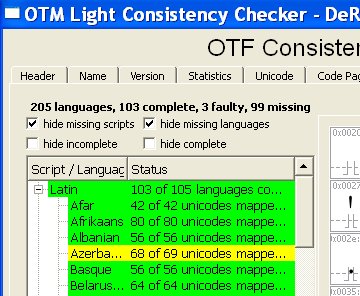
DTL OTM Light has a nice tool:


http://www.fontmaster.nl/

Captured from web.archive.org on 17 Mar 2015. view this capture