It’s interesting that the typewriter used for the customization was different than the one used for the form letter.
But was the form letter typed or typeset?

.
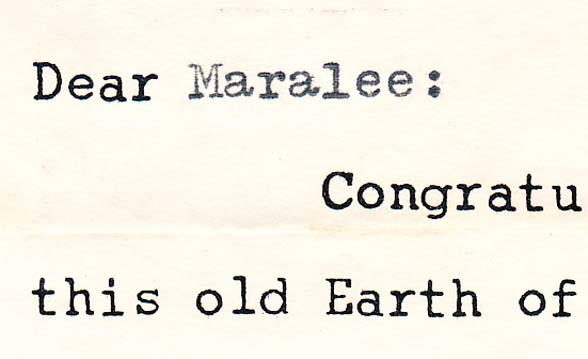
It’s interesting that the typewriter used for the customization was different than the one used for the form letter.
But was the form letter typed or typeset?

It would be hard to say without looking at the original. I think it was typewritten, then reproduced on already two-color printed sheets using a mimeograph.
Nice sample by the way. It’s part of your research for Checkers?

The body was typeset and the name typewritten. In Ye Olden Days, it was not unusual for letters set in faux-typewriter foundry type to be printed on a platen press using a large, looped typewriter ribbon instead of ink, which helped strengthen the illusion that the entire letter was machine-written.
The form printing doesn’t look like a typewriter ribbon impression.
The ink sits flat on the paper, is much darker than the custom typing, and has a slight gloss.
much darker than the custom typing, and has a slight gloss
I didn’t knew they had laser printers back in the day! ;-)

The printed type has a lot of similarities to Stymie. Sort of a "Stymie Monospace". It looks different from most typewriter types I can recall.

I agree with you Nick, does not look like a typewritten ribbon impression.
And, even the stains look simulated, almost too symmetrically distributed.
The crease coloring looks suspicious, I wonder if this could be a fabrication of sorts?
Dame hard to figure things out unless we actually had the piece, in hand, to examine ourselves.
Nice sample, sure reminds me of the 1950s. Like taking a step back in time.

The "stains" and "crease coloring" look suspicious? Why?

Look at the different "a" glyphs used in the persons name vs the rest.
My guess would be that it was all done with an impact printer or what we used to call "cold type" except for the typewritten name "Maralee".
Yes, I would guess that the main text is a metal type font meant to look like a typewriter, with the exception of the typewritten address, date, and name.
Must be real...
Can't dig up anything on internet reference to 'Rannard's Shoe Store', but found obituary on Andrew B. Rannard, died 25 Dec 1956, VP of a Shoe store.
http://awt.ancestry.ca/cgi-bin/igm.cgi?op=GET&db=linclinks&id=I116019&ti...

My guess is that the dark part was mimeographed. I don't know what machines were in use in 1956 but in the mid sixties, in my school, we had an A B Dick. We would type on some special support (without a ribbon) and then use some chemicals to transfer what was typed onto a metal sheet (I think it was zinc) that would then be used for printing.

My guess is that the dark part was mimeographed.
That's what I was thinking too.
Yes, your first post.

Could the form letter have been printed through a carbon paper? Not sure about the gloss, but this tends to make the text look darker. Though it would've also blurred the text.
With mimeography, an oil-based ink goes through a waxed mulberry paper.

> mimeographed ... some chemicals to transfer what
> was typed onto a metal sheet
Perhaps there were different types of mimeographs. In my first job I had to mimeograph a weekly newsletter and no metal sheets or chemicals (except ink) were involved.
I removed the typewriter ribbon and typed on a stencil, which felt like a sheet of waxy paper. The typewriter punched through the stencil's waxy layer, but a bottom layer which was permeable stayed intact. Then I wrapped the stencil around an inked drum. The ink would ooze through the areas cut out by the typewriter.
The waxy stencil would deteriorate after printing a few hundred copies. Perhaps the metal sheet you mentioned was used in jobs where more durable materials were needed to print larger quantities.
The "spirit master" lives ;-)
James, the one I remember using worked in a similar way, except that, if I remember correctly, one didn't write directly on the stencil, but there was some processinvolved between typewritten sheet of paper and the sheet applied to the drum. I don't remember the process except for the smell.
I just remembered that there was an optional method in which a small machine scanned the layout and created a stencil or printing plate from that scan.
If I remember correctly, that method reduced the overall quality slightly, but it made it easier to produce more complicated layouts and/or include illustrations. (If you produced the stencil directly on your typewriter without a scanner, illustrations needed to be drawed directly on the stencil, or else you needed to purchase pre-made stencil illustrations that were then cut and pasted into the stencil. I did that occasionally and it was a pain.)
Since the scanning method required the purchase of a special scanner, it was probably used mostly by larger organizations that could afford the extra expense.
Perhaps there were different types of mimeographs.
I never handled the printer but I am fairly sure it could be used as a mimeograph, i.e. you could put directly the typewritten waxed paper on it and print; that's how most handouts would have been produced. However, for our newspaper, what was typed on the waxed paper was transferred onto a plate; the same machine would then be used as an offset printer. I googled and found no reference on such machines that could do both. So far as I understand, when used as a mimeograph, the ink would have to be put inside the barrel; if a plate is used, the ink needs to be put somewhere else, I guess. I dont' remember that there were two printers but maybe it was so (the year was 1964-1965).
> the ink would have to be put inside the barrel
Yeah, the scanner method I mentioned created a stencil that looked very similar to a typewriter-produced stencil, and the ink still came from inside the barrel that it was wrapped around.
The spirit duplicator was something different. The ink was on the stencil itself (there were stencils of different colors). I used such a printer many times in the seventies and eighties.
The following scanned complement for a Bourbaki seminar (pdf 191K) would normally be called "notes miméographiées" but I can't guarantee that the printing process was not in fact offset, on a Gestetner printer.
The first printer that was used by the printing services on my campus is on display at their entrance with pieces of equipment inside the cabinet, as well as an instruction manual, dated 1947. It was a hand cranked A.B. Dick mimeograph.

Captured from web.archive.org on 22 Oct 2013. view this capture