
Typophile
Israeli court finds against Microsoft in font case

Hmmmm
Microsoft paid for Times, I assume. And they paid for their new Cleartype collection. But they imitated Helvetica with Arial, and were sued successfully over Segoe imitating Frutiger. You'd think that paying the creator and foundry would be cheaper than paying lawyers. I really don't understand them, as I really doubt that Zvi Narkis and Eliyahu Koren were making exhorbitant demands for rights.
In an article I posted to the Hebrew section, it was said that Microsoft paid Zvi Narkis after years of his complaints to them. So I don't know how this relates.
Both Narkis and Koren are "type heroes" who devoted their lives to improving Hebrew type and graphic design. So this is also symbolic. Koren died in 2001, and Narkis last month.

Incredible.
Microsoft still doesn't respect type authors.

Hi,
The two fonts in question were licensed by Microsoft in good faith several years ago from the Kivun company and Shmuel Guttman respectively and the case in Israel is ongoing. Hope to be able to provide additional details on its conclusion.
Thanks, Si (Lead Program Manager for Fonts, Microsoft)

were sued successfully over Segoe imitating Frutiger
Umm, I thought that they were blocked from registering EU Design Rights for Segoe, not sued?

Sii: Kivun made a Word Processor called Dagesh and Accent. Shmuel Guttman was an individual who sold his renditions of fonts to this Word Processing company (at which many of my friends worked at). Since when does Microsoft license fonts from little companies that make word processors.
Surely Microsoft could have picked up the yellow pages and looked up Koren Publishers Jerusalem and asked them if Guttman had the rights to their font? It's not as if nobody has heard of Koren, heck Jerusalem even named a street after the guy for his work on his font (http://albums.phanfare.com/isolated/0KDDZyNj/1/4350281). Funnily enough there is no Guttman Street!

Does Koren own part of Narkiss' designs?
Or does Koren have a valid legal claim to designs inspired by Koren's books, namely a derivative of his Bible face, if that new creation was made in the USA where Koren P. do not have a desihn patent, or copyright on any computer code?
GoHebrew is a legitimate foundry, but KP seems not have any legal rights, except maybe in Israel.
For example, E Koren passed away. His rights ceased. Therefore, Dafka for example, knocks out a Koren font, even though its entire owner lives in Israel.
KP does not protest. Years go by. Hence, what claim does KP have?
Thanks Si and Raphael for commenting. Very interested to see how this develops.

As Simon said -- the case in Israel is ongoing.
> Surely Microsoft could have picked up the yellow pages
Surely Microsoft Israel...
gohebrew: I am confused as to why you think that Koren would have any claim to Narkis's fonts.
regarding whether Koren has copyright over it's fonts, nobody in the world (with the exception of you of course) disputes this.
I don't think you understand what this first part of the court case is about. Please reread the article.
Regarding Davka, (not Dafka), yes they did sell the Keren font and as soon as I started working there, I was in touch with them to ask them to stop selling it and they promptly did so not realising that this wasn't okay. So you are wrong. We did protest and they immediately stopped so your comment is incorrect and unfair to Davka who are an excellent company selling and excellent products which we use! (their website is www.davka.com).
Now if GoHebrew, as a legitimate font foundry, creates a version of the Koren font without the permission of Koren Publishers Jerusalem Ltd, then I'm not sure why you think that this is okay and I wonder if others on this forum also think it's okay for foundries such as GoHebrew to copy other people's designs.
Israel,
Raphael is right. Why to copy Koren?
> ...in the USA where Koren P. do not have a desihn patent, or copyright on any computer code?
So? Why to copy Koren?

Si, i don't believe this is clear either, from the same story,
"Indeed, Microsoft argued against the entire system of copywriting fonts: Fonts cannot be copyrighted; they should be considered designs, Microsoft argued."
It must be, that
Microsoft argued against the entire system of copywriting font designs. Font designs cannot be copyrighted; they should be considered objects of utility. At least that was the old argument against even copyrighting them as software.
Surely MS has a lot of expensive copyrighted font software it was not arguing against?
May I just add, that there are 2 Koren families, Koren Siddur and Koren Tanakh.
These were not available digitally until very recently. My first project at Koren was to oversee the digitisation of the Koren Tanakh font (we saw that people were prefering Windows and MacOS over lead for some odd reason :-) ) and now the entire original families are available in OpenType format from www.masterfont.co.il (who has exclusivity our fonts). There are some very cool features in the font, particularly in the Tanakh Bold.

Pirates Of The Mediterranean, Part I
The two fonts in question were licensed by Microsoft in good faith several years ago
Jeez, sii. Don't you guys "get" font licensing after all these years? No wonder you can't write me up a paragraph explaining it.
But good to know the effort to weasel out is ongoing. ;)
And BTW - the argument that fonts are designs makes perfect sense as a defense. And where else would it be precedent except in Israel?
Ahhh, what do I know.... nuttin'.
(I'd kill to read the briefs and transcipts in English. Anybody got any legal contacts there?)
I hear that a. the Haaretz article is inaccurate, and doesn't get what is going on. b. This case is the first time the Israeli law on fonts that is at issue is being tested. I still don't know what is going on, but very curious...

...the Haaretz article is inaccurate, and doesn't get what is going on.
You've just described every newspaper article I have ever read that related to a subject about which I knew something. Needless to say, this makes me kind of worried about all the articles on subjects of which I am ignorant.
John, I agree wholeheartedly.
I think that maybe the internet can help to correct this habitual failing of journalists. At any rate we should try.
[political discussion deleted by author]
Lawsuits are particularly difficult to cover, as information is weaponry in the suit. It probably takes specialists to get this right, but here they usually only cover the Supreme Court and notorious cases.

Typefaces are designs, while fonts are software. I assume that while Microsoft made use of the design of the typefaces in question, either Microsoft, or the company from which it licensed what it used in its products, originated fonts corresponding to those designs. And so Microsoft is being sued under an unusual Israeli law, which protects typefaces by the copyright law, instead of (as designs) by patent law.
If the allegations against Microsoft, and its response, are both true, then I would expect things to play out like this: the fact that Microsoft may have been a victim of fraud when it licensed the typefaces in good faith would not entitle it to continue using them - it could recover what it owes to Koren from Kivun, if they have the assets, but this wouldn't necessarily be a shield for Microsoft against civil liability the way it is against criminal liability. (Under some circumstances, the court could go tell Koren to sue Kivun, at least to recover damages for past use, but generally acting in good faith doesn't protect one from being liable even when the moral fault is really someone else's.)
...generally acting in good faith doesn't protect one from being liable even when the moral fault is really someone else's.
No, but Microsoft's licensing contract presumably includes a clause in which the licensor affirm that they own the relevant rights and may legally license them to the licensee, accepting liability if this is not the case. That's pretty standard in OEM license agreements.

The article mentioned above
see www.haaretz.com/print-edition/business/groundbreaking-hebrew-fonts-are-n...
seems to be sort of a hoax or sort of a legal joke.
1) The Israel copyright law does not contain any provisions for the copyright protection of fonts.
see www.tau.ac.il/law/members/birnhack/IsraeliCopyrightAct2007.pdf
2) The Israel copyright law as a national law is not binding for any foreign country, especially here it is not binding for Microsoft as a USA company.
3) Both Israel and the USA are members of the RBC (Revised Berne Convention), but the USA became a RBC member four decades after the publication of the 1950 Hebrew fonts mentioned above.
see www.wipo.int/treaties/en/documents/pdf/berne.pdf
4) So, even if the 1950 Hebrew fonts were copyrightable as per the Israel copyright law (which they are not), this would be irrelevant for Microsoft, because the USA became a RBC member in 1989, while the 1950 Hebrew fonts were issued forty years earlier.
National laws are always binding on foreign companies doing business in the relevant country. One may not be able to arrest those who are physically in foreign countries, but everyone within a country must obey the laws there, and assets within the country can be seized, the continued ability to do business in that country can be ended, and so on.
However, your other points are interesting, and could well mean that Microsoft has nothing to worry about.
> The RepubliCON party. Motto: "Conning the public since 1980"
I agree with this argument wholeheartedly, except for one thing: the same is true of Democrats.

You eyes must be brown William :-)
According to the Associated Press several weeks ago the rich are spending less and the misery is trickling down Bill. So tax them more and they will hold onto their money, just like the corporations are dong now, and it just makes the recession cycle worse.
To correct a point , tax revenues went up during Kennedy's, Reagan's and Bush's tax cuts.
Explain that away, please.
No don't Bill, this is not a political forum and I do not know why you even went there.
Sorry, I could not erase my retort to Bill.
Michael, you can just click on "edit" and remove content. A blank post will remain, I think.
It had already run out of time.
I've also removed my original political content, as you're right it is out of place.
I don't understand how it can be out of time to edit yours; I just edited mine, which is older.
Edit: I just checked another thread dating back to June, and not started by me, and the "edit" link was there at the bottom left, just as in this thread. And it worked in opening the comment.
After a certain amount of time the edit function disappears.
.
I think you have to be a paying member of these forums to have certain functions available. I know when I post, "edit" is only an option under the post for a very short period of time after I post it.
So much for it being a free forum... hmmm, almost sounds capitalistic, god forbid. Tax it dammit!
That's weird. Hopefully one of the admins can clarify what is going on. Here I was thinking that Michael can't bear look to the Left side :)
ps. I did contribute, but didn't know it affected any functionality. This was not advertised.
I could probably delete mine if the edit link was there... /shrug

Maybe being the thread starter gives you nonexpiring edit links.
What is inaccurate about the article. I just reread it. It seems pretty accurate to me.
Raphael, I don't know what is inaccurate, if anything. I heard that a knowledgeable Israeli type designer said that it is inaccurate, and my experience with journalism made me predisposed to think there was something in the complaint. But you are in a position to know, so I appreciate your commenting. I will try to dig into this further, to find out what is the complaint about the article.

The Haaretz article is hugely inaccurate. I just downloaded the pdf of the decision (in Hebrew).
Here is the deal:
1) The "most popular Hebrew sans-serif" is not at issue here at all. That is a whole other story in itself. I did the design of the Arial Hebrew for Monotype (who licensed the font to both Apple & Microsoft), so I happen to know it. Firstly, it is true that Zvi Narkis made claims against my Arial design back in the 90's. Unfortunately, despite clear expert opinion Microsoft obtained that Arial was an original design and not a copy of "Narkis Tam", they chose to settle with Zvi Narkis instead of litigating. Interestingly, one of the plaintiffs in the current case – Zvika Rozenberg – was consulting Apple on the development of the Hebrew fonts [Apple was intimately involved in the process, while Microsoft licensed the already existing font] and was involved during my Arial creation process. What IS at issue in the current case is an alleged misuse of the font "Narkisim" (which NOT a sans-serif font at all). Even the illustration in this Haaretz article uses the wrong fonts, not "Narkisim".
2) I only quickly scanned the court decision, but it is clearly not the end of the case. The merits of the claims were not at all discussed here, the decision pertains ONLY to the definition of the legal protection enjoyed by fonts. It is a long document full of learned back-and-forth on whether fonts are to be considered "designs" or "intellectual property". The decision was "intellectual property" (in original Hebrew "creator rights").
3) There is nothing in the decision about any restraining order prohibiting further usage.
4) The legal costs are to cover FOR THIS PARTICULAR part of the case by the losing side – the defendants.
The merits of the case are still to be argued, it would be interesting to see what the claims are.
Thanks, Baruch, that is very helpful. But what I am puzzled by is why Microsoft would argue that they are "designs" rather than "intellectual property". I think their fonts are generally protected in the U.S. as software, not as as designs. —I'm sure I will be corrected here if I got it wrong.
If so, it would appear, as David Berlow says above, that Microsoft was, in effect, arguing against itself.
Does this have to do with the different definitions of "design" and "intellectual property" in the two countries? Can you shed any light on this? What is at issue here is still not clear to me, either in the current ruling, or the case going forward.
Baruch,
I haven't gotten any responses to my emails as yet.
Could you post the PDF somewhere? Just the exact names of the law firms and plaintiff would be of help. Dates, too.
There must also be, at least, the complaint that started the suit - and, obviously, briefs if the court ruled on an issue.
"the decision pertains ONLY to the definition of the legal protection enjoyed by fonts."
Based on this, it seems likely that MSFT's lawyers did indeed challenge the KIND of legal protection the font is entitled to.
This makes sense and was probably smart lawyering. If the judge had ruled differently, the whole thing would have gone away. I'm assuming the lawyers are being paid to win the case, with whatever line of argument needed to win it.
Richard, I just made the decision pdf available here: http://www.sendspace.com/pro/wtzfqk
Plaintiffs: The Estate of Zvi Narkis, Koren Publishing House, Zvi Rozenberg, Mastefont (Zvi Rozenberg is the owner of Mastefont)
Defendants: Microsoft Israel, Microsoft Corp
The court decision was rendered on October 5, 2010
William, I do not know the merits of the case and thus the reason behind Microsoft's attempt to frame the legal protection of fonts this way. I can only assume it was a move to shorten the litigation (if they would have won at this stage, the merits of the case would have become irrelevant, as Richard just wrote), or perhaps they really have nothing else in their arsenal? I am very surprised they didn't just settle the mater out of court though.
I will say this though: regardless of the merits of the case and its eventual outcome, this decision is good news for anyone doing Hebrew type design.
Baruch, does the intellectual property decision refer to fonts, i.e. to the software implementation of a typeface design, or to the typeface design? This is not clear from your summary, and it is an area in which many countries make a distinction, e.g. as in the USA recognising copyright protection for fonts as software but recognising design patent protection for typeface designs. It is important to be clear about what is subject to this decision, the font software or the design itself or both.
John, the decision was about the design itself, not the digital fonts. The claim is against an "unauthorized digitization" of these Narkisim and Koren designs by a third party.
Moreover, it is a well-established law in Israel that the design itself is protected. The question here was not 'weather' it is protected, but rather 'under what rubric' does this protection fall? If a font is to be protected as a "design" – מתגם, then there is a time expiration on this protection (like with a patent). If they are to be protected under "creator rights (copyright)" - זכויות היוצרים, then the protection either doesn't expire at all or has a much longer shelf life (I am not clear on that last point). This question is irrelevant for newer designs that are protected in either case, but the designs in question date back to 1950's, so it is very relevant indeed.
[Btw, the idea of a separate hearing on this purely legal issue was (according to this decision) proposed by the Judge himself in a pre-trial hearing back in March and accepted by both sides. Thus they can now proceed with the actual case based on this decision. My guess is that Microsoft will attempt to settle the case and might go after the entity that licensed the fonts to them in the first place.]
Thanks, Baruch. That was the clarification I sought, and it is an important one.
> Microsoft...might go after the entity that licensed the fonts to them in the first place.
pp.7-8, section 14: they are saying that they have a license (Narkisim); maybe from that entity?
> the decision was about the design itself, not the digital fonts... but the designs in question date back to 1950's, so it is very relevant indeed.
Read pp.21-22, section 35: Shamgar's ruling (was President of the Israeli Supreme Court), the case of Interlego.
That said, font design, font software, or whatever the name, is one package.
Baruch, that's helpful, thanks. I can't find the word מתגם in the my Alcalay dictionary, and Google translate doesn't know it either. Is that the correct spelling? Do you know whether "zechuyot hayotzrim" is legally the same as "copyright," or whether something else is going on here? As I said, the puzzling thing here is whether Microsoft had been arguing against copyright, which protects its fonts in the U.S., as I understand it.
That said, font design, font software, or whatever the name, is one package
John's question was whether design alone is protected; and it is.
William, the US copyright law is not relevant here, the question is usage in Israel. I misspelled the word מדגם
If Microsoft's fonts are protected as software, why would they say they were designs? I think that confuses something: while the fonts are software, those were not copied - only the designs might have been.
>US copyright law is not relevant here
It's not directly relevant to the case in Israel, but seems peculiar for the lawyers to make essentially opposite arguments in different countries, if the issue is the same. Then maybe their argument could be quoted back to them in another country, in another case.
I think I understand the differences now: The Israeli law allows font designs to be protected by copyright, according to this ruling. This is unlike in the U.S. where, as I understand it, only the software is copyrightable, not the design. The design has to be patented to be protected. But here the issue was not copyright of software, but of a design, so the issue is different.
I must say I prefer the Israeli law!

I have a copy of the decision. There can be copyright in a typeface as a matter of Israeli law; the parties will now argue whether there is copyright in the types in question. The decision is scholarly, as the judge happens to be a law professor. I can provide some commentary after I read the decision closely.
Bill: I think I understand the differences now: The Israeli law allows font designs to be protected by copyright...
The difference is always easier to comprehend if you avoid phrases like ‘font designs’.
A font is always a particular technical implementation of a typeface design, and that is true whether you are talking about trays of cast metal, sets of Linotype brass matrices, Berthold glass photo discs, Letraset rubdown sheets, or an OpenType digital font file. A typeface is a design, a font is an implementation. Both the design and the implementation may involve original creative work, and different jurisdictions recognise that and protect that work as intellectual property in different ways. The recent Israeli ruling apparently establishes that, under Israeli law, a typeface design may be subject to copyright protection. This is different from e.g. US or Canadian law, in which the design is subject a different category of intellectual property protection (design patent or design registration).
>font design
Oops. Yes, of course: typeface design.
According to the decision, copyright can exist in a typeface if it satisfies three requirements: creativity (יצירתיות); originality (מקוריות); and artistry* (אמנותיות), that is the design must be artistic as opposed to purely functional.
* According to para. 52 of the decision, for the design to satisfy the third requirement it must be guided "mostly" by artistic considerations. This prong of the test may cause problems in the future.
Thanks, EK. I agree that the "mostly" artistry requirement will be hard to judge. But the other two are not so easy either. However I would think that judging what is an "original design" for a design patent in the US is also equally difficult.
Is there a difference here in burden of proof? That is, with a copyright, you can just register it, and it has to be challenged. To get a design patent you have to make some kind of positive proof to a judge or examiner, I think, though I'm not sure. Is there any kind of difference like this in Israel between protection of "design" and "copyright"? Above Baruch Gorkin tells us there is a difference in length of protection, but is anything else different?
Thanks EK.
The appearance of a purely functional type design, and the performance of a purely artistic type font, are what'll have me baffled for today.
Thanks for the pdf, Baruch.
A font is always a particular technical implementation of a typeface design, and that is true whether you are talking about trays of cast metal, sets of Linotype brass matrices, Berthold glass photo discs, Letraset rubdown sheets, or an OpenType digital font file. A typeface is a design, a font is an implementation.
This has me confused. (You know, I confuse easily.)
For a design patent, you have to have drawings, right? Which, under your definition is yet another implementation of "the design".
So, if these are all "implementations" of "the design", where does the actual "design" exist?
people might be interested in this link:
http://blog.ipfactor.co.il/2010/10/12/are-fonts-registerable-designs-or-...

In High Art Lite, (1999), his book on YBA (Young British Art, eg Hirst, Emin, &c.) Julian Stallabrass attempted to find some way of describing their art in such a way that a line could be drawn between Art and Not Art, but was unable to come up with anything more substantial than the fact that the art which appears in art galleries is made by people who have been to art school.
Purely objective descriptions of the works were typically categorical, in the sense that no matter how one attempts to pin down a definition, there is always an exception to the rule. Bring on the expert witnesses.
Thanks, Raphael. I have now read it once, but am not too much the wiser. I will have another go or two at wading through the legal reasoning.
One interesting wrinkle here is the discussion over whether typefaces are an "article of manufacture", with I gather the idea being that software is not tangible, so it is in a different category.
That's an interesting point, though I don't yet understand its significance; perhaps I will get it in a few more reads.
Note that Baruch's dismissal of the relevance of US patent law is incorrect. In discussing the case, the author refers to U.S. and European law, and it seems that he is at this point summarizing what the judge wrote. Foreign laws are not controlling, but they are relevant to the discussion.
William, I stand by my assessment:
I did see that the judge brought foreign law examples in his 31 page decision text, but these examples only speak to his thought process in reaching the decision (unless the decision itself is appealed, which I am sure will not happen).
Now that the final decision has been rendered, the only law that will make any difference in this and other cases tried in Israel will be the Israeli law. Moreover, I do not see how, absent 'prior art', Microsoft can possibly justify using these fruits of the "unauthorized digitization". Given what we hear, there is little doubt that the shapes of the letterforms in question are close copies of Narkisim and Koren.
In other words, whoever did the digitizing of these fonts must have relied on the US law that only protects the actual electronic fonts of the non-patented art. Surely you must agree that this US law will be of no help to Microsoft going forward.
Baruch, maybe we mean something different by "relevant". The Judge saw fit to discuss foreign law, including U.S. law, and that is what I mean by "relevant." As I said, obviously Israeli law is controlling, not U.S. law. The U.S. and other foreign laws are relevant to considering legal theory. And I wouldn't be surprised if the Israeli decision were referred to in a future U.S. case, if it contains reasoning that bears on a U.S. case. That's in fact why I was puzzled by the newspaper article's account.
I agree that the the U.S. law has no bearing on the further proceedings in Israel, as these will concern the facts of the case, and how to apply Israeli law. It is only the issue of law where comparison where legal reasoning in other countries would be relevant.
William, that I agree with.
> that is the design must be artistic as opposed to purely functional.
> * According to para. 52 of the decision, for the design to satisfy the third
> requirement it must be guided "mostly" by artistic considerations. This prong of
> the test may cause problems in the future.
Why problem?
There is a reason why the judge Gruschkopf had mentioned different cases. In the Interlego case Supreme Court judge Meir Shamgar added the artistic or artistry criteria because his aim was to prevent one side from gaining a monopoly if the case was judged on functionality alone.
There are several artistry criteria:
1. the choice option where the buyer has the option to choose from several products on the shelf.
2. the creator's intention.
3. how the public accepted/viewed the product.
4. willingness of the public to pay for that product [if they think that the product is good and worth the expenses]
5. aesthetic
6. artistry
Now the judge Gruschkopf said in section 52 that effort by itself is not enough. This is clear, why? Let's say that a person is "designing" typefaces by tweaking other designs, where no intention or care is given to other aspects of the design; so this kind of case won't hold water.
Judge Gruschkopf is saying that a typeface could and should be under the umbrella of creator rights. He understands that a typeface design is not a one day task/job, and the designer should have a long time to hold the rights to the designs in order to gain profit!
And by the law (Duration of Copyright, section 38): "Copyright in a work shall subsist during the life of its author and for 70 years after his death, subject to the provisions in this chapter."
BTW, the judge is not accepting the view that a typeface that was designed in the digital era is subject to a different law treatment than a typeface that was made by trays of cast metal.
This is also based on the ruling of Shamgar in the case of Interlego.
Boruch,
Tzvika is a lousy witness to cite. Is his version for Apple of David a cheap lousy knock-off of Itamar David's elegant and original design? What a joke to bring him, the rip-off artist himself?
Boruch,
Aren't the font laws stricter in Israel than US Copyright law?
So, if a font is created and registered for US Copyright here in America, inspired by a Hebrew perhaps created in Israel, then the law should follow US Copyright laws, because the State of Israel signed on to US Copyright law under the Berne Convention, agreed upon by most every civilized country in the western world. I think Russia signed on too recently.
Your Arial Hebrew is stunning. Clearly, your height and weight stroke achievements prove alone that Arial Hebrew is in a class for itself. I am shocked that Tzvi sued.
I am not saying this because you came to my house in Kfar Chabad, as a very young man,, still in Yeshiva Tomchei Tmimim. Or because you gave great fabrenghen at Aaron's house. Like most Russians, you hold your mashke (not in your hand).
Baruch:
"other words, whoever did the digitizing of these fonts must have relied on the US law that only protects the actual electronic fonts of the non-patented art."
I don't think Shmuel Gutman who made the Keren font in question was relying on any law. He thought it was okay to make the changes and because he made changes he called it Keren NOT Koren. This is what he told me personally some years ago when I met with him (before I worked for Koren).
Scott:
"Tzvika is a lousy witness to cite. Is his version for Apple of David a cheap lousy knock-off of Itamar David's elegant and original design? What a joke to bring him, the rip-off artist himself?"
I know you hate Zvika Rosenberg for some reason, but let's try and keep the forums professional and not bring in your personal feelings.
Again according to my conversation with Mr Gutman who was a good friend of Ismar David, he related to me that Mr David was happy for everyone to use his font and develop it further or to simply copy it. That was why Gutman called his version of the font David (he didn't change the name) and therefore you can't call anybody's version of it a "knock-off" because that implies it was copied without his permission and he clearly gave it to everyone.
Finally, your rather rude comment about Rosenberg being a rip-off artist is not appropriate. It is interesting that Tzvi Narkis z"l chose Rosenberg to digitise his typeface and to market it and not another company. Tzvi Narkis was an internatially acclaimed font designer and certainly would not have worked with Rosenberg if he didn't think he was an upstanding honest business man. Again this information is directly from Narkis's mouth to my ear.
> Scott:
"Tzvika is a lousy witness to cite. Is his version for Apple of David a cheap
Raphael,
Israel, not Scott.
David,
Not according to his facebook account:
http://www.facebook.com/#!/profile.php?id=1127971979
> Not according to his facebook account:
Ahh, "double agent"
:)
Raphael quotes:
Baruch:
"other words, whoever did the digitizing of these fonts must have relied on the US law that only protects the actual electronic fonts of the non-patented art."
This is exactly accurate, Raphael.
US Copyright law rejected applications for font software as being "digital data that described letter forms".
After outline typeface software was released by Adobe in the verbal PostScript language as scalable outlines defined mathematically, and later by Apple and Microsoft as TrueType, font software was no longer "digital data that described letter forms".
So, the very conservative US Copyright Office now required outline typeface applicants to sign a disclaimer, rendering their applications powerless.
I refused to sign in 1989.
A long correspondence ensued between the then head of the US Copyright Office, Ms. D Lawrence, and myself, then the CEO/President of Font World, Inc. She asked me why the US Copyright Office should accept my applications for hundreds of outline typeface fonts in every world language except Chinese, Japanese, and Korean.
I presented an analogy, which explain in easy-to-understand terms why the US Copyright Office should accept my applications.
I told them that an outline typeface software was like telling a common story. Some storytellers are good, and some storytellers are better. It's the same story, but each one tells it different.
One uses this word, while another uses that word. This is like placing the BCPs, the bezier control points in a PostScript font here or there, although the result look similar. However, one way renders better than the other.
The US Copyright Office accepted this explanation, and issued me and those after me, US Copyright registration, granting me full intellectial property protection, even for Crown, inspired by the public domain design, that Eliyahu Koren claimed untruthfully for himself. The date was 1989.
US Copyright law sign by the State of Israel in 1988.
In the USA, US Copyright law does apply to art designs, such that employed by Eliyahu Koren. Rather, US Patent law applies, if certain conditions are met, as done by Linotype for Times-Roman. Eliyahu Koren never made a US Patent application, because to do so was too complicated until very recently.
Hence, no intellectual property protection applies.
Raphael:
>> I don't think Shmuel Gutman who made the Keren font in question was relying on any law. He thought it was okay to make the changes and because he made changes he called it Keren NOT Koren. This is what he told me personally some years ago when I met with him (before I worked for Koren).
How does Keren differ from Koren besides one letter?
Raphael quotes and comments:
Scott:
"Tzvika is a lousy witness to cite. Is his version for Apple of David a cheap lousy knock-off of Itamar David's elegant and original design? What a joke to bring him, the rip-off artist himself?"
I know you hate Zvika Rosenberg for some reason, but let's try and keep the forums professional and not bring in your personal feelings.
GoHebrew rephrases:
Why was Masterfont owner Tzvika Rosenberg brought as a witness, when all who with him realize he is not a talented artist, and simply a businessman?
My father zal taught as a small child to "practice what I preach". His father did not teach little Tzvika. He told him: "Say whatever to get money".
Raphael:
> Finally, your rather rude comment about Rosenberg being a rip-off artist is not appropriate.
I disagree. In the USA, we have freedom of speech, religion etc.
In Israel, tzaddikim were inprisoned by the PM Peres, because of kefiah datit and incitement.
When the true messiah arrives, there will be a new government in Israel after the state is disbanded, the government of Dovid Melech Mashichei, and there will be peace on earth forever.
Raphael:
>> Tzvi Narkis was an internatially acclaimed font designer and certainly would not have worked with Rosenberg if he didn't think he was an upstanding honest business man.
Tzvi made a big mistake.
David and Scott:
My legal name is Scott Irwin.
In Hebrew, Shlome Yisroel was given to me at birth.
In English, this is Solomon Israel.
For business, I have a DBA as Israel, because most Americans can not say "shl..." I say that I'm Isreal, like the country.
Arabs hate saying Israel; to them, I'm Scott. Arabs call me Scott.
In England were you Raphael or Richard?
David:
>> Ahh, "double agent" :)
Actually, triple. I really work for G-d.
1. My name is Raphael in all languages. Why should it be Richard?
2. I am not a lawyer. I have no idea what the law is in the USA regarding copyright (nor am I much more knowledgeable about Israeli copyright law :-) )
You say:
"The US Copyright Office accepted this explanation, and issued me and those after me, US Copyright registration, granting me full intellectial property protection, even for Crown, inspired by the public domain design, that Eliyahu Koren claimed untruthfully for himself. The date was 1989."
What public domain design are you referring to exactly? Are you saying that there is a public domain font called Koren that you have used as a basis for a font that looks like Koren that you call Crown and that Eliyahu Koren copied this font, which also happened to be called "Koren" and made his own font and that he lied and made up was his own?
Are you also saying that the printed Koren Bible made in 1962 which uses this illegal Koren font was a copy of the 1989 font and that Eliyahu Koren was in fact a Time Lord and sneekily got into his Tardis, jumped forward in time, saw this great public domain font called Koren, then jumped back in time, changed his name from Korengold to Koren just to make this up? You realise that this is impossible since Time Lords live for hundreds of years and Eliyahu Koren should therefore still be alive. Wow, I must write to the BBC. This could make a great episode of Dr Who.
Just for the public record, Eliyahu Koren created his typeface for the Koren Bible that he printed in 1962. It was in all the newspapers of the time and we have the clippings in our offices. We also have the original drawings in my office and if any typophile readers are ever in Jerusalem, you have an open invitation to our offices in Talpiot to see some amazing history (which unfortunately doesn't correspond to gohebrew's version of history).
Eliyahu Koren was an employee of Koren Publishers Jerusalem for his entire life until he passed away. Koren Publishers Jerusalem Ltd have given exclusivity to sell our typeface/font/(again call it what you may) to Masterfont. I should also say of the public record that Scott/Israel/GoHebrew (however he wants to refer to himself) begged me on the phone for us to license the font to him/GoHebrew and not to Masterfont.
Now it may be "legal" to copy/adapt/rip-off or whatever you want to call it. Maybe there is no law that protects the designer. I don't know. It seems that this recent Israeli ruling seems to side on protecting the designer, but it's early days. I'm sure Microsoft will appeal etc.
But since we are on a forum that discusses type, I'm curious, do members of this forum think it's okay to take a design such as Koren or Narkisim, and make their own versions of these fonts if the designer doesn't agree to this? GoHebrew states plainly and openly on this forum that they have created a typeface called Crown (which I would love to see) which has been "inspired" by the Koren font. Let's see some samples. Put up some words in the Crown font on this forum, I'll put the say words up in the original Koren font and let's see if
a) people think that it's the same and
b) people think that it's okay (not from a legal point of view but from a typophile point of view) for gohebrew to do this.
I am more curious to hear people's opinion on type design and interpretation on this forum rather than about the Coming of the Messiah (bimhera beyamenu -- sorry about the bit of Hebrew but it's kind of automatic for me too :-) )
I would also be happy to post up, once gohebrew put's up some Crown examples, of the Koren Bible font, the Koren Siddur font and also Gutman's Keren font. I can also put up Masterfont's Koreen font which was Rosenberg's interpretation (not the same as the real thing) which was done with Eliyahu Koren's approval (and of course the company get's royalties on :-))
This would be an interesting exercise.
I'll let gohebrew choose the text (but would make sure the text has the following letters: א, ל, ש, ר, ת.
Oy, a bunch of Jews arguing. This thread will stay on the front page until 2017, at least.
@nick
Expert witnesses, yeah.
At least you didn't answer that the design was in 'the mind of G-d" or 'David Berlow's garage'.
@gohebrew
One uses this word, while another uses that word. This is like placing the BCPs, the bezier control points in a PostScript font here or there, although the result look similar. However, one way renders better than the other.
Today, in court, such decisions would be treated as unoriginal under the scene affair doctrine. These are decisions that flow logically from the circumstances - required by factors external to the "program", such as hardware or compatibility with other programs. Technical know-how is not creative expression.
Software infringement cases are very different from, say, a novel or a screenplay.
@raphaelfreeman
Thanks.
Your link is the second source that flatly says MSFT's lawyers argued that neither fonts nor typefaces were copyrightable. And that the appropriate protection was the Israeli equivalent of a design patent.
(Obviously, the judge felt the typeface rose to the level of Art.)
Hmmmm one more citation and it's a hat trick.
@davidhamuel
First, Hi.
Second, you seem to be drawing conclusions about fonts in general from the judge's ruling about this one particular font/typeface. Is there anything in the text of his ruling to give you this impression?
rich
Hi Richard,
Everything is there.
1. Now the judge Gruschkopf said in section 52 that effort by itself is not enough. -- see page 31, section 52.
2. the judge is not accepting the view that a typeface that was designed in the digital era..... -- see pp.21-22, sections 34 & 35.
3. what is functional? -- see page 30 sections 50 & 51
what else?
> We also have the original drawings in my office and if any typophile readers are ever in Jerusalem, you have an open invitation to our offices in Talpiot to see some amazing history
I plan on going to Israel at some point. I'm not sure when, but when I'm going I'll let you know. I'd love to see those drawings!
Raphael
>> What public domain design are you referring to exactly? Are you saying that there is a public domain font...?
No. At RIT is housed a document which proves that the Askenazic-like drawing of the Hebrew alphabet was not invented by Eliyahu Koren, as some suggest, and was not drawn by him, as he suggested, and you believed (for monetary reasons).
It was drawn a very long time ago, and used in ancient documents of Biblical text.
Raphael
>> Just for the public record, Eliyahu Koren created his typeface for the Koren Bible that he printed in 1962. It was in all the newspapers of the time and we have the clippings in our offices. We also have the original drawings in my office and if any typophile readers are ever in Jerusalem, you have an open invitation to our offices in Talpiot to see some amazing history (which unfortunately doesn't correspond to gohebrew's version of history).
This is fiction.
Eliyahu Koren did not created the typeface named after his surname. He simply popularized it.
Publish your drawings in part on the Internet. Since it is only in part, the drawings can not be misused.
I am currently attempting to obtain copies and historical evidence that Koren's drawing were directly based upon ancient manuscripts.
Raphael
>> Eliyahu Koren was an employee of Koren Publishers Jerusalem for his entire life until he passed away. Koren Publishers Jerusalem Ltd have given exclusivity to sell our typeface/font/(again call it what you may) to Masterfont. I should also say of the public record that Scott/Israel/GoHebrew (however he wants to refer to himself) begged me on the phone for us to license the font to him/GoHebrew and not to Masterfont.
Again, this is merely fiction.
I simply warned you not to work with ganef. Look at the time has passed, and has he even run Volt once on his Mac. :)
I don't want that stolen work; go to John. I doubt if he'll take it. How 'bout Ofek - they know some of Volt.
R
>>> Crown (which I would love to see)
See the widths and metrics thread...
Richard,
>> David Berlow's garage
Wow, what a treasure chest? old maps of Boston, and older type books...
Richard,
>> scene affair doctrine
What's that?
Raphael,
>> gohebrew: I am confused as to why you think that Koren would have any claim to Narkis's fonts.
When Reuhl helped Frank, it was FrankReuhl.
When Koren helped Narkiss, it was Narkiss.
Was it a derivative work, a collabarative (sp) work, or a work for hire?
Was Eliyahu working for Tzvi like a petty worker? Or did he lend Tzvi artistic/creative/technical skills which surpassed the job he did for Tzvi?
>> regarding whether Koren has copyright over it's fonts, nobody in the world (with the exception of you of course) disputes this.
If you see clear evidence the design was used before many generations ago, would you concede?
Raphael,
>> Regarding Davka, (not Dafka), yes they did sell the Keren font and as soon as I started working there, I was in touch with them to ask them to stop selling it and they promptly did so not realising that this wasn't okay. So you are wrong. We did protest and they immediately stopped so your comment is incorrect and unfair to Davka who are an excellent company selling and excellent products which we use! (their website is www.davka.com).
Funny, when I bought DavkaWriter 6, it was there. Did Alan burn new CDs afterwards?

Somebody tell us more about whatever injunction or lawsuit there was about Segoe.
It seems Alan removed it, like you said, Rephael.
What is Gutman's Keren? How is my Crown different besides having better alignment?
Bill & Sii,
>> ... Indeed, Microsoft argued against the entire system of copywriting fonts: Fonts cannot be copyrighted; they should be considered designs, Microsoft argued. Designs of objects are protected by law for 15 years in Israel. ...
This, allegedly argued by Microsoft's attorneys , was untrue.
"Fonts cannot be copyrighted" does not refer to outline font software, but rather to bitmap font software or "mere digital data".
As you know, Microsoft won a second lawsuit regarding the Comic typeface. Adobe won the first case against Swfyte for copying Adobe's fonts and renaming them, I believe in the mid-nineties. Microsoft cited the Adobe case as a precedent.
Adobe's case was won based on my correspondence with the US Copyright Office, in which I explained clearly and logically why outline font software was not like bitmap font software or "mere digital data".
I used a simple analogy to telling a similar story by different storytellers. The US Copyright Office accepted it in early 1989, and was the basis of both Adobe's and Microsoft's law suits.
Why did Microsoft present an untruthful argument?
Raphael,
>> ... Designs of objects are protected by law for 15 years in Israel. ...
Hmmm
Why is there still a patent claim on Koren's alleged designs anymore?
Joe, here is a report on the Segoe ruling.
And here is a typophile thread on it.
How accurate either is I have no idea.
brianskywalker: you are cordially invited! I can even show you 3 Rashi typefaces that he drew, and sans serif, but none ever came to fruition. However, we are hoping to digitise one of the Rashi fonts.
gohebrew: okay. I will try at the beginning of the week to scan in some of the pages and put them on the net. I think people will enjoy seeing that.
"Was it a derivative work, a collabarative (sp) work, or a work for hire? Was Eliyahu working for Tzvi like a petty worker? Or did he lend Tzvi artistic/creative/technical skills which surpassed the job he did for Tzvi?"
Er no. I'm not exactly how old Zvika is, but if Koren created the font at the tail end of the 1950s... I'm a little confused as to why you think there is a collaboration here. Masterfont did not design the Koren font. They digitised it. Masterfont sell the font exclusively for us, that's all.
"It seems Alan removed it, like you said, Rephael."
yep.
"What is Gutman's Keren?"
That is the whole court case! Microsoft bought Gutman Keren from Gutman (and apparently Kivun according to Sii Daniels) and distributed it with Microsoft Office. The court case is whether this was okay or not. We contend not and it is in the court's hands to decide.
"How is my Crown different besides having better alignment?"
I don't know. I haven't seen Crown. Can you post the link (I couldn't find it). I know that Gutman based his font on Eliyahu Koren's work because that is what Gutman told me when I visited him once, I don't know what you based your work on.
> Microsoft bought Gutman Keren from Gutman (and apparently Kivun
So, If Gutman is the source why you're chasing MS.
Are you asking why is Microsoft being chased instead of Gutman or as well as?
Yes, why is Microsoft being chased.
Again, "instead of" or "as well as"
However, regardless of that particular question...
DISCLAIMER: Please note that when I use the word "copy" or "illegal", this of course is poetic license until the court rules so please don't take offence at my language it's just easier to say it like that.
The Keren font was a copy (with a few changes) of the Koren font. Therefore this font was illegally created without permission of Koren who created the font.
The question is whether this is legal or not. Can Microsoft purchase an illegally created font and distribute it? This is the court case.
It seems that stage one has ruled in Koren's favour and not in Microsoft. We'll see what happens. I'm sure they will be appeals etc and the case will progress.
I think it's very interesting for type designers to see how the court rules over the coming years. If an employee at Adobe create a typeface, say Minion, and then a freelancer makes a slight variation of the typeface and calls it Minon. Would it be okay for Microsoft to buy this typeface from this freelancer for $1,000 and distribute in Office 2012? Would that be okay? How about Adobe Garamond? Would that be okay, I mean Garamond is in the public domain.
I wonder what Adobe's response would be?
Raphael,
>> Er no. I'm not exactly how old Zvika is, but if Koren created the font at the tail end of the 1950s... I'm a little confused as to why you think there is a collaboration here. Masterfont did not design the Koren font. They digitised it. Masterfont sell the font exclusively for us, that's all.
no, no, between tzvi n. and eliyahu k., not tzvika
tzvika sold to apple for the apple mac when mac was born
tzvi narkiss was already a star by then, and eliyahu k. was a great elder
raphael, i think very highly of you
people think wrongly that i want to harm you
i don't at all
i held back crown from commercial release so your koren is alone
I have no knowledge of any font collaboration between Eliyahu Koren and Tzvi Narkis. Narkis never mentioned this to me which is odd since he knew I was working at Koren. Although to be fair he was in an old-age home at the time.
I am glad that you are not releasing Crown commercially. This is appreciated.
Raphael,
>> "How is my Crown different besides having better alignment?"
I don't know. I haven't seen Crown. Can you post the link (I couldn't find it). I know that Gutman based his font on Eliyahu Koren's work because that is what Gutman told me when I visited him once, I don't know what you based your work on.
very rare drawings, research at rit, and my eye for detail to improve crown.
i want to create a few kinds of crown: crown jewls, crown royal, etc., to be better than koren, a modern version, an ancient version (an authentic version like what eliyahu saw in his old draawings that an ancient drew - not his personal drawings which he drew, and that you have)
Have you seen Koren's original version of his font. He typeset Sefer Yonah (The Book of Jonah) with it. It was done by hand.
raphael,
>> I have no knowledge of any font collaboration between Eliyahu Koren and Tzvi Narkis.
but i read this here. isn't it in the article.
to me it made no sense. why would eliyahu need narkiss? only for the technical knowledge narkiss had that eliyahu did not, as eliyahu only new older technology from early electronic typesetting, but narkiss knew newer technology and had better contacts.
so you say the whole issue is that microsoft licensed karen not koren
so what is arial hebrew - isn't it narkiss?
it used to look like narkiss
if karen has difference than koren, why is it a knock-off?
btw i would license crown on a non-commercial basis as a custom font only for internal use.
that couldn't hurt you.
again, bill, what narkiss did to that concentration camp victim is sick. i hope he did teshuva. his estate should give a big donation to holocaust survivors. this nothing nothing to do with l'dann zechus. and tzvika is a bum. watch out for that scum.
raphael,
i have no interest to digitise koren for kp
none
let us only be friends
raphael,
>> Have you seen Koren's original version of his font. He typeset Sefer Yonah (The Book of Jonah) with it. It was done by hand.
no. nothing. just a jerusalem bible which i thought was lousy.
btw, realize i have everything to reproduce a bible like it but without those flaws
but gohebrew decided not to offer it commercial
not because you have any rights which i contend that its all hype
but simply because of hasagat gevul - to enable another jew to make parnasa
>> I have no knowledge of any font collaboration between Eliyahu Koren and Tzvi Narkis.
>>>but i read this here. isn't it in the article.
nope.
>>to me it made no sense. why would eliyahu need narkiss? only for the technical knowledge narkiss had that eliyahu did not, as eliyahu only new older technology from early electronic typesetting, but narkiss knew newer technology and had better contacts.
no no. Eliyahu Koren's (Bible) font [which is one being discussed] was only made in lead. I decided to digitise it recently after I joined the company many years after Koren's death. I never knew Koren.
>>so you say the whole issue is that microsoft licensed karen not koren
they licensed Keren from Gutman. correct. Sorry for the spelling correction, but it's critical in this conversation.
>> so what is arial hebrew - isn't it narkiss?
no, it looks vaguely similar to NarkisTam. The argument is about the font Narkisim. Both typefaces created by Tzvi Narkis.
>>if karen has difference than koren, why is it a knock-off?
aha! well that is really for the court to decide, but from what I understand the font has to be significantly different (there is some method of defining this) and Keren is not different enough in our opinion. Again, this is for the court decide.
>>btw i would license crown on a non-commercial basis as a custom font only for internal use. that couldn't hurt you.
Again, I have never seen Crown. If it is significantly different, then there is no problem and you can commercially sell it, but if it's very similar then clearly I cannot condone it and I would prefer that you purchased it like everybody else purchases fonts.
raphael,
thank you for the clarification about ms licensing keren for office
so why is borech gorkin here? he made arial hebrew. a great job.
>> if it's very similar then clearly I cannot condone it and I would prefer that you purchased it like everybody else purchases fonts.
i don't need to buy fonts b/c i made and make more that you conjure up
i sell both commercial fonts for $350 and $750
and custom fonts for $1500 to $15,000
if my crown is similar (better), why should i buy koren?
i simply want to sell it as a custom font as a license and with a contract that says the customer can only use it conventionally for editing text and making pdfs to print with
no derivative works
an idea:
sell me one user license to koren
i trash it and license my crown for a custom font
the customer can't sell it
1. do you sell a single license for resale one time
2. how much?
>> thank you for the clarification about ms licensing keren for office
so why is borech gorkin here?
dunno. Ask Baruch!
>> i don't need to buy fonts b/c i made and make more that you conjure up
>> i sell both commercial fonts for $350 and $750
>> and custom fonts for $1500 to $15,000
I don't make fonts. We make books. See www.korenpub.com
>> if my crown is similar, why should i buy koren. i simply want to sell it as a custom >> font as a license and with a contract that says the customer can only use it
>> conventionally for editing text and making pdfs to print with no derivative works
Again, I don't condone this. I don't know if it's legal.
>> an dea: sell me a user license to koren
>> i trash it and license my crown for a custom font
>> 1. do you ell a license for resale one time
>> 2. how much?
All licensing and sales of the Koren typefaces are done via Masterfont. You'll have to be in touch with them. They are a font foundry, we are a publishing house. You really have to put your personal feelings towards the owner of the font foundry and speak to them if you want to use Koren in some way that we deem as legal.
I should also point out that the Ministry of Defence Publishing House used the Keren font to create their own Bible. Even though their *use* of the font was not in any way illegal (they got with Microsoft Word like everyone else), their publishing of the Bible was considered to be and they were ordered by the court to stop selling their Bibles since it looked too much like the Koren Bible. So if you create a font in the way that you suggest, then even though you may not get into any deep water, your client could. You should be aware of this.
Raphael,
>>> > if my crown is similar, why should i buy koren. i simply want to sell it as a custom >> font as a license and with a contract that says the customer can only use it
>> conventionally for editing text and making pdfs to print with no derivative works
Again, I don't condone this. I don't know if it's legal.
It's sure not illegal here.
Even in Israel, it should be legal, because I made it from sources that he did not have.
So, why would it be illegal?
>> ...via Masterfont
forget the idea.
hagonave meh haganav, pattur.
if one steals from a thief then he's exempt.
kol sh'kayn certainly then if he doesn't steal.
i'll be a nice guy for you, but not not for a scumbag. let jesus turn his cheek.
is he selling it yet now?
how much?
add a zero, and i sell mine.
>> speak to them if you want to use Koren in some way that we deem as legal
how many eggs can you suck?
if you made the font from a basis that Mr Koren didn't have (and thank you for clarifying that point because earlier it seemed that you contended that he made his font based on this source), and if this source predates Mr Koren by many generations, then I seriously doubt that your font looks anything like the Koren font and there will be no problem.
If, on the other hand, they look the same, then there is something rather interesting and strange going on. Again without seeing your font this is all conjecture.
>> I should also point out that the Ministry of Defence Publishing House used the Keren font to create their own Bible. Even though their *use* of the font was not in any way illegal (they got with Microsoft Word like everyone else), their publishing of the Bible was considered to be and they were ordered by the court to stop selling their Bibles since it looked too much like the Koren Bible.
why not sue the idf? you could have every jew hate you.
you could make a deal with the devil
and the have the nazis buy from you instead of ibm
>> So if you create a font in the way that you suggest, then even though you may not get into any deep water, your client could. You should be aware of this.
we write in a disclaimer for him.
plus his work is private and non-commercial
non-profit
>> if you made the font from a basis that Mr Koren didn't have (and thank you for clarifying that point because earlier it seemed that you contended that he made his font based on this source), and if this source predates Mr Koren by many generations, then I seriously doubt that your font looks anything like the Koren font and there will be no problem.
who knows what he had.
he had drawings that he drew while looking at something.
did he trace it. maybe he has no rights at all.
really public domain.
i think your boss bought the brooklyn bridge
>>> If, on the other hand, they look the same, then there is something rather interesting and strange going on. Again without seeing your font this is all conjecture.
if eliyahu saw the rit drawings, then they would surely look the same
now, i'm convinced that koren is a knock-off of something very old.
hashem should have mercy for his soul.
he was a dati? modern mizrachii or kooknik?
you described him as a such a great pro... maybe a typesetter.
Why should we sue the IDF? The IDF our now our largest customer.
Do you read what I write? Do you read what you write before you post?
Do you think about what other people think when they read what you write?
Goodness, you asked me a question about whether you could license the font. I answered you politely and correctly. I didn't ask you to post slander on the web. Freedom of speech is one thing, being sensible is quite another.
I think that the moment the conversation turns devils and nazis and thiefs, then perhaps that thread should be taken off-line and you can write to me whatever you want privately. Let's keep this forum about typography, fonts etc.
In that vein, and since we are not a legal or intellectual property forum, I would really like to hear what people's opinions on, and excuse the terms, "knock-off's", "revevials" etc.
>>>who knows what he had.
he had drawings that he drew while looking at something.
did he trace it. maybe he has no rights at all.
really public domain.
i think your boss bought the brooklyn bridge
That's not the impression that I get from people who worked with him. Now let's avoid slandering my boss because he will take offence at such comments and he is really nice guy.
>>>> now, i'm convinced that koren is a knock-off of something very old.
Thank goodness you are not the judge in this court case then :-)
BTW what is and where is RIT? Excuse my ignorance.
Here is beta sample of my Crown:

A few side-bearings need to be adjusted. I didn't touch it since 1989.
I have lameds with a curled top, nikkud, taam etc. Yiddish and wide forms, too. I think the tzaddi(k) and zayin needs to be raised, and the final feh tilted to the left a bit.
Raphael, does it look like Eliyahu's? Can you post it?
What was slander?
If Koren took the design exactly, and didn't recognize the source, he violated Avot.
A knock-off, imo (Brian) is no knock-off but a great service.
The source is clearly mentioned.
A knock-off does not mention the source. Money is the only motivation.
RIT, like MIT (the school for genuises) is in Rochester, NY.
RIT stands for Rochester Institute of Technology. It is mainly funded by the US government's CIA, the Central Intelligence Agency, to give the Defence Department an edge over its enemies. It has a 25 year lead time over everyone.
Israel's Mosad exchanges information with them.
What does this have to with type?
The same technology used for advanced imaging was created for type, and is used by intelligence agencies, like the explanation of 2 45 degree birds eye view images in Photoshop which can detect underground nuclear weapons The Israelis discoved a way to take this information and destroy those weapons of mass descruction through brilliaqnt software code. If the Iranians ever release their missiles, they will return and flatten Iran.
Rochester houses the imaging center of the world, and RIT masters it in imaging, type, paper, and print.
The brains in Silicon Valley add the software.
By looking at Crown now, it wasn't really intended for Biblical text.
That was Koren's innovation and commercial motivation.
I added a 'curly' lamed for that purpose.
your font is very interesting. It definately looks like a version of Koren in my eyes. However, it is further away from Koren than Keren is. I am willing to bet that 99% of Israelis would think it's Koren.
Now what is more interesting is the "source" of your font. You claim it's a public domain font from many generations ago. I would love to see that source font and the date of it. You surely must have it if you created this font based on it.

this is your version. Where is the source?
>> You claim it's a public domain font
not a font it was hand drawn.
koren is a metal type font
crown is an advanced opentype volt made using volt
tzvika doesn't know volt
john does, but his volt is buggy
mine isn't
the drawing is from before there was printing
no source code
just a great hand-drawn art
where did eliyahu find it?
the source is in rit
it could be nowhere else
there was no internet as we know it
it wasn't in a book
i think the rit librarian gave me about a hundred photo-copies
maybe he remebers
he knew what to give me
maybe i pick it out
how would he know
ask scott for his name, if he didn't retire yet
Koren is a digital opentype font with automatic positioning of nikud and taamim and of course with kerning too :-). The VOLT programming was NOT done by Masterfont. It was done by Koren Publishers Jerusalem. Masterfont SELLS the font not programs it.
So do you have thisw great hand-drawn art that is over 300 years old? I would love to see it.
the text i saw had no nikkud etc
i added that from whaat john drew for heni
henri is my hadasa
friedlander himself approved it
he said that it was the closest to his first drawings
which was a huge compliment from him
he cried like baby
and taught me secrets of hebrew type
i published it elsewhere
i have no secrets to hide,
but eliyahu a"h had a big secret
again, you keep talking about this famous source. Can you provide a link to it? Can you scan it and put it online?
i have my source code
i created it
i registered it for copyright in 1989
i even went to washington dc to the library of congress
i exchanged correspondance with that office for 3 months
back and forth
they conced in the end
i recognize no rights to you at all
it's all chesed - one frum jew to another
if the court grants gutman the rights
i surely have the rights b/c of your comments
that my crown is further from koren than keren
that means eliyahu embellished it
i didn't
only mine is a revival of the original
>> Koren is a digital opentype font with automatic positioning of nikud and taamim and of course with kerning too :-).
i bet its buggy
send me a pdf in private
i'll annotate the bugs
if you want i can fix it.
i wish i had the art
rit does
they don't lend it out
when my parents moved in 1996, they threw out the copies
easy come, easy...
>> again, you keep talking about this famous source. Can you provide a link to it? Can you scan it and put it online?
can you please post the csource for his drawings.
are you saying he drew them from scratch?
how dumb do you think we all are?
my current source are fog files from 89
i think i have the source code printed out for the us copyright registration
i think i kept it
anyway washington filed it
they must show you, if you are a us citizen
there may be a fee
do you wanna sue the us govt. too?
first microsoft
then the us govt
then warren buffet (he owns the usa and israel)
i think i made the bold for crown and queen esther
(hadasa or henri) from a different source
some big artwork i bought at a flea market
raphael,
why is this a patent suit if your patent expired?
hey, i go to gutman instead of kp
because i don't go to ganavim
and he has a good name
would this influence the judge?
where's he live? b'nei brak.
who did alan of davka get from?
regarding the legalities, again the court has to decide. Let's leave that process to them... it will take months or even years, but I think that is the beyond the scope of my knowledge and my ability.
regarding our font. It's rather rude of you to say that you bet it's buggy. Why should it be buggy? The programmer is an expert at this and did a superb job. I have yet to find a bug in the font -- it works perfectly.
now let me get this right.
Some time before 1989 you saw some hand drawings of some letters which you converted into a font. These drawings you no longer have any copy of digital or otherwise because your parents threw them out in 1996. Your created your font baaed on these drawings.
Now may I assume that you were in now way influenced by the official Koren font which is extremely common place and had been since 1962 and that your typeface was created purely from these drawings?
I am not in the USA, but I wonder if RIT has internet access now and could e-mail you a scan of some of the letters. I bet they've digitally archived all their drawings and this would be an easy task. I also bet they have dated it too.
I'm not really sure how Eliyahu Koren could have come by these drawings. He escaped Nazi Germany and came straight to Israel. He worked on the fonts here in Israel and had no money -- he nearly went bankrupt in the process of making the Tanakh but that is whole other story.
Also it is important to note that he actually started with a prototype of the typeface which he did by hand and created the book of Jonah. He used this to try and get financial interest in the project. The final Koren (Bible) font was an evolution of this font and this early font looks very very different to your version. In fact your version looks more similar to Masterfont's Koreen. Since Masterfont's Koreen came out before you got your copyright on the font, then your copyright is probably invalidated and in fact he may have a case against you. (Let's hope he doesn't read these forums eh!)
finally, you say:
"ask scott for his name, if he didn't retire yet"
um, you are Scott. We have already established that on this thread. If you are confused as to who you are, check youself out on facebook. You even have a picture of yourself and your family members there.
* Well his drawings are kind of copyright so I can't post them. Sorry.
* Yes I am absolutely saying that he drew his fonts from scratch. I don't think that anybody is dumb.
* I am not a US citizen. I don't know what to ask for exactly. I never saw this drawing.
* No, I don't want to sue the US govt.
Now this is more intersting, you write:
"think i made the bold for crown and queen esther
(hadasa or henri) from a different source
some big artwork i bought at a flea market"
So you drew the font from a book you saw at a flea market. Is it possible that the font was the Koren font that Mr Koren created? I thought you said that you based your Crown font on a drawing that is generations old that is stored at RIT. Now you are saying you copied it from a book that you bought in a flea market.
* I didn't say it was a patent suit.
* Good luck going to Gutman z"l, but I should warn you, he passed away some time ago. But he lived in Jerusalem. Davka (I don't know if it was Alan, but it could have been) licenced the fonts from Gutman.
Oh and I don't appreciate you calling Koren Publishers Jerusalem, thieves (you used the Hebrew ganavim).
As a director of the company, I take personal insult from your comment.
Raphael, Sii
>> regarding our font. It's rather rude of you to say that you bet it's buggy. Why should it be buggy? The programmer is an expert at this and did a
the current version has three serious GSUB bugs which affect diacritical marks for every language which uses diacriticals, like Biblical Hebrew and Vocalized Hebrew.
I spent close to year creating versions after versions, installing and test each, so many times... until I defined the bugs and wrote new programs to avoid these terrible results.
I have never seen anyone's fonts that use Volt that did not have these results. Except mine.
Cheers!
>> Your created your font baaed on these drawings.
copies of these drawings, or copies of copies
>> Now may I assume that you were in now way influenced by the official Koren font which is extremely common place and had been since 1962 and that your typeface was created purely from these drawings?
i own and still use a dinky version to jerusalem bible with english to look up a verse to read the translation
the hebrew sucks
small, no tiny
lousy typesetting
barely legible font
taamim nikkud way too low
i use it for the english because i avoid the reform and christian translations
>> I am not in the USA, but I wonder if RIT has internet access now and could e-mail you a scan of some of the letters. I bet they've digitally archived all their drawings and this would be an easy task. I also bet they have dated it too.
if its online
every book i mean
i doubt it
if it is, please tell me
if microsoft got it, they'd win the case
>> I'm not really sure how Eliyahu Koren could have come by these drawings. He escaped Nazi Germany and came straight to Israel. He worked on the fonts here in Israel
he got in germany.
then its there too
maybe at linotype
they bought almost every small foundry in europe as friedlaender said
>> Also it is important to note that he actually started with a prototype of the typeface which he did by hand and created the book of Jonah.
where did he create the prototype?
>> Since Masterfont's Koreen came out before you got your copyright on the font, then your copyright is probably invalidated and in fact he may have a case against you. (Let's hope he doesn't read these forums eh!)
knowing him, he ganvened it too from someone
does he read?
i'm afraid of only hashem.
a lawsuit is great publicity.
sue tzvika sue!
>> finally, you say:
"ask scott for his name, if he didn't retire yet"
um, you are Scott. We have already established that on this thread. If you are confused as to who you are, check youself out on facebook. You even have a picture of yourself and your family members there.
====
Scott-Martin Kesofsky
http://typophile.com/user/39882
the head librarian is a very tall sweet thin from crown heights brooklyn
must have been rich as ch was the richest part of town
home of chabad-lubavitch today and then
i am not every scott, of course
just one bottle washer
i use the name scott there because non-jews view it too, and that's my name
shlome is my hebrew name
israel is my business name
i am shlome yisroel
now do you understand, richard?
(richard obm was my very dearest friend in israel and from manchester uk - when i was a kid; he was killed in the first lebanese war by a hezbollah bastard. he left a young lonely wife who became a chabadnik, and a baby girl. may his memory be blessed. hashem yakum damav)
>> So you drew the font from a book you saw at a flea market. Is it possible that the font was the Koren font that Mr Koren created? I thought you said that you based your Crown font on a drawing that is generations old that is stored at RIT. Now you are saying you copied it from a book that you bought in a flea market.
no the BOLD weight was made from drawings i bought featured in a book. i scanned it, as it was out of print and very old.
read my words.
so gutman died.
who got his font rights?
did he leave a will?
i never called kp thieve.
tzvika is the ganev. why did your boss go to him?
hamenavel eem hamenuval, meetnavel.
raphael, you are gettng insulted from your own misreads, like bill
[By this point in the conversation, this response might be considered an aside.]
Rich: This has me confused. (You know, I confuse easily.)
For a design patent, you have to have drawings, right? Which, under your definition is yet another implementation of "the design".
So, if these are all "implementations" of "the design", where does the actual "design" exist?
A set of drawings (or even a printout or PDF showing a typeface, which is a typical US design patent submission document these days) is not an implementation of the design, it is a showing of the design. An implementation of a typeface is a font, i.e. a functional tool for setting type. What distinguishes the design from the font is that the same design can be implemented in multiple formats or technologies, and even if the manufacturing demands of these technologies affect alterations to shapes, the overall sense of the design remains intact and identifiably the same. It is in this distinction, and the gap that it opens between a protected design and a protected implementation, that the lawyers make their money.
Thanks for returning to the topic, John!
john,
what makes all the versions of baskerville valid new and unique versions??
what makes new times roman not an avenue of theft from linotype?
what makes all the versions of baskerville valid new and unique versions?
They're not all new or unique relative to each other, but some are new and unique in themselves and none of them are slavish copies of a design by John Baskerville and John Handy in 18th Century England. They're all interpretations of a style, because the original Baskerville design only exists in artefacts produced by lost fonts, i.e. books, and you won't find any single instance of a letter on the page that is identical to another. The original design is obscured behind the printing process, and hence any ‘revival’ is a work of interpretation and production of a new design, not of direct implementation of the original design.

what makes new times roman not an avenue of theft from linotype?
"no the BOLD weight was made from drawings i bought featured in a book. i scanned it, as it was out of print and very old."
I would love to see that scan. Can you post it?
"tzvika is the ganev. why did your boss go to him?"
My boss didn't go to him. I did. Please stop calling him a thief on these forums. Freedom of speech is one thing, slander is another.
"where did he create the prototype?"
At work of course! We have a picture of him doing it in our offices as you walk in and also you might be interested in a picture of him working on the final font on our website:
http://www.korenpub.com/HE/static/about
"i own and still use a dinky version to jerusalem bible with english to look up a verse to read the translation the hebrew sucks small, no tiny lousy typesetting barely legible font taamim nikkud way too low"
Well that Bible is considered by many to be the most beautiful Hebrew typesetting ever done in history, but each to their own opinion. The Nikud and Taamim of course were done by hand since in the late 50s Adobe had yet to invent OpenType. Anyway, we have reset this Bible with much larger English using Adobe's beautiful Arno Pro font. It's a chunky monkey but very legible: Here is the English link to this Bible in case you want to upgrade your current Bible:
http://www.korenpub.com/EN/products/tanakh/sifrei_tanakh/9789653011762
The typeface shown here as "Crown" does resemble the serif typeface called "Narkism" in one illustration of the different Hebrew typefaces available on Windows that I've seen on the Web - but the news article shows the "Narkism" face in question to be a sans-serif one. This puzzles me.
Incidentally, the Shalom typestyle used on Selectric elements looks somewhat similar to these as well, but perhaps not similar enough.
John Savard,
No, my Crown font does not resemble the Narkissim font.
Here is my font:

Here is the Narkissim font:

or

My font does look family to an early version of Koren.
My font:

Eliyahu Koren's Koren - his latest version:

Althous many letters are in deed similar, as it appears that Koren early versions and original were both based on the same source, Koren's final clearly contains many optimized changes for printing that mine does not have, as it was hand-drawn and not made for a medium that did not exist yet.
I only are looking at these 10 letter difference as seen in Tzvika Rosenberg of Masterfont's digitised version of Koren.
Most obvious is the poor spacing or kerning between the lamed (on the right) and the yud (on the left), as seen here:

Lokk at the difference between he lamed (on the right) and the yud (on the left), and the difference between he lamed (on the right) and the chof (on the left), as seen here:

The problem here is not in the design but the type philosophy of the dizitizer. He has many bad typography attitudes which in my view render him a non-professional etc.
He once told me in the mid eighties when his Masterfont was still his dream, and he rode on a bicycle then to appointments, for whatever reason, long before it was cool and environmentally idealistic:
"The hirik or shva position beneath the daleth or reish should be positioned on the right of bottom leg, so the viewer can distinguish it apart".
I retorted that "Jews have correctly placed underneath since we have had nikkud".
Clearly, his ideas do not conform with aesthetics or traditions.
There may seem minor issues. But we are dealing with holy books in Hebrew, ancient scribal traditions, which good Hebrew typesetting should emulates, as Maimonides rules in the laws regarding the writing of a Sefer Torah in his Mishnah Torah codex of Jewish laws.
One who deviates from these traditions is considered invalid. Creativity should allocated to that which is permissible.
When one creates a font on the Apple Macintosh, the time and date is recoded permanently. I reviwed fonts from various font maker from Israel. Almost every font was created on the Sabbath, in violation of the Bible and Jewish law. What cares I, or what cares anyone? Everyone is free to do whatever the wish.
But holy books are different, say I. A prayerbook or a Bible should respect the Sabbath. No, Raphael?
Now, let's look at Eliyahu Koren's final version of Koren, as poorly digitized by Tzvika Rosenberg:

And let us compare it my GH Crown's version, based upon the save ancient artwork used by Eliyahu Koren:

Do you see how the vertical bar on the left of Koren's optimized or embellished version is thickened, and lacks elegance, to print well at small sizes of paper?
See how the original version slopes narrower and narrower as it descends, which can produce excellently today, with higher resolution screens, even at smaller sizes on poorer grade thinner paper.
Also, the original daleth which Crown revives is wider, as Koren made it narrow, very like to save paper.
John,
>> ... you won't find any single instance of a letter on the page that is identical to another. ..
This seems like a definition.
Raphael, the same height, is this true of Shmuel Gutman's Keren, versus Eliyahu Koren's Koren.
Are are seeing this clearly with my GH Crowm?
Now, let's look at Eliyahu Koren's final version of Koren, as poorly digitized by Tzvika Rosenberg:

And let us compare it my GH Crown's version, based upon the save ancient artwork used by Eliyahu Koren:

Do you see how the vertical bar on the right and left of Koren's optimized or embellished version is thickened, and lacks elegance, to print well at small sizes of paper?
See how the original version slopes narrower and narrower as it descends, which can produce excellently today, with higher resolution screens, even at smaller sizes on poorer grade thinner paper.
Now, let's look at Eliyahu Koren's final version of Koren, as poorly digitized by Tzvika Rosenberg:

And let us compare it my GH Crown's version, based upon the save ancient artwork used by Eliyahu Koren:

Do you see how the vertical bar on the bottom of Koren's optimized or embellished version is thickened, and lacks elegance, to print well at small sizes of paper?
See how the original version slopes narrower and narrower as it descends, which can produce excellently today, with higher resolution screens, even at smaller sizes on poorer grade thinner paper.
For anyone who's wondering, I've tried to contact RIT and am awaiting their response. I am interested in seeing how this turns out.
I should note, though, that the rounded edges in the Koren and Crown typesfaces looks like ink squash, which would make me think that they would have to be based upon a printed and not written document. But I think that's also possible with ink bleed, or scribal intention (shrug), so we'll see.
On Crown being higher quality than Rosenberg's digital version of Koren, I hope I don't make anyone mad, but I'm having trouble seeing much difference. There are some small variations, yes and improvements, but that even seems negligible. If I wasn't told that I was looking ay Koren and Crown, I would think I was looking at different versions of the same font. There are small differences in each that look like they might be more closely based upon scribal works, but the differences aren't too big. Crown also has widths that vary quite a bit.
Anyway, I'm a bit confused.
What I see is that Crown and Koren are "similar" to the extent that both are calligraphic serif typefaces with substantially less stroke contrast than the traditional typefaces for Hebrew.
That doesn't make them identical, but in the case of Microsoft, a font for the identical typeface was, of course, what they licensed, allegedly from the wrong company, so this doesn't directly impinge on that.
Certainly, in the English-language world, while typefaces do have some limited design protection, it isn't possible to pre-empt a whole genre of typefaces. Thus, the designer of Papyrus can't sue the designer of Ereshkigal - a similar face which is not a knock-off, but an original face although similar.
If Israeli law makes it possible for one typographical firm to own a huge swath of modern Hebrew typography, this appears to be cause for concern.
Okay, so as usual gohebrew has got his facts a little but wrong. He is NOT comparing to Eliyahu Koren's typeface which he created for Bible which was printed in 1962 and is available for purchase in OpenType format.
If somebody could enlighten me as to the best way to post images (and in what formaat) on this forum, I'll happily post the real font for real comparison.
Brian,
I contend that Mr. Koren homogenized the design to best work for printing the Bible in Israel at the best way technology would allow, and to use less paper, to keep the cost down and to less thick.
Crown never incorporated this homogenisation, and stayed true to orinal scribe's intent.
The design was used not for Biblical text, but if I recall for a commentary.
The bold version was from an Israeli art book, to demonstrate how it could work with Koren. It had a version of Hadasa in bold, and inclined version of David, too.
I don't believe Koren, Friendlander, or David, drew these weights. Narkiss did draw different weights for his font, as they were intended for computer-based typesetting.
Again not true. The Koren font used in the Bible is actually the bold version. He also created a light version of both typefaces for the verse numbers but didn't invest as much time in these faces and they don't look as well polished since there use was (excuse the pun) marginal.
Again, if somebody could let me know the best way of posting images, I can demonstrate what the Koren font really looks like.
Raphael,
>> If somebody could enlighten me as to the best way to post images (and in what formaat) on this forum, I'll happily post the real font for real comparison.
I export a PDF.
Then, I make a .jpg version in oAcrobat Pro, or any graphic program.
Then, I post that .jpg in a Typophile text block, about a few lines under the text, so they don't bump.
I leave a few bland lines under it if I add further text.
You can add the .jpg images later too, but they appear at the end of the text. You can copy and paste them to wherever you want.
here is the same text that gohebrew has posted in the real Koren Bible font:
:-)

and my name with some nikud:

I think it's more constructive to compare the correct fonts
Raphael,
This is much worst that what I posted.
What I posted is from the My Fonts web site at http://new.myfonts.com/fonts/masterfont/koren-mf/
Yours is really dorky. The nikkud is way too big and too rounded. It's not from the Koren. Koren was a master.
This must be an early version of Tzvika's. I hope for your sake.
This Koren Bible font is definitely much more crisp than Rosenberg's version. It also appears to be less consistent in line stroke, which can sometimes be a good thing.
This shares less with Crown, but again Crown's proportions are way off from either example of Koren. The awkyts or עוקץ (serif in Latin fonts) also vary greatly. Still, this analysis doesn't really say anything except that the fonts are similar but differ.
I'll take time to ask this question now: earlier someone posted (GoHebrew, I think) that Koren isn't a very readable typeface. What is the basis for this statement?
Well I respect your opinion but forgive me if I disagree. I think the font is beautiful but then again, some would argue that I am little biased.
This is 100% the real thing. Rather than checking myfonts, why don't you check your Koren Bible that you have in your house. You'll see that it's 100% identical. However, even though the version you list is on myfonts isn't the real Koren font, it is interesting that they credit the design to Eliyahu Koren.
I have the original drawings of the nikud that Koren made, and the "letraset" that were subsequently created (actually letraset was only invented a few years later so he had films made with the nikud that were pasted onto the page that was printed at 200%). In fact, we wanted to enlarge the nikud (remember it gets printed at very small sizes too), but then there would be too many nikud collisions.
Now I have mentioned that there are 2 Koren typefaces, Bible and Siddur. The first line is the Bible font, the second the Siddur (Prayer Book) font. Note the differences.

I think I agree with Raphael in the case of the Nikud, because small nikud would be terrible at small sizes. I recently tried using a font with some small nikud, which, while it looked beautiful at larger sizes, was terrible when I tried to print it at small sizes.
I did think the newer example of the Koren Bible font looked better than the earlier example, but maybe I just don't know because I don't really know Hebrew - I can only sound things out very badly and recognize a few words. And even then I wouldn't be a native speaker.
Brian,
>> I'll take time to ask this question now: earlier someone posted (GoHebrew, I think) that Koren isn't a very readable typeface. What is the basis for this statement?
In my view, most PostScrpt, TrueType, and OpenType fonts, need multiple versions of the same font, a same weight, to be best viewed at different sizes.
Larger point sizes needs tighter sidebearings, or narrower inter-letter spacing, than small point sizes which need wider sidebearings, or wider inter-letter spacing.
Larger point sizes can have letters that have greater details, while smaller point sizes must have less details, to be legible and conducive to comprehension.
Smaller point sizes too need design adjustments in certain letter like the shin for example. The spaces between its vertical strokes must be farther apart. On the other hand, the spaces between its vertical strokes in a larger point size must be closer together. As the point size increases, the closer these vertical bars get to each other. As the point size decreases, the farther apart these vertical bars get to each other.
Koren has many details in the designs of its letters. For example, look at the aleph and the gimmel. They are complex. Many letters, like the chof and peh, have unusual angles. These are details which draw attention to the eyes of the reader.
Hence, this design works better at larger point sizes, and do not work well at small point sizes, like Biblical text.
The sample I saw was fairly large text. At that size, details are pleasing to look at.
Fonts like Romm Vilna, Rashi, Hadasa, David, and the fonts of Tzvi Narkiss, are excellent for small text. Romm Vilna had different designs to appear at larger sizes. Rashi, Hadasa, David, and the fonts of Tzvi Narkiss, simply do not work at larger sizes. Koren could work well at larger sizes.
Raphael, was Koreen of Masterfont licensed from KP?
I don't understand why extemely rounded nikud is matched to a non-rounded font.
When John and I made Henri (Hadasa), which is a non-rounded font too, John design the nikkud not round at at all. Although it was small than by Koren, Brian, it was very legible even at small point sizes, because the strokes did not contrast a lot, for they were thicker and not rounded.
The Koren nikkud look like they were lifted from another font.
Yes, gohebrew, as I mentioned earlier in this thread, Koreen of Masterfont was licensed from Koren. Eliyahu Koren even made some slight changes. We get royalties from sales of Koreen. But now you can also purchase from Masterfont, Koren. So you have a choice, both of Koreen and Koren. The company's preference is for people to purchase the real Koren font now that it has been fully digitised, but if somebody has started a project in the Koreen font and somebody else continues it and they want the same typeface, then clearly they may prefer to purchase Koreen.
Regarding your comments about the font should change as the size changes. In principle I fully agree with you. The gimmel used to be the famous example where the tail of the gimmel should move further away as the letter gets smaller. I think that this was relevant for lead and could have been relevant for multiple masters, a technology that ceased to exist, and I think that Adobe have addressed that to a large extent with their new typefaces with caption, subhead, display etc optical weights. In practice, it's probably not going to happen though :-)
Again, regarding the nikud, it hasn't been "lifted" from anywhere. Next time you come to Israel, please come to Jerusalem and I'll be happy to show you all the original drawings and the evolutions. I think then you'll realise that your comments are a little misplaced.
I would still like to reiterate my request that you post the drawing of the page from that book that you bought in the flea market. I'm dying to see how you improved on the design of that font that was printed in that book.
As promised, here is a crop from his Sefer Yonah. This was the prototype for the Koren font (please no copying of this for creation of new fonts!)
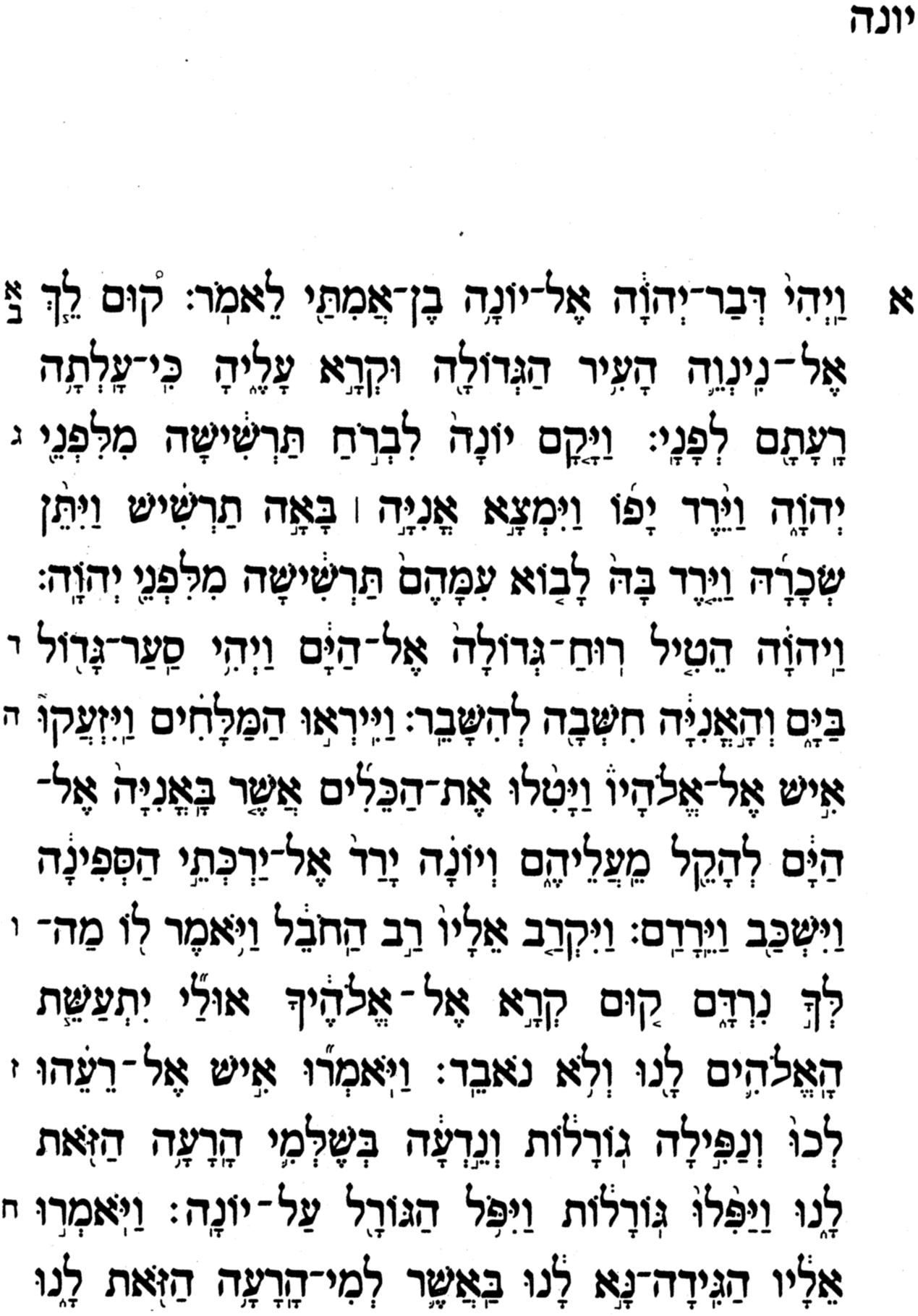
This debate has piqued my curiosity.
In a web search, I found this page:
http://www.fathom.com/course/72810016/session3.html
The Hamburg Haggadah and the Montalto Megillah, depicted at the bottom of the page (the small pictures link to larger ones) would seem to be of interest for someone wishing to design a somewhat modernized Hebrew typeface.
This article about the origin of the Koren typeface
http://www.tabletmag.com/life-and-religion/8297/prayer-type/
notes that it did take inspiration from Sephardic manuscripts.
indeed tabletmag are correct, but then again where do you think they got their info from :-)
And, in all fairness, it might be noted that the Koren face wasn't simply a copy of any style of writing in Sephardic manuscripts, but was carefully designed to reflect modern research on readability.
Thus, it ought to be easy to distinguish between something that is a copy of Koren, or based on it, and something newly done from the same sources.
It is easy :-) If only gohebrew would post this famous source of his which conveniently is either at RIT or the fleamarket (depending on the day) and is impossible to source :-)
Thanks for the post of the early version of Koren, Raphael. That is fascinating.
In spite of Israel's dreadful example on derech eretz, I have to admit that I think he has a good point on the problem of size with the Koren Bible face. I have a small size of the Koren Jerusalem Bible (roughly 8.2 x 5 inches), and do find the Hebrew visually not as readable as I'd like. And the problems may well be tight letter spacing and other adjustments as Israel mentions. I have the "Personal Size" of the Koren Siddur, 7.25 x 4.75, though it has larger size Hebrew type than the Jerusalem Bible's. Whether because of the design of the font or the larger size, I find the Koren Siddur font strikingly readable, one of the best.
According to the article on Koren:
...He based his letter on medieval Sephardi script, while giving it a modern touch....
...Koren also developed a distinct but related siddur typeface, since he felt that the one he had developed for the Bible was too sacred to reuse, except for biblical quotations....
I also found this bit quite interesting:
Unlike virtually every other Hebrew-English siddur, the Koren siddur prints the Hebrew on the left-hand pages and the English on the right. This strategy, which Koren advocated during his lifetime, is both aesthetic and practical: it means that no matter which language you are reading, you start from the center and read outward.
Makes sense!
raphael,
i have nothing now. not the rit document, or the flea market book.
it was 1989. now is 2010.
where are koren's sources? not his drawings. his sources. did he burn them?
is koren a sephardic face?
is koren an ashkenazic face?
john savard says its from a sephardic manuscript.
really?
but the askenazic books look like koren,
and romm vilna look like ols sephardic books.
is stam ashkenazic or sephardic?
brian,
how can it be a modern touch to be like an ancient sephardic script?
right size english moves from left to right. the extreme right of the 2 pages.
left size hebrew moves from right to left. the extreme left of the 2 pages.
does one eye move right, and other left, and then becomes with eyes far apart.
the koren siddur is not intended for bi-lingual use, but to pray only in one language, and later to learn the other.
does this make sense?
raphael,
where did the yonah sample 3 lines go, that you typed in koren bible? why did you remove it?
I was going by an illustration in one of your posts here
http://typophile.com/node/49385?page=1
which showed the Sephardic style as being similar to pretty well all conventional Hebrew typefaces, but the Ashkenazic style as being - at least in the first two alephs - clearly suited only to display uses. But looking at that illustration again, I can see where there are Ashkenazic elements in Koren.
Brian,
Which post and graphic do you refer?
The manner of drawing the aleph is just a beginning. I am working on an article but am still collecting much research. It's year or two away.
Excuse me, John
John S.,
Which post and graphic do you refer?
The manner of drawing the aleph is just a beginning. I am working on an article but am still collecting much research. It's year or two away.
Oh this one:
http://typophile.com/node/49385?page=1
look towards the bottom
The "sfaradi" script caught my attention, as my research showed that many Askenazic-stlye scripts had the shapes of the aleph as this one, with the right top element facing to the left, and Sephardic-style alephs with right top element facing to the right. Here is an example:
.
.
.
Does anyone have older manuscripts with either Sephardic-style alephs with right top element facing to the right, or Askenazic-style scripts with the shapes of the aleph with right top element facing to the left, or otherwise?
John Hudson, I know you have and seen many older manuscrpts with Hebrew. Have you seen this? Do you think this is an accurate distictive trait?
Israel, Hebrew on the right or left doesn't make a difference as far as the eye jumping from one side to the other, if the reader's eye jumps from the end of a Hebrew or English line to the beginning of a line in the other language.
If you jump from the beginning of a Hebrew line or an English line to the beginning of the other language—which the imperfectly bilingual reader will want to do sometimes—then Hebrew on the left and English on the right is shorter, and better.
I don't think the reader has any reason to jump from the end of an English or Hebrew line to the end of a line of the other language: he or she isn't going to learn anything that way. That would be the only situation where the eye jump is closer for Hebrew on the right, English on the left.
For these reasons, when you have pages of fully mirrored text, I think that Hebrew on the left is better. Thus I followed the Koren Siddur example in my Pirke Avot: Timeless Wisdom for Modern Life, to be published this week by the Jewish Publication Society. It has an appendix with the whole of Pirkei Avot on mirrored pages, uninterupted by commentary, with the Hebrew on the left and the English on the right. I used Hadasa MFO and my Williams Caslon Small (not yet published as a font) on the right. As you might guess, I think the Williams Caslon Small looks a lot better than the latin font used for the small text in the Jerusalem Bible :)
When the situation is mixed Hebrew and English on the same page, I think the best way to do it is a more complex decision. For example, I don't fault the beautiful new Conservative Machzor for Hebrew on the right. In the main text of my Avot, with the commentary, the Hebrew is on separate lines from the English, on the same page.
Bill,
1. >>>>> English on the left >>>>> <<<<< Hebrew on the right <<<<<
is easier line by line than
2. <<<<< Hebrew on the left <<<<< >>>>> English on the right >>>>>
1. If you start either in Hebrew or in English, your eye travels less
about half a line per line, forward
2. If you start either in Hebrew or in English, your travels more
about half a line per line, backwards
It's the same.
מודה אני לפניך.....I thank you
<<<<<<<<<<<<<<.....>>>>>>>>>>>
versus
I thank you.....מודה אני לפניך
>>>>>>>>>>>.....<<<<<<<<<<<<<<
I think you're correct, Bill
PS I thought that you gave up stone throwing.
I guess AKs can't change their ways. :)
> does one eye move right, and other left, and then becomes with eyes far apart.
hahaha.
this is the article I refer to:
http://www.tabletmag.com/life-and-religion/8297/prayer-type/
The yonah in the Koren Bible face is on another thread.
I didn't know that Koren based his font on another font. This is your theory. I know he was influenced by "Sephardi scripts" but honestly I have no idea what that means. I also know that he spent a long time with experts in readability to improve the readibility of the fonts. However, I don't know the scientific process of the late '50s so I can't really tell you if that works or not.
Regarding the quality of our books at small sizes. We have made tremendous development in the last year or two in increasing radically our production process. It's definately not there yet, but the books that we have printed in the last couple of years are of a much higher standard.
The new Koren Siddur for Israel is currently at the printers and we have just start getting in the new Shabbat Chumashim for Israel (we did USA versions of these books last year in the Sacks and Talpiot Series). I think there you can see that the legibility of the Tanakh font is much better.
However, I really do think that legibility is about what you are used to. For example in the English language, there was a period that books were printed all in italics. Today it's considered poor typography to set large amounts of text in italics, but isn't that because we are just not used to it?
Israelis love the Koren font. They think it's really really legible. So perhaps it's different for people that read Hebrew all day than it is to people who read English all day. I honestly don't know.
>> Israelis love the Koren font. They think it's really really legible. So perhaps it's different for people that read Hebrew all day than it is to people who read English all day. I honestly don't know.
To me the added differentiation, many of the angled strokes, seems like it would add legibility, just like many of the rounded forms in Hadasa. If each letter was constructed in a very rigid way, and there was very little differentiation, this would make things less legible.
I think the main reason that it's different for people who read English all day as opposed to Hebrew, is the fact that they may not be familiar with some of the forms Hebrew letters can take on. In all of the English introductions and lessens for Hebrew I've seen, they have really only used some very old Hebrew typefaces. Both Hadasa and Koren look a bit odd to many westerner's eyes, this is not even mentioning sans Hebrew fonts. I remember showing someone a Hebrew sans font, and she was saying "Are you sure that's Hebrew...? I don't know, that's really weird." So I showed her some awkyts/serif fonts, and she liked them much better. When I tried to explain to her that Hebrew, like most other languages, has a variety of styles and forms it can take on, she had the most peculiar look on her face. I do not know, but I think that is the position many people who don't use Hebrew often take.
Having found "An Annotated Bibliography of Hebrew Typesetting" by Sivan Toledo (it is on his web site that "Über hebräische typen und schriftarten" was found), it turns out it has type specimens in it, it is not just a big list of books.
At the top of page 8 I finally saw why Koren is a strange and unique typeface. On the letters He and Heth, it has a little point on the right side of the letter, making the top symmetrical. I can see that as a unique innovation.
At the top of page 13, however, an illustration of Intertype's Hebrew Modern seems to be bad news for Gohebrew (Israel Seldowitz) - apparently a Lamed with a curled ascender has been done before. (On page 15, we see that Linotype got into the act as well.)
John S.,
Do you have the link to Sivan's web site?
I claim no monopoly on a curled lamed, but created it for the Crown/Koren design first - but not first in everything. The Talmud had it too long ago.
Here is the link I posted in another discussion:
http://www.cs.tau.ac.il/~stoledo/fonts/articles.html
The one to his web site as a whole, of course, is
http://www.cs.tau.ac.il/~stoledo/
As for the curled Lamed: I wasn't really expecting that you were claiming that, but given my initial perception of what some others were claiming, I was not sure. That perception has changed, though, as I've seen that the Koren design does have some specific unusual features.
> Do you have the link to Sivan's web site?
It was on the "Über hebräische typen und schriftarten" thread. http://www.cs.tau.ac.il/~stoledo/fonts/articles.html
John S.,
In your view, do you thing Koren's unusual features are Eliyahu Koren's invention, or did he find them in other older sources.
I think that he is had a pattern of such unusual creativity, such a two or more earlier creative works, then I attribute his unusual features in Koren to him.
Otherwise, I would prefer to think that he was inspired from much older sources like other great designers.
Do you agree?
JS and Brian,
Thank you.
Have you seen any articles linking these Hebrew deigns to either Askenazic or Sephardic roots?
Readability versus Attractiveness
Earlier, it was noted by Raphael that Koren was very readable, even at smaller point sizes.
I argued it was not. Of the popular Hebrew typefaces, FrankRuehl, Hadasa, David, and the font designs of Tzvi Narkiss, Koren was the least readable, because of various factors. See above.
Brian, who is not a Hebrew reader, agreed with Raphael, for the same reasons which I cited made Koren not readable.
I think his terms are confused. A letter with many unusual features, and diagonal cuts on its ends, are attractive, and draw the attention of the eye.
According to the established theory of 'eye movement', these (details and diagonals) are factors that will show down the eye in reading, and reduce readability, although they are in deed attractive.
Raphael, I don't agree that readability is only a matter of familiarity. Nor do I think Koren would have agreed, looking at his typeface, where he took pains to increase the differentiation of Hebrew letters along the tops of letters—less familiar but perhaps promoting readability.
In Eurpoe, the all-italic style was quickly abandoned. And today, European readers are very familiar with italic, yet you almost never see a whole book of text published in it.
There has been a lot of digital ink spilled on this subject on Typophile, and while there are big differences, I think it fair to say that most agree that there are some typefaces that are inherently less readable than others particularly at small (text) sizes in extended, continuous text.
Good to know you are improving the text for small sizes.
Israel,
> henri is my hadasa
> friedlander himself approved it
> he said that it was the closest to his first drawings
really? do you have any proof?
Mr. Seldowitz,
I'm not qualified to comment on whether the apparently new features in Koren are from older sources or not. I have only begun to look into the subject, having been inspired by this controversy to do some web searching in hopes I might find something that could arguably be your lost, or temporarily mislaid, source.
What had initially concerned me was that perhaps a claim was being made that covered any calligraphic Hebrew face with reduced stroke contrast.
david,
no.
he was an old man. he died in 96. this was ten years earlier I think
i just got married in 1982. i leaned in a college yeshiva kollel.
my parents gave me a 1mb mac just after the fac mac and the ibm pc.
altsys fontographer was 1.0. they upgraded it for free to 1.1
i made queen esther. it was my hadasa. the medrash said esther's real name was hadasa.
i sent henri friedlander a check for 100 shekels. a royalty. it was peanuts.
he called. we spoke for over an hour. he was sending me the check back, because he sold the design to the amsterdam foundry. then he asked it i was a lubavitch, because my address is kfar chabad. yes. was i a dati? yes. he was quiet. i said hadasa now was accepted by all the datis. they are setting the tanach with it. then he was quiet, and started to cry a long time like a baby. he calmed down, and stated to teach me many secrets of hebrew type design from all his research. he said that my hadasa was very very good. like his original drawings. he pointed out a few flaws to fix. then he said bye.
just one phone call.
so i got the address and mailed it to them. $50.in europe. they mailed it to linotype germany which bought all the type foundries.
linotype germany wrote me a very long thank you letter for 50 bucks. i don't recall what said. bunch of bull. they just were moved and wanted to write. they asked about friedlaender. a wierd letter.
henri has many more improvements that he would be proud of, that john made to the nikkud.
i am never releasing it as a commercial font. i made it as memorial for mr henri friedlaender zal - $5,000 - 8 weights - light, text, bold, poster. light/narrow, text/narrow, bold/narrow, poster/narrow - half the money goes to charity for his neshama.
i deciding the same for Crown. $5,000 - 8 weights - light, text, bold, poster. light/narrow, text/narrow, bold/narrow, poster/narrow - half the money goes to charity for Koren's neshama.
Koren was a breakthrough, even if he neglected to name his source. like narkiss.
why am i mr. s., and not nemo's cousin, now.
i appreciate your effort. i doubt if rit will send you anything.
in a research library, the researcher does the leg work. the library for type is huge. hebrew alone are many many shelves.
the conservative judaism seminary in manhattan, and the reform judaism hebrew union college may have it as well. the same old books are their but sorted differently.
the chabad-lubavitch research library too is very huge, but the researcher must make a specific request, because every book is in cold storage for preparation.
the reform are the largest, but rit is devoted to type in particular.
i think it'll never be resolved until i do to rit myself. 10 years. 15?
I hardly know you, so I didn't feel I should do like your colleagues and fellow professional type designers here are doing, and address you by your first name. I did not intend to indicate I was upset with you.
I think I might have been misinterpreted somewhat on Koren at small text sizes.
I don't think that the Koren font is good a small point sizes. It would benefit from a "caption" version of the font, but we have no immediate plans of doing such a font.
In our new Israeli siddur which is currently at the printers, we decided to use FrankRuehl for the halakha (laws) guide at the back of the siddur since we felt that when we printed the siddur at the pocket size, the text was so small of the guide, that it would be very hard to read in Koren.
I was just saying that in general and at normal point sizes, Israelis seem to find Koren quite legible. It's hard for me, in my position of seeing the Koren font on my monitors 9 hours a day, to be a good judge :-)
A very good font in my view than FrankRuhl is a version of Hadasa or David.
I am working on an advanced OpenType font to do this automatically.
Choose 12 and up to say 36, one set of glyphs are used.
Choose 10 and down to say 4, a different set of glyphs are used.
Choose 37 and up to say 99, a third set of glyphs are used.
Cool?
Scott-Martin's will be an even better font than Hadasa or David, because it haic edges) Hadasa's widths and "blockiness", and David's simplicity (but not sharp calligraphic edges.
John S.,
No anger perceived.
I descend from BeloRussians. We know the secret of never getting drunk.
Let's make a bet.
You can have two tall glasses of tzex-an-nine-tzeker. 96 proof drinking alcohol. Not vodka. Tzex-an-nine-tzeker. And plain water.
I have a tall glass of tzex-an-nine-tzeker. 96 proof drinking alcohol. Not vodka. Tzex-an-nine-tzeker. And plain water.
We drink it in two continuous gulps. Then, the water, too.
If you get drunk, you lose. But if I don't get drunk, I win.
David and Bill can be the judges.
If you lose, you call me Israel; if I win, I call you John S.
Are we on?
lol on last post. I think he prefers to be called Israel. I prefer Brian to Mr. Z. In fact, I hate being called the name of a grocery store.
> I am working on an advanced OpenType font to do this automatically.
> Choose 12 and up to say 36, one set of glyphs are used.
> Choose 10 and down to say 4, a different set of glyphs are used.
> Choose 37 and up to say 99, a third set of glyphs are used.
I had though about this, but didn't know if it was possible? Could you show me what kind of code you use to make the features size-specific?
Not automatic is really easy.
Automatic is complicated, because there is no one tool that can do it all, and the three tools erase what the other two do.
I think the Adobe text tool can do more that Microsoft Volt, if nikkud/taam is no issue.
Right, John Hudson.
Basically, if the Adobe tool supports the OT command I think it's called SIZE, then the GSUB replaces each letter, that's it.
If the Adobe tool doesn't support it yet, or the command is limited to do something else, OT is open source/expandable, and a new command can be defined (but InDesign must support it too).
John Hudson, is this doable?
Ahh, so it's still theory. But that's how I thought it would work. There isn't a SIZE feature by default in Fontforge, which means that would have to be written in by hand. But I don't have any idea how a lookup like that could be made. It's obviously easy to make forms specific to size and then have them as subs. Making that automatic based on size, that's something I don't know about.
You can have size-specific changes to metrics in Fontforge, but I think that's limited to TTFs.
Have you used Volt?
John used the Adobe tool.
If a look-up takes a user input, like a string of "small_text", then that input sets off a different series of GOSUBs.
If a look-up takes a user input, like a string of "big_text", then that input sets off a different series of GOSUBs.
If a look-up takes a user input, like a string of "default_text", then that input sets off a default series of GOSUBs.
The question is if the font can get that input if the text is typeset in a certain point size.
Again, FontForge is like FontLab Studio.
The more advanced OT is in Volt or Adobe's tool kit. They are free.
> Have you used Volt?
Nope.
> Again, FontForge is like FontLab Studio.
> The more advanced OT is in Volt or Adobe's tool kit. They are free.
Ah, I do have the Adobe Font Development Kit for OpenType (AFDKO). Would that be it?
What is Volt? Where do you get it?
> The more advanced OT is in Volt or Adobe's tool kit. They are free.
Brian: Ah, I do have the Adobe Font Development Kit for OpenType (AFDKO). Would that be it?
Both are downloaded.
One is somewhere at the huge Adobe site. Maybe, you have it already. It works on Windows.
John Hudson knows. John, is that it?
Volt is downloaded too. Go to the even huger Microsoft.
Google VOLT for the link. You must get approved first before you can join and download. After that, you're a star.
Hmm, it had VOLT free for download. I think it used to have to be approved. For VTT you have to request it though.
What's VTT?
VTT is Microsoft's Visual True Type program, for adding hints to TTF files visually. It's for making screen fonts look better on Windows.
Now this discussed really has gone off topic, and subsequent discussion of tools and lookups really belongs in the Build forum.
Israel, I only use VOLT for OpenType Layout work, not the Adobe FDK tool. I only use the Adobe tool for hinting PostScript fonts.
Basically, if the Adobe tool supports the OT command I think it's called SIZE, then the GSUB replaces each letter, that's it.
The OTL 'size' feature is not a GSUB feature and it will not substitute different glyph sets within a font for different text sizes. The 'size' feature is very problematic, and it isn't supported in any major software that I'm aware of (maybe in XeTeX?), although you can use the Adobe FDK to define the 'size' feature in your GPOS table (but you can't mix VOLT and FDK workflows). The 'size' feature uses a GPOS lookup to store some information about the sizes at which a particular font is designed to be used, such that, in theory, an application could choose the appropriate font from a large family containing multiple size masters. It's a hack: an official hack but still a hack. It makes use of a table usually accessed late in text layout for store information that an application needs even before it determines what font should be used for the text. It should be replaced by a better mechanism more likely to be implemented by software developers. Since size specific designs are predominantly implemented as separate fonts, rather than as variant glyph collections in a font, I favour something like a SIZE table that an application could access long before it needs to be dealing with GSUB and GPOS.
Well, this discussion led me to take a close look at a number of Hebrew typefaces, and to otherwise research the subject, with the result that I modified an illustration I had made for my web page:
by improving the design of both Lamed and Qoph:
Try using shortened ascender for the lamed, and shortened descender for the kuf, nuhn, etc.
Like this:
John S.,
I see you like kabballah and different forms of gematria.
See http://www.bobdylan.com/#/user/37204 to observe the Sephirot in 3 columns. There is also a single order.
>VTT is Microsoft's Visual True Type program
Is Anyone here using VTT to hint Hebrew?
>> Is Anyone here using VTT to hint Hebrew?
I think Diane does for Microsoft. She can be reached at "Diane" .
Baruch,
Arial font is indeed very nice, especially considering that I don't see any other hebrew fonts on your website - was Arial your only one? Impressive.
And true - there was one expert opinion stating that it was an original design. There were more than ten expert opinions to the contrary (saying that Arial was clearly a copy of Narkiss Hadash).
While it is possible that you created an entirely original font that just happens to match an existing font almost perfectly (other than 3-4 characters), copyright laws still protect the original.
gohebrew: "again, bill, what narkiss did to that concentration camp victim is sick. i hope he did teshuva. his estate should give a big donation to holocaust survivors."
HOLY CR@P, Gohebrew - I have no clue what you are referring to here. Are you referring to Zvi Narkiss? Please email details to hanaan@mac.com.
Over the weekend - I have absolutely no idea why - it struck me that of the Jews I know, I doubt if 1% of them would know what a pilpul is.
Is it 2017 yet?
Captured from web.archive.org on 21 Sep 2019. view this capture