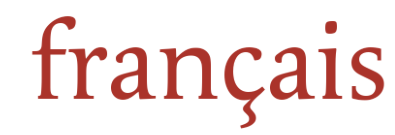
Here is a grab from Apolline by Jean-François Porchez

This should answer the "is it ever". I personally prefer when it is a continuation.
Currently working on a script font, and I've got two questions:
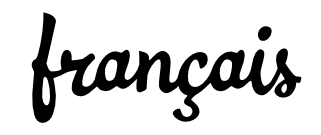
1. is ccedilla ever written with the cedilla as a continuation of the stroke? I'm thinking when the c doesn't connect to the next letter, as in ç’est bon
Here is a grab from Apolline by Jean-François Porchez

Ooooh, that's nice. Never seen it like that before.
Ever, shmever. I think what you're doing there with the cedilla is pretty cool. And I don't even like script fonts! :-)
hhp
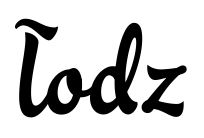
2. How children are taught to write Łł: http://www.yummy.pl/video/pl/alfabet/pl/lodz
Can you connect "wave" to /l ?
łódź = boat, Łódź = city
It looks like Łł is used in another languages: http://en.wikipedia.org/wiki/%C5%81
And I don't even like script fonts!
I've got bills to pay! I've got a similar treatment on the ogoneks but they are always endforms (never connect to next glyph)
Thanks Janek, but I'm not sure what you mean by connect wave to l. You mean the slash should touch the l? I'm thinking I'll have a regular lslash and save the script one for a stylistic set. So it'll probably never be used.
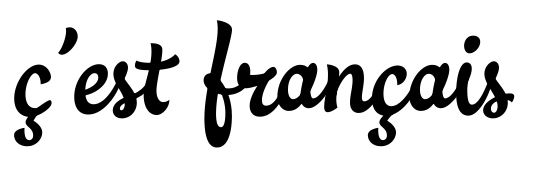
I don’t know if it’s relevant, but ‘ce’, shortened to ‘c’’ before a vowel, is written with a plain ‘c’, not with a ‘ç’, i. e. ‘c’est français/bon’.
I think I knew that somewhere in the back of my mind. I guess the situations where a non connecting ccedilla would arise are pretty few then. Still, you never know, it might be useful to someone.
Yes, the cedilla can be formed in a cursive fashion based on some kind of reversal from the terminal. However, such a cedilla should carry some of the same sense of speed and of the script style, and your cedilla shape is too slow and formal. A shape more open, like that in the Apolline example, would be appropriate.
"the slash should touch the l?" not obligatorily... but may be longer, wavy, and ascending at the end?
your cedilla shape is too slow and formal
I personally don't feel that it is too formal and I would not open it much more than this

Thanks for the advice!
Janek, is lslash ever followed by an ascender? This would make a longer slash a bit problematic.
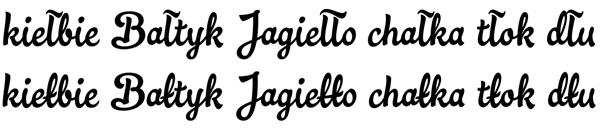
kiełbie bełt Bałtyk Jagiełło dałby chałka opałka kobiałka półka pustułka zapałka
tłok dłubać
Note that for double lslash, as in 'Jagiełło', you can use a single stroke above both letters in a script style type, handled as a ligature.
Would an italic ever be considered “scripty” enough to warrant the top slash?
With Swash caps or the quaint Discretionary Ligatures?

[lower row] ł needs a bit more room, I think. Also "slash" could be a bit more inclined - check "chałka" vs "chatka".
From the Wikipedia article, apparently most of Poland doesn't need the Ł anymore; while its sound is preserved in Eastern Poland, the rest of the country just pronounces it as a W. However, in Polish, W is pronounced as V, if I remember correctly. But then, V is also pronounced as V.
So Ł may be a casualty if Polish is ever subjected to orthographic reform.
Not exactly, John
That is the fact old-school forms of "Ł" "H" "Ó" (almost) disappeared*. But as "H" [hard h] changed* into [soft h], the difference between "L" and "Ł" is still great, they are two distinctive letters, no matter how negligently spoken.
Exercise: chatka, chałka, halka
* in the spoken language
Captured from commoncrawl.org on 25 Apr 2015. original URL