
I need to render these glyphs in a Word document, without resorting to copy/paste images as I did here.
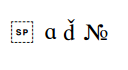
Thanks in advance for any hint
I need to render these glyphs in a Word document, without resorting to copy/paste images as I did here.
Thanks in advance for any hint

You won't be able to display the boxed SP with a font, I think.
These two are easy, and you should find quite a few fonts that support the simple Unicode characters:
ɑ U+0251
№ U+2116
The d with a hacek above is a bit trickier. This is best attempted using a lowercase d with a combining hacek mark (U+030C), but software may normalise this as U+010F -- ď --, which has a different form. This is because this is the conventional display of d+hacek in two European orthographies that use the diacritic, Czech and Slovak.
>> You won't be able to display the boxed SP with a font, I think. <<
But how this character and many other boxed characters were printed in this Unicode code chart ?

Using a specialised font (and since you can’t copy the content to check, they could really be any character).
Yes, the Unicode glyph charts make use of specialised fonts to display visual representations of control characters and other normally non-visible entities. They are also built using a custom piece of software, which means they avoid the default layout behaviours of typical text processing apps when dealing with these characters.

The d with a hacek above is a bit trickier. This is best attempted using a lowercase d with a combining hacek mark (U+030C), but software may normalise this as U+010F -- ď --, which has a different form. This is because this is the conventional display of d+hacek in two European orthographies that use the diacritic, Czech and Slovak.
Try U+0064 U+034F U+030C -- works with some fonts (e.g., Calibri, Charis SIL, Doulos SIL).

You won't be able to display the boxed SP with a font, I think.
Well, there is the SYMBOL FOR SPACE Character (U+2420) “␠”. Its look depends on the typeface.
I see it in Arial Unicode MS, Lucida Sans Unicode and Apple Symbols on my machine.
Great suggestions. Thanks to all of you !!!
1. John, I want to assure you that before posting the question I spent almost an hour trying to find the character ɑ U+0251 in the code charts, to no avail.
2. Bob, the trick with the Combining Grapheme Joiner worked beautifully in Calibri.
3. Ralf, unfortunately the characteres U+2420 and U+20DE (COMBINING ENCLOSING SQUARE) don't combine in Arial Unicode MS. In Lucida Sans Unicode, the glyph for the character U+2420 (␠) is even better, but the font doesn't have the code U+20DE.

Get Hrant to design a special font…
Captured from web.archive.org on 11 Aug 2014. view this capture