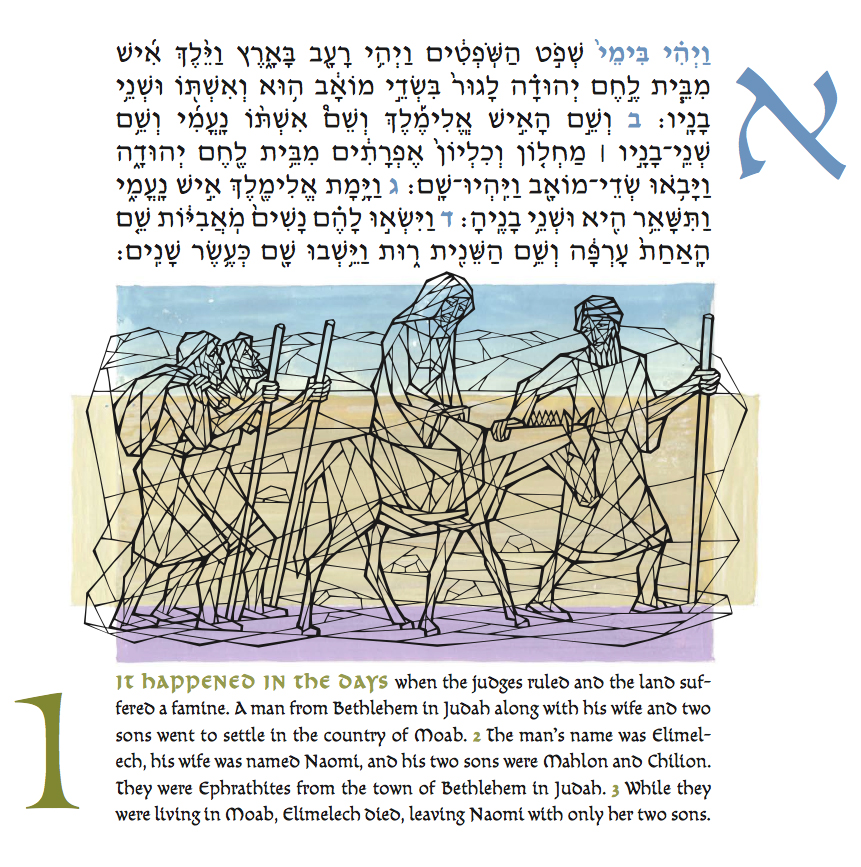
David Hebrew may seem like old news: it happens to be one of the most ubiquitous Hebrew fonts. Everyone has David Hebrew in some form or another installed on their computer (David on Windows, Raanana on Macs). In my recent book The Book Jackets of Ismar David I touched on what made David Hebrew so popular:
"Scarcity of good quality Hebrew type compelled David to embark on his quest to create a new typeface. His work began in 1937, and culminated in the 1954 release of David Hebrew by Intertype Corporation in Brooklyn, N.Y. David’s groundbreaking design was not a revival of an existing type, but was inspired by historic calligraphic hands, distilled to their purest expression. David Hebrew went on to become one of today's most popular Hebrew typefaces and may well be considered Ismar David's most recognized legacy in design. Its success may be attributed to the innovative design approach, but more likely it is due to its clarity, grace, and exceptional beauty."
While all existing versions of digital David Hebrew are at best lookalikes of the original design, David Hadash™ (Hadash means "new" in Hebrew) offers a faithful digitization of the original drawings, preserving the subtlety and better letterfit of the metal type design, subsequently lost in multiple generations of redrawing for new typesetting systems. This type is for the first time issued as a complete type family envisioned by the designer in the early 1930s, but never fully realized until today. It includes upright (called Formal), cursive (called Script) and monoline (called Sans), each in three weights, as well as extended character set for the upright (called Biblical), including a full set of cantillation marks (te'amim).
It should be noted that the cursive (first issued in one weight by Intertype in 1950s) was the first true cursive Hebrew type of the 20th c. The never-before issued sans is noteworthy as one of the very few "humanistic" Hebrew sans types, closely following the classical proportions of the upright "serif" design.
Despite having been designed over half a century years ago, the appearance of this long-awaited family today is remarkably fresh.
Upd: See the official announcement here.