
Dear all,
we have a new Riqa in dev... It is displayed in fine way within WinWord... However, it has many problems with Adobe InD...
Some ideas/solutions?
http://typophile.com/files/roqa-1.jpg
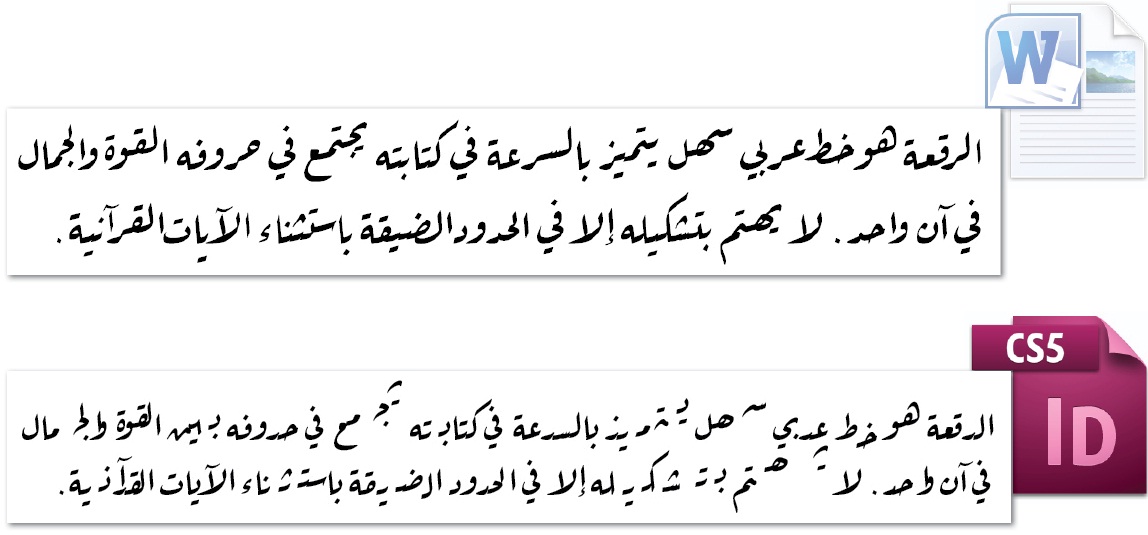
Thanking you in advance...
Oussama
Dear all,
we have a new Riqa in dev... It is displayed in fine way within WinWord... However, it has many problems with Adobe InD...
Some ideas/solutions?
http://typophile.com/files/roqa-1.jpg
Thanking you in advance...
Oussama

You know that InDesign doesn't support Arabic out of the box without some special tweaking, right?
http://www.thomasphinney.com/2009/01/adobe-world-ready-composer/
Cheers,
T
Many thanks Thomas for your feedback. However, we use ME products... so we should not limited for any feature... )-:
By the way, have you a copy from the FontShop document, it seems that it is not anymore available...
Many thanks in advance,
Cheers,
OR

As far as Arabic Font/Text is concerned, there is no alternative to the Mother of All Softwares + plugins:
http://typophile.com/node/48495
As easy to use as frying an egg!
All the Best with Flowers
Thanks Aziz, but we are looking for mother-free solutions... You know that we entered in the freedom era...
All the best with Edelweiss flowers...
http://www.edelweissgrowers.com/
OR
1. Free M$ + Adobe products?!
2. Freedom era or Chaos?!
I am asking for technical help to develop the font independently from software, like any font developed for ex. by Monotype and Linotype... I want to be software free!

I fully support open architecture solutions. The arabic font sector is highly deficient. However, the Arabic market dynamics don't really encourage developing 'open' type. I wonder what your marketing plans are.
Your design is quite nice, and I am personally very interested in the Ruq'a style. I think it is the ultimate in cursive handwriting. This arises from the exceptional economy in the letter forms and the exquisite balance between catenation and separation that is inherent in the Arabic script in general.
Ruq'a is also a strong and dynamic style that was useful in writing newspaper headlines. In my article here, I showed how print technology and the development of the Al-Harf Al-Jadeed font for the Linotype swept away Ruq'a from the headlines. Solutions like yours might lead the way for a Ruq'a comeback.
Please do proceed with the development of your font, and I hope you will find a solutoin for the InDesign compatibility soon.
Khalid
Many thanks Khalid... We start to find a good solution for our technical issues and I hope to provide the nice outcome very soon...
Our marketing plan is "very special" as we are connected to media and publishing groups. We are able to use our fonts directly in final products that you can see in the Arab/Arabic language market...
Although we are committed firstly to our classic khatt, we plan to produce old and not-copyrighted fonts in opentype versions (Arabic Font Revival Program)... keep tuned
Oussama

Oussama,
it looks like you probably have problem with the glyph alternates replacement. Try posting the question in the Typophile Build section, with a part of your code.

Some ideas:
Which version of ID ME are you using? Cursive attachment positioning support was only added in CS4.
Do you have any custom kerning defined in the InDesign version? I've found that applying kerning between non-connecting Arabic letters will break nearby OpenType cursive attachment.
Is justification turned on? What happens if you alter justification settings?
@froo @ John Hudson :
Many thanks. The font is tested with InD CS5 as displayed in the image.
The issue was solved and InD interact very well with the result. Actually, InD does not accept the multiplication of the same glyph in different cells but MS products say nothing for this multiplication.
I hope that I can propose the result very soon. :-)
New InDesign sample... As you can see, it works!
Other samples will be available soon...
Please do not hesitate to contact me if you need any information or have any comment.

Congratulations!
I hope your Roqa will be uploaded somewhere for free down like:
http://www.crulp.org/software/localization/Fonts/nafeesRiqa.html
Though I am more after text than headline fonts, I will try to combine the 2 to come out with a dynamic + unique roqa font for our Arabic Calligrapher.
As I always emphasize, Arabic fonts are useless unless made dynamic.
All the Best with Flowers
LOL!
This Nafees Riqa is free because it couldn't have a better value!
Anyway, The developed Riqa will come in different aspects & weights: for headlines, for text and also in an extended version...
We will publish some samples on the next week during the Fourth International Symposium for History of Printing and Publishing.
I would like to see one of these 2 words included in your samples:
لمحجوبون لمجموعون
I wonder how they will appear in the different aspects & weights: for headlines, for text and also in an extended version!
Thanking you and awaiting for the outcomes of the Fourth International Symposium for History of Printing and Publishing.
Latest News: Innovative Roqa by Sultan Maktari from Yemen.
http://sultanfonts.com/
http://sultanmaktari.blogspot.com/
http://www.aratypo.net/forums/showthread.php?t=576&p=1250#post1250
Attached images speak louder than words.
See also:
http://typophile.com/node/85632

Hi, Aziz
This is what you asked before:

Thanks Badr Oraby.
Have you discussed the rivers of white spaces caused by the font?
How are you going to get rid of them?! By:
1. Single or multiple line-spacing?!
2. Manual or auto kern?! And/or:
3. Alternative Glyphs + Ligatures?!
The Alternatives in Ruq'a - In traditional - is not so much, you only can use the ligatures and sometimes you have no choices to change it.
But still, There are several ways to handle the spaces, such as Kern.
Badr
> But still, There are several ways to handle the spaces, such as Kern.
Alternatives: null to zero?!
Kerning : Manual or auto?!
How else?!
Kerning : Manual or auto?!
We speak about opentype font, so,
Do you know an opentype font uses the manual kerning in simple text editors like MS Notepad or Mac Textpad ??
And what about MerEmad, does it??
The Microsoft Arabic shaping engine has the OpenType Layout kern feature on by default, so you will always get kerning for Arabic script in any application using either Uniscribe or DWrite for layout. OpenType kerning can include contextual lookups, which is useful for this kind of Arabic, although the lookups can get very numerous if you want to really refine the spacing between lettergroups of different shapes.
@ Badr Oraby,
In MirEmad + QalamBartar, auto kerning is carried our for the high frequency lettergroups , but for the low frequency lettergroups , you can do manual kerning inside M$ Notepad, Wordpad, Word 2003-2010, IndesignCS5, PhotsShop + Illustrator + PagePlus X5 ++
God willing, both software will be available for Mac Users, by the mid of 2012.
You can do Auto Kerning as mentioned by John Hudson, but that is a fix-one-bug-create-more process, and I am afraid you keep answering the Roqa-thirsty fans with Work-in-Progress message, even after the Tenth Fourth International Symposium for History of Printing and Publishing.
Hoever you can do ONLY Manual Kerning + ONLY in IndesignCS5?!
The Choice is yours.
Captured from web.archive.org on 30 Jul 2018. view this capture