Typophile

Mono(poly)type

The capture this came from was cut short by the archive that made it, so the text may be incomplete.

Ascender Corp. Acquired by Monotype Imaging:

http://www.ascendercorp.com/pr/2010-12-08/

Update 10.Nov.2011, (part of) Bitstream (MyFonts included) Acquired by Monotype Imaging:

http://typophile.com/node/87262

Wasn't Ascender started by refugees or defectors from Monotype? What's the story behind the story here?

Ascender was formed before Agfa sold Monotype Imaging. Perhaps the Ascender founders were trying to avoid visits to Belgium. :-)

Arial + Comic Sans Rebus FTW!!!

I have no immediate plans to cash out.
So the monopoly will have to wait.

And here I thought someone was trying to identify Kabel.

LOL.

I'd sooner have guessed (Bhikkhu Pesala's) Kabala in that case.

Buy your Comic Sans 2010 now from Monotype Imaging!

Will there still be April fools jokes?

So every designer or foundry with Ascender contracts will be now a part of the big Monotype univers.

Guess that's the risk of going with the Times.

Inertia is an easy course of action.
However, I would imagine that most contracts have cancellation clauses.
Or may be renegotiated.

Monotype House
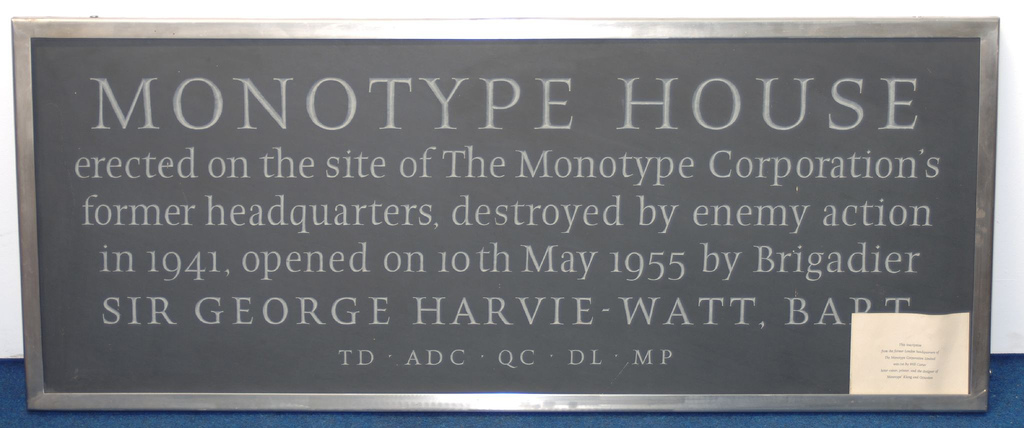
I'm curious, what do formerly-Bitstream's people in Noida, India do exactly?

hhp

The "If you can't beat them, buy them out" policy which has been so successful with the banking industry and airline industry seems to be also working quite well to keep the type industry equally healthy.

Looks to me like we now have three categories of foundries: 1. the non-designer owned foundries—now only one; 2. The foundries associated with primarily non-type companies—Adobe, Microsoft; 3. Designer-owned foundries.

Pretty soon, my mortgage, my bank, my airline, and my type will all belong to the same company :-/

>Pretty soon, my mortgage, my bank, my airline, and my type will all belong to the same company :-/

The United States Federal Government? Don't forget your auto-maker.

Nope. MicroAppleSoft.

Nope, "The 1% of the 1%"

Si,

The Chinese Government is far more likely than the U.S. Gov ;-)

After giving this a lot of thought, I think the only way to move forward is for type designers to unionize. The problem will be getting all the dead type designers to join. I think the Mormons may have worked out a solution for that but I'm not entirely sure.

Comrades, are you with me? ;-)

You remember TyD, right?

hhp

Well, at least the impending merger puts to rest the question of "Who's your Daddy?"

So $50 million for Bitstream, really MyFonts. Given the multiples that these sales usually work on, that means MyFonts is generating around $13 million a year. The real question, is who is going to buy this Monotype/Agfa/Linotype/ITC/Ascender/Bitstream amalgamation?

It is all venture capital so I can't imagine it will stay in current hands for long. They are interested in making money, not licensing type.

Si, Perhaps just a coop would be better. We make an online setup like MyFonts and each contribute a fair and reasonable percentage for operating cost.

@James,
Donald Trump :-)

The real question, is who is going to buy this Monotype/Agfa/Linotype/ITC/Ascender/Bitstream amalgamation?

That’s an interesting question. Bill Gates does not seem interested in developing the type business that Corbis acquired when it bought Veer. Steve Jobs could have done a bang-up job, but he is out of the picture. I think it’s more likely to be a small purchase by a massive holding company that wants a small but steady stream of revenue that is relatively insulated from local economic shocks. But I’m not a business guy, so my guesses would just be the obvious mammoths like Bain or Berkshire, and they’re to big to bother.

Si, Perhaps just a coop would be better. We make an online setup like MyFonts and each contribute a fair and reasonable percentage for operating cost.

Something like Vllg, but without the focus on mammoth families and editorial faces, might be a good idea. But is there someone out there who really knows how to put that together? If most type folks were great at digital retail we wouldn’t have hooked up with MyFonts to begin with.

The folks who started MyFonts are out there, James.

The folks who started MyFonts are out there, James.

But have they expressed any interest in starting another online font store? When they cashed out did they contracts they signed prohibit them from even doing so?

I anxiously await to hear the presidential candidates weigh in on this topic.

The Texas Gov does not remember the question; The WackJob lady is too busy getting her face tightened; The GodFather guy is booking time on Maury; The Geezer has wax in his ears; The other guy is just waiting out the competition.

> The folks who started MyFonts are out there, James.

Chris,

the folks who started MyFonts are still at MyFonts, and I don’t think much will change in that respect :)

It’s already about 7-8 years ago that a couple of the original team members left the project and since then, MyFonts hired some new people, but practically all of the original team members are still with MyFonts. I joined the team some 9 months after the project’s inception and have been working for MyFonts for 11 years now — and I don’t intend to go anywhere.

(One person whom we do miss indeed, and owe a huge lot, is Charles Ying, then-Bitstream Chairman who came up with the MyFonts idea and nurtured the project from its early years. He passed away in 2010.)

Remember, when MyFonts started, there was much trouble in the air because of the fact that it was Bitstream who started the project. Back then, Bitstream was considered the “bad guys”: “the knockoff boys who almost killed the industry for bundling 900 fonts with Corel Draw and selling a 500-font-CD collection for $50”.

I try to judge people based on the quality of the work they do, not based on the labels they carry. When I was joining the MyFonts team in 2000, it was important to me that Bitstream showed its intentions to “clean up its licensing mess” — and they did. (2003 was the final round when they signed licensing agreements for some Linotype designs — which Bitstream still sold under different names, but the designs were finally licensed).

From what I’m hearing from the new owners, one of the main reasons why they paid $50 million for MyFonts was because they found our project to be successful, and I like to think that one of the key factors behind its success has always been the team (I think they mentioned that, too).

After 11 years now, I can say that it’s by far one of the best teams I’ve ever worked with, or heard that anyone’s worked with. The MyFonts people are dedicated, focused and show amazing work ethics (by my standards anyway). It’s also true that we’ve enjoyed great autonomy and freedom in running MyFonts.

I for myself cannot imagine “starting another online font store”. So far, MyFonts has been the place where I could see my best and sometimes craziest ideas come into existence. The spirit and chemistry among the team has been just mind-blowing (without exception, for 11 years — beat that!), and I expect this to continue the same way.

What’s important: Monotype says that they recognize the way the team operates as a key factor behind MyFonts’ success, so I’d be rather surprised if they decided to suddenly change things. Of course, we shall see how it goes — but I don’t really think the question would be any less open if anybody else acquired MyFonts (say, an investment bank or whatever).

In a sense, while I did recognize the fact that Bitstream was MyFonts’ owner, that fact never was of paramount importance. Had MyFonts been owned by Monotype or whomever else from the very beginning, I guess the same would have been true.

Economic theories say that monopolistic developments are not good for the market because they slow down innovation and make people lazy. Well — at least from what I’ve learned from working with the MyFonts people for 11 years is that those folks are anything but lazy or lacking innovation.

Dunwich Type writes:

> When [the folks who started MyFonts] cashed out

The folks to cash out would be Bitstream shareholders. Bitstream has been a publicly traded company for a long time now. If *you* had bought any shares, you’d be one of those to cash out, I guess. Not sure, however, whether the Bitstream shareholders are the ones whom Chris is referring to as “the folks who started MyFonts”. The MyFonts team consists primarily of employees of the company as well as consultants (such as myself). And most of us were in their early 20s when we started the project.

One thing is certain: consider that Monotype Imaging bought Linotype for $60M and MyFonts for $50M (a rather comparable amount). I still remember the times very vividly when we hit the first 1,000,000 purchases, or when MyFonts broke even financially. It’s amazing that within ten years, the humble work of not much more than a dozen people helped generate this value, and that I’ve had the privilege to be part of it almost from the very beginning.

So — let’s get back to work. As usual, there are many amazing things that we want to do!

(Incidentally — I do have quite a few good friends and colleagues within Linotype and Monotype, so actually I am glad that I’ll probably have more chances to talk to them and work with them. Monopolies aren’t very welcome but fierce competition can be as damaging.)

Best,
Adam

"Not sure, however, whether the Bitstream shareholders are the ones whom Chris is referring to as “the folks who started MyFonts”

Adam,
I was referring to the people who did the work as a labor of love hands on, not the investors. I have no problem with the much needed investors and greatly thank them but they were not the ones to whom I referred.

James writes:

> They are interested in making money, not licensing type.

Are these mutually exclusive things? So far, I’ve had the naivety to believe that the point... Oh, wait. Where’s that Google Web Fonts and open-source discussion again? ;)

It’s amazing that within ten years, the humble work of not much more than a dozen people helped generate this value

Well, and the work of the participating foundries, of course!

> Well, and the work of the participating foundries, of course!

Absolutely! This is why I wrote “*helped* generate this value”. The foundries did all the hard work anyway, and truly are the ones who generated the value. We’ve only provided a platform for typefaces to be discovered, enjoyed and licensed.

Chris,

> I was referring to the people who did the work as a labor of love hands on

Thank you, that’s what I thought you meant :) Well — in that case — those folks have been with MyFonts, and are with MyFonts. Different investors now. Same hands on!

They are not mutually exclusive things at all. I'm thinking about companies like Bertelsmann, Disney, Universal etc.

King of all media...

I think it's funny that every time something like this occurs, it's reported that all the people in the company acquired won't be going anywhere. Everything will stay exactly as it was.

Richard,

Actually, the press announcements in this case tell a different story. Monotype did not acquire Bitstream as a whole but the font business including MyFonts, along with some things like patents trademarks. Other parts of Bitstream's business (Bolt, Pageflex), remain in a separate company. I think it's useful to know who's joining Monotype and who will go to the other company (which will no longer be called Bitstream since AFAIK the Monotype acquisition included the rights for the Bitstream name, which of course makes sense since that name has been used extensively in the context of the Bitstream font library).

So for "all of Bitstream", not everything will stay exactly as it was, and I wasn't under the impression that it's been reported in a way that would suggest that it would.

Best,
Adam

"
Dear MyFonts:

Regarding to latest news about Monotype will be acquiring the font business of Bitstream. I can just hope that MyFonts' services will stay as fast as they are now.

Posted on November 11, 2011
MyFonts says:
It's all good. Monotype intends to keep the MyFonts team and our method of operating exactly as it is today.
"

Thanks for the clarification Adam. I didn't mean specifically this acquisition it was just meant to be an offhand observation. Companies are always concerned about alarming customers fearing changes to come. (If things are going fairly well, that is.)
But I did not make that clear. I did wrong, frankly. I went OT, in a fashion.

But my mistake did prompt you to clarify a bit, and that's a good thing, so thanks.

Yesterday, I had a type designer - who shall remain nameless, but is very much in the mainstream, not libré - tell me that he thought this new entity was truly a Monopoly with a capital M. (Not makin' it up just to be provocative. There seems to be some nervousness about this and what it means for font distribution, at least in the short run.)

Got thoughts?

I would be concerned if MyFonts were to stop passing on the email addresses of its customers to its suppliers.

It will be interesting to see if Myfonts web font licensing model can coexist with Monotype's.

>It will be interesting to see if Myfonts web font licensing model can coexist with Monotype's.

Well, Monotype does provide self-host options, but it's not surprising that they promote the service model. If Bitstream had ben able to invest in developing their own web font service then my guess is they'd have been promoting that option too.

Quiet day.

>Quiet day.

Well put #2. Or is FSI #2 now, and FBI #3? ;-)

I like quiet days. The last couple was pretty crazy for me. Little did I know what I signed up for when I took on the role of managing type designer and foundry relationships here at Monotype Imaging. :)

Like many others, I have the utmost respect for the MyFonts team and the dynamic font community they have built – and I echo Adam’s comments about looking forward to the opportunity to work together to grow and support that community, and to maintain and strengthen the MyFonts.com.

Adam: The foundries did all the hard work anyway, and truly are the ones who generated the value. We’ve only provided a platform for typefaces to be discovered, enjoyed and licensed.

So how much of that $50 million is going to be shared with the people who generated the value that Bitstream are now cashing in on?

@jh

"So how much of that $50 million is going to be shared with the people who generated the value that Bitstream are now cashing in on?"

Bravo, John. You're consistent, I have to hand that to you.

Yes, why weren't the type designers in for a piece?

Why do the credit card companies make more per download on a song than nearly all recording artists do?
(This is factual.)

Why doesn't the assembly line worker at an automobile plant get a percentage of the sale and subsequent sales of the car she worked on?
(Not bizarre. Just never done. Why not structure compensation that way?)

Because the system was and is set up another way, and it was never challenged.

BTW - I feel bad that Bill Davis - who I like, personally - is stuck with the job of delivering the post-acquisition blather. Yuck.

...the system was and is set up another way, and it was never challenged.

Wasn't it?

John,

Unfortunately, I’m not able to answer your specific question. However, I’ll try to help. First, let’s have a look at how companies work, in a somewhat simplified model:

1. You want to set up a company.
2. Usually, you need money to finance your operation. That’s called capital. You find capital: either you invest your savings (in which case you’re the owner, i.e. sole shareholder or stockholder), or you take up a credit at a regular bank (in which case you’re also owner but have a credit running that becomes part of your expenses — but we’ll get to that later), or you sell shares aka stocks of the company (then you have other shareholders/stockholders, i.e. co-owners).
3. You can offer the shares to an investment bank, in which case it becomes the shareholder or co-owner of your company. Or you can sell the shares to some selected individuals. Or you can offer them for public trading (so-called IPO).
4. You set up a business model. You have expenses and you have revenue. If you’re selling some vendors’ products, you typically offer the vendors a deal: a part of the revenue (your first expense) goes directly to the vendors.
5. The other part of the revenue (your commission) covers your other expenses: office rent, revenue taxes, reserves, investments, payroll for employees, consultants, payments to contracting companies and other “cost of operation”.
6. The revenue minus the expenses equals profit. You perhaps pay some taxes off the profit, and then you distribute the profit to the shareholders (i.e. owners) as a dividend.
7. As long as your company is a publicly traded company, anyone with some spare capital is free to buy the stocks from existing shareholders who are willing to sell them. At any time, employees, consultants or vendors can become shareholders as long as they buy the stock.
8. You continue to run your business as long as you decide to do so.
9. If you decide to stop running the business, you negotiate with your shareholders a potential sale of the shares, and negotiate with prospective buyers.
10. If the negotiations with both parties work out fine, the transaction happens: the buyer acquires the shares from the shareholders (i.e. owners), and becomes the new owner. The former owners i.e. shareholders receive a payment.

To sum it up, there are typically three groups (roles) of people who contribute value and receive money in exchange while a business is running:
a) Vendors contribute their goods and receive payments as part of the business deal outlined in item 4.
b) Employees and consultants contribute work, contracting companies contribute services, and they all receive payments as part of the item 5.
c) Owners i.e. shareholders contribute capital, and they receive payments as part of item 6, and — should if items 9 and 10 occur — as part of 10.

As I wrote above, the roles listed above can be interchangeable: vendors, employees, consultants or contracting companies are free to become co-owners or shareholders as long as they contribute capital. If they do so, they become recipients of the payments in items 6 and 10.

> So how much of that $50 million is going to be shared with the people
> who generated the value that Bitstream are now cashing in on?

If you’re a shareholder of Bitstream — which has been a company traded publicly in the U.S. (NASDAQ symbol "BITS") — I assume that there are appropriate channels where you can find it out. I’m not a shareholder of Bitstream and am not involved much in stocks trading in the U.S., so I cannot answer your specific question.

Some information about the acquisition can be found in the Bistream press release and the Monotype Imaging press release. Also, according to Google Finance, Bitstream currently has a market capitalization of approx. $57.7M. You may also find the SEC 8-K filing summary or the actual SEC filing materials (1 | 2) interesting.

But I hope I was able to clarify the issue a bit, and provide you with some pointers to where and how you can find more information! :)

Best,
Adam

Hey yo, I'd like to take this opportunity to give some well earned kudos to Monotype Img.. I own a successful company (it was two separate companies but I merge them into a single company, but still feels like two for me. First one I started in first year uni way back in '91) so I know a thing or two about survivability.

TYPE is up three bucks from their common share IPO - is that about right? And a healthy market cap to throw around town too. That's pretty good in today's environment - so ya kudos for building a solid day job!

So how much of that $50 million is going to be shared with the people who generated the value that Bitstream are now cashing in on?

Why would I expect a cut from my distributor when that business changes hand?

It's their business, not mine, which I still have.

It could also be said that Bitstream has generated a large part of my business's value, as a major distributor—and I don't intend to share any of its value with them.

However, IMO fonts are worth considerably more than three times annual revenue, which is a rather generic or default multiplier.
But you get what you can, and that goes for both parties involved in the deal.

Quiet and peaceful day too. What piece? What system? What's blather? ;)

So what major foundries are left after Bitstream's assimilation? All I can think of are Font Bureau, P22 and Berthold...

Thank goodness that is all you can think of.

@mjkerpan

There are over 300 type foundries in my bookmarks directory… A substantial percentage of those sell their own products. So… not all are major, but together they probably equal the new MT-entity.

Adam, I know how corporate capitalism works. As you may have noticed, Tiro tries to operate in a different way. I believe -- doubtless to my own financial detriment -- that the people who create value should share in the returns on that value to a proportionate degree, and that one shouldn't seek to profit from the labour, skill and creativity of another person except insofar as you add value to what is produced (a distribution system adds value, for instance, but is of its nature secondary to the production of the thing distributed). So when you acknowledge that 'the foundries did all the hard work anyway, and truly are the ones who generated the value', I'm bound to ask what share those value-generators get of the income from the transfer of ownership of that value. I know they probably won't get any, because Bitstream -- like most companies in the capitalist system, as you describe -- is set up in a way that rewards people who have had no direct hand in the creation of the value, but have only wagered on the ability of the people who have.

Meanwhile, here we plug along trying to make good things and sharing the profits among the people who contribute their labour, skills and creativity, 'cause that's how we roll.

> However, IMO fonts are worth considerably more than three times annual
> revenue, which is a rather generic or default multiplier.
> But you get what you can, and that goes for both parties involved in the deal.

Nick,

please note that according to the current NASDAQ stats, Bitstream’s current total market capitalization is some $57.7M. Total market capitalization means: the total price which the market participants would be willing to pay for all of Bitstream’s stocks. In recent times, the BITS stock price was on a slight declining course, with no major changes. Of course the “total market capitalization” is a bit of a fictitious value because if the stockholders offered all the shares for sale on the open market at the same time, that price would not be achieved. But given that the Monotype merger has not covered all of Bitstream (i.e. the Pageflex and Bolt businesses are being spun off), the $50M sum seems rather close to the stock value.

So — while I don’t really have any actual knowledge about this whatsoever — it seems to me that the price paid at the merger has simply been a fair reflection of the current market value, not necessarily based on the annual revenue multipliers. In that respect, I don’t see anything “sensational” (either way) happening.

Best,
Adam

MyFonts does not have exclusive access to the value font makers add to its business. And the value goes both ways. The value to MyFonts to me, as a font producer, is its excellent website and customer base. I signed an agreement with them where all the terms were spelled out, and I don't remember seeing anything in it about paying me some kind of bonus if they changed hands.

I love MyFonts and I just hope they can keep doing what they do so well.

@John: (a distribution system adds value, for instance, but is of its nature secondary to the production of the thing distributed)

It does way more; in the case of MyFonts, it has enabled a great many foundries to be founded and create fonts, which wouldn't have existed otherwise. MyFonts type tester, which shows OpenType features, has been a stimulus to the production and dissemination of OpenType-featured fonts; and if I am wrong about its primary agency, at least it is part of the economic micro-system which furthers that cause.

…the price paid at the merger has simply been a fair reflection of the current market value, not necessarily based on the annual revenue multipliers.

If that is the case, the market has been distorted by the relative size of the players here—in particular Monotype, which has a strong negotiating position due to the lack of other potential purchasers.

Surely a typeface that pulls in revenue over many years should be valued on that basis.

Fair points, Mark and Nick.

I wonder if Bitstream will continue to have the fiction of an independent existence a la Linotype and ITC or if it will simply assimilated into the Mono-borg.

I like Hudson's link. "This video kills fascists" it should say. Cool. The union movement is given short shrift these days, and that's unfortunate.

The value of creating markets, which Mark and Nick point to is only one problem for Marx's labor theory of value, which you have alluded to, John. While it has a moral appeal, it has never worked as an economic theory. For example, in order to price your fonts you would have to include the labor of all those involved in inventing and producing your computer, the software, the internet, the books you've read etc., etc. Nobody has ever made it work. Making capitalism more just and human is a crying need, but for anything that will actually work, I think you'll need to look elsewhere than Marx.

>wonder if Bitstream will continue to have the fiction of an independent existence

Interesting choice of words. Would you consider the Audi, Bentley, Bugatti, Lamborghini, Porsche, SEAT, and Skoda brands fictional because they are part of Volkswagen AG? If a brand has value it will be retained.

Unless that brand is called "British Leyland" :-)

*puts face in hands* . . .

Bill, I don't think I alluded to Marx's labour theory of value, although I think its 'moral appeal' lies directly in the common sense appreciation that value is created by labour and, although the total value of a thing cannot be calculated from this basis, to deny it is, at least, morally unappealing.

I'm not looking for an economic theory, I'm looking for a way of doing business that puts profits into the hands of the people who make things: not instead of into the hands of people who finance things, but more equitably distributed, so that capital -- and its corollary, power -- is concentrated in fewer hands and more people can have a greater say in how their lives are organised and to what end. Capitalism left to its own devices will never become 'more just and human', because neither justice nor humanity are its concerns. When individual capitalists behave in ways that are just and humane regardless of the effect on financial return, they do so contrary to capitalism, out of personal beliefs that are, at best, orthogonal to capitalism and frequently in opposition to it. Such beliefs can be a starting point for reform, but only widespread structural change is going to humanise economic activity. I believe this structural change should subsist in worker ownership, whether directly (roughly how we run Tiro), through cooperatives, or in joint ventures (there is a successful pulp mill near here that is jointly owned by the workers and a group of private investors). Where such businesses have been established, they compete in the same market as capitalist businesses, which is ample evidence that commercial activity is not reliant on the capitalist class, that the free market may be just as free -- or more so -- without them.

Eighty years on, Quadregismo Anno remains pertinent reading.

@db

Surely you remember Gracie Slick's song lyric, "Blather was thirty years old today."

Oh, yeah, it was "Lather". Sorry.

MyFonts foundries just received a new email explaining the acquisition. The line that I find troubling is:

"When foundry contracts come up for renewal, we will of course revise the contracts to reflect the new ownership."

Perhaps that's just the "official" way of saying they'll change the name and address on the top of the page. "reflect the new ownership" sounds more technical and serious.

But the fact that you're reading into things of that nature doesn't bode well for them.

Check out Fontspring, or one of the other smaller distributors. They're just as web-savvy, commercially ambitious, and certainly as innovative as myfonts.

Nothing lasts forever - especially market dominance on the web.

Nothing lasts forever…

But “Trajan” is giving a good impression.

But Nick, Trajan really is etched in stone ;-)

Chris, that essay also points out that royalty rates will not change, if that is what has you worried.

"...also points out that royalty rates will not change"

I hope you are right in your interpretation, James.

John,
In a post-industrialist service-oriented society, how do you define “making things”? Isn’t a website, a database, a user interface or, more abstractly, a user experience, also a “thing” that somebody has made, and invested a lot of know-how and time and creativity into? What people get for their money when they visit a website is not just this “thing” called a typeface or a book or a toaster, it is also their buying experience, the information provided, and perhaps quick and good service if something goes wrong. A distributor like MyFonts offers these things and seems to do a good job at it. Is it part of the product or isn’t it? It seems to be part of the reason why people come back, so it’s part of what people are willing to pay for. If a designer/foundry is not very interested in providing all of that, then they can either try to sell their “thing” as is, without the same quality of experience attached; but they might be doing users a disservice, or simply not reach any users. Or they outsource that part of their product, and pay a commission based on the success of the service (i.e. sales). Why would producing this service at a mutually agreed price be in any way unethical or redundant?

You seem to argue that service is, in any case, of a lower order than “things”. I don't want to get into that. Much of my work is a hybrid of both; and I think that valuing the part of my work that results in something tangible higher than the part that results in somebody smiling or nodding, would be … counter-productive.

Btw, a typeface also has an abstract component. It implies, or provides, a user experience which can be good or not so good. This is independent of its actual drawings, the stuff that you can see and almost touch and that makes it most similar to a “thing”. In fact, that part (OT programming, Unicode compatibility, etc.) is quite similar to user interface programming. Less thing-ness, but just as crucial to the experience. Which takes me back to my initial question: define “thing”.

John, there are a lot of questions that are important and too demanding to get into depth here, aside from the fact that I'm not knowledgeable enough to do it well.

But two points anyway. One of the discoveries in my wife's book Success in Agricultural Transformation is that the Left has made the mistake of thinking who owns what is the key issue. I think you're making that mistake. The mistake on the Right has been to think that income inequality doesn't hurt anything, which is also wrong in a big way.

The other thing is that the minimizing the value of the services of the merchant, which I'm not sure you meant to do, but it sounded like it as Jan mentions, is wrong both economically and morally. The services are very real economically, as MyFonts in fact seems to indicate. Morally, the devaluing of the merchant, the seeing of the merchant's cut of the price of goods as an ill-gotten gain, can get very ugly. It has been used to justify riots and murder against minority merchants all around the world: Jews in Europe, Chinese in Southeast Asia, and Indians in Africa.

As with all things, the particulars make the difference. The percentage of sale price paid to the individual type foundries with MyFonts, to date, has been reasonable. This is one of the reasons for the success and the feeling of partnership in the working arrangement. With this fair share per sale model, I see no reason to divvy up any portion of the $50M sale price of MyFonts organization with contributing foundries. I see it as we have been paid monthly all along just as promised.
In the recent past, there have been (and may still be) arrangements with larger resellers where the percentage of sale price received by the designer foundry has been far less to the point of seeming unfair. With MyFonts, this has not been the case. MyFonts makes no claim of ownership of the intellectual property nor does it set prices. Further, there are no binding exclusivity clauses. Those of us selling through MyFonts are not taking a risk.
My hope is that all of this continues. I hope that: "When foundry contracts come up for renewal, we will of course revise the contracts to reflect the new ownership" does not mean any changes in either policy or rates or contractual expectations. The Bitstream folks who sold off the MyFonts assets have every right to their $50 M. I certainly do not feel that I am owed any portion of it.

The merchant, right. That’s a simpler way of putting it.

Also, what may need to be clarified: while Bitstream as a foundry owns a number of original typefaces and their trademarks (like those designed by Carter, Unger, Dennis Pasternak, Holly Goldsmith), this is not the case for MyFonts. MyFonts’ dowry, so to speak, consists of a system, a brand identity, a lot of code, the goodwill of customers and foundries, and a team of people — part employees, part freelancers. No typefaces will change hands apart from Bitstream’s.

John,

if you look through the SEC filing documents, you’ll discover that one of Bitstream’s stockholders is an investment firm that otherwise invests mostly in hotels and resorts, and their website advertises mostly to senior U.S. citizens. I don’t want to go into a detailed discussion about investment firms, but one simplified view of the situation can then be described like this:

A number of U.S. senior citizens have put the money that they have saved over the years into an investment firm, which then bought Bitstream stock and provided capital to run the MyFonts operation. For the first few years, setting up and running MyFonts cost more money than it generated. It was those senior citizen’s risk to put their money at our disposal (indirectly, of course, through the investment firm).

We could have screwed up or we could have done well. In that time, those investors saw little or no money coming in, but the employees and consultants as well as the foundries who offered their fonts for sale, have been constantly paid.

In other words (in a very simplified way), for the first few years, some U.S. senior citizens financed my living (as a MyFonts consultant). I contributed labor, and I have been rewarded. It has always been my choice or right to try negotiate my payment terms. I may or may not have made use of that right. But, since I did agree, it means that I did agree. I have been paid constantly for the last 11 years for the labor I contributed. I did not need to care where this money came from.

The same was truth for the other employees or consultants, and for the foundries. They have received their checks regularly.

The investors, however, put their capital on risk: they had a chance of "cashing out" or they had the possibility of losing everything. (Of course, they did trade the stock between themselves etc., but at every single moment there was a group of investors whose money was being used by Bitstream to operate MyFonts, and it was their money that was at risk.)

At some point, Monotype Imaging offered the $50M, and that money can now flow back to the investors. Whether it’s a big cash out or just moderate, or actually just so-so, or perhaps it’s even less that they invested — I don’t know. And I don’t care. They put their money to our disposal so we could work. Now they’re getting some money back. I actually do hope that it’ll be more than they invested. I hope that it’ll be *significantly* more than if they invested into some other business.

They chose our stock. They didn’t choose Apple’s, Microsoft’s, Nike’s or whomever else’s. And for that, they should be rewarded as handsomely as it is only possible. Because, on top of our brains and time spent, and in addition to the hard work and talent of the type designers whose fonts we’ve been selling, we also owe our success to the investors, since they provided us with capital.

(At any time I could have chosen to buy BITS stock, i.e. become part of the investors group.)

To me it does sound like a fair deal. The investors are getting their money, the foundries have been getting theirs, and I’ve been getting mine. I think, I’ll continue to be paid, as long as I contribute my labor, the foundries will continue to be paid as long as their existing or new fonts will be attractive to the buyers, and the investors will continue to have a chance to be paid as long as they contribute their capital.

I don’t see anything fundamentally wrong with the system. There are many details that are worth working on, but I do believe we need all components of the system. We need labor and we need capital.

Best,
Adam

Adam, I agree with your analysis.

I think the problem is that wherever there are large amounts of money involved, such as in banking or stocks, there is tremendous opportunity for corruption and exploitation. To prevent this requires strong government regulation, progressive taxation, and enforcement. Unfortunately these have failed often the past 30 years, partly due to campaigns against them in the name of the "free market." I think this is what makes people extremely suspicious, even when capitalism is working well, and to the benefit of many people.

John, concerning the issue of whether ethical business practices are inherently anti-capitalist. I interviewed the great industrialist Aaron Feuerstein, who paid all of his workers for a year after a factory fire, until the factories were rebuilt. He has been held up as the model of an ethical capitalist. He told me that you can combine ethics and profit, but it takes a lot of creativity and courage to do so. I hope he's right.

The Long Tail principle often referred to with regards to MyFonts has an added relevance for fonts: the length that font products remain viable commodities. Consider Bitstream's Font Odyssey 2, published ten years ago. Without revealing too many trade secrets (Shinntype participated), I can say that sales have followed the Long Tail curve—the point being that they were not exhausted after three years, despite the product not being updated.

Several Bitstream types (not the the originals Jan mentions!) are in the Myfonts top 20 — versions of Helvetica, Futura and News Gothic. Those would have been worth more to a company other than Monotype/Linotype.

@Adam: …but the employees and consultants as well as the foundries who offered their fonts for sale, have been constantly paid.

However, foundries too have not immediately recouped their investment, which was in font development.
And font development is a risky business, as it's quite possible to put a lot of time into a typeface that sells very few licences.

Jan and Bill, note again that I was responding to Adam's statement that 'the foundries did all the hard work anyway, and truly are the ones who generated the value'. Now, as you and others have pointed out, this is not actually the case, and the MyFonts staff have also created value and, by financially facilitating the activity of that staff, so have the investors. They have all generated value, through a combination of products and services. My belief, though, is that everyone who contributes to the generation of value should receive a share in the profits of that value proportionally equal to what they contribute.

I am not suggesting that, under the present arrangement, MyFonts should divvy up the $50 million in this way. I am questioning the present arrangement, which is based on a negotiated inequality among the creators of value. Chris and others have expressed their satisfaction that 'the Bitstream folks who sold off the MyFonts assets have every right to their $50 M', and that's an entirely legitimate view that I don't challenge, and I fully agree with Chris that the MyFonts contract and royalty model is much better than that offered by many other resellers or foundries. MyFonts has been, on the whole, a good thing for type. But here's an idea: when the products and contributed marketing materials of a vendor contribute substantially to the value of a corporate asset, wouldn't it be a good thing if the vendor contract made provision for dividends from the sale of that asset? This isn't even a negative for the corporation, since it can be used as a means to encourage vendors to continue to sell their products through the reseller's service, by linking the dividends to active contracts.
_____

Bill, ownership becomes the key issue when ownership of the means of production by capital has such a strong tendency to exploitation of the non-owning worker. Sure, it isn't a philosophical issue: one can imagine a capitalist economy in which all the capitalists were really nice people who believed in a more equitable distribution of wealth and acted accordingly. But that isn't how they act, nor how they have acted, in any significant numbers, for the few hundred years in which they've been doing their thing. So it is a practical issue. For the past hundred years or so, unionism and sometimes governments have tried to ameliorate the inequality while maintaining capitalist ownership. The result, in case you have not noticed, is that wages, in real spending terms, have decreased over the past half century, the inequality has grown more extreme not less. The bail-out swindle by which profits are privatised while loss is nationalised, by which the most profitable sector on the planet holds nations to ransom and forces taxpayers to cover its bad gambling debts, is simply the latest round of what as Warren Buffett rightly describes as a class war by the rich against the rest of the population. I see no evidence at all that this will change or improve without an increase in worker ownership.

If you visit cooperative, worker-owned or hybrid workplaces, you'll find that it is, in fact, the key issue that transforms the nature of work from one of servile indebtitude -- I must do this job and not rock the boat because otherwise I will be unable to feed my family -- to one of active agency -- I do this job because I have a stake in this business and am share in its success.

Bill: ...concerning the issue of whether ethical business practices are inherently anti-capitalist. I interviewed the great industrialist Aaron Feuerstein, who paid all of his workers for a year after a factory fire, until the factories were rebuilt. He has been held up as the model of an ethical capitalist. He told me that you can combine ethics and profit, but it takes a lot of creativity and courage to do so. I hope he's right.

It also requires the will to do so, which is what seems to be mostly lacking. And note that I didn't say that ethical business practices are inherently anti-capitalist: I said that they were contrary to and, at best, orthogonal to capitalism. By this I means that while not incompatible with profit, they will tend to reduce profit, which is why creativity and courage are required.

John, ownership of the means of production by the government has also proved, contrary to Marx, to be highly vulnerable to exploitation of workers. That's why focusing on ownership misses more important factors. In studying agricultural transformation all around the world, throughout modern history my wife found failed and successful examples with government ownership and private ownership, small and large farms, etc.

Your citing experience in the past 50 years is misleading. In the US, before FDR there was extreme inequality. From FDR through about Jimmy Carter, greater equality held. From Reagan on—the past 30 years—the inequality has increased. This is because of government policies, as Paul Krugman explains in his book Conscience of a Liberal. Contrary to what you say, mixed capitalist and government ownership economies, such as we've had in the West, can work without the the extreme exploitation you've pointed to. Employee ownership also has a mixed record, in reducing exploitation, from what I've heard. So it alone isn't a magic bullet.

As far as ethical practice tending to reduce profit, I think that's wrong as a general rule. Building relationships of trust among partners in an enterprise, which ethical conduct achieves, generally promotes profits—an argument made to me by Feuerstein, and which he actually did benefit from monetarily, in specific ways. It is also true that being ethical can at times run contrary to short term profits, as Feuerstein also conceded. So ethics can cut both ways. The creativity is to find a path where you take advantage of the profit-enhancing aspects, and minimize the losses. I think that's Feuerstein's view, if I got him right.

>But “Trajan” is giving a good impression.

Funny! But "on the web" I said.

Pardon me for the irrelevant type joke.
Try this instead:

Nothing lasts forever - especially market dominance on the web.

Tell that to Jeff Bezos.

Bill: John, ownership of the means of production by the government has also proved, contrary to Marx, to be highly vulnerable to exploitation of workers. That's why focusing on ownership misses more important factors.

That doesn't follow. I never said anything about state ownership of the means of production: I talked about three different practical models of worker ownership of the means of production, including one that involves shared ownership with capital investors. The fact that both capitalist and state ownership of the means of production tend to exploitation of the workers suggests to me that anything other than actual worker ownership will tend to that exploitation. Yes, there are other factors that should not be overlooked -- including bureaucratization, resulting in a division within worker owned businesses between a management class and a labour class, which is a criticism that has been made of the Mondragon cooperatives by some commentators --, and I don't think worker ownership is a 'magic bullet'. But I do think there needs to be an increase in such ownership, that financial services should not be biased against such ownership as they are now, and that an accounting of value needs to include a reasonable consideration of the contribution of labour and corresponding reward. [Note that this is something quite different from a Marxian labour theory of value, which seeks to establish value by reference to labour; I'm talking about a multifaceted estimation that tries to account for the ways in which different people contribute to commercial value.]

Contrary to what you say, mixed capitalist and government ownership economies, such as we've had in the West, can work without the the extreme exploitation you've pointed to.

Because thousands of men and women shed their blood to win the eight hour day, the weekend, collective bargaining, universal suffrage, labour law, and the other ameliorating checks against such exploitation. None of these things were handed to the workers by capitalists: it has all been fought for, and frequently died for. And these are precisely the hard-won checks on exploitation that today's capitalists, with the collusion of bought-and-paid-for governments, are systematically dismantling.

@nick

>>Nothing lasts forever - especially market dominance on the web.

>Tell that to Jeff Bezos.

I think you're holding up Amazon's continued success as proof positive that the statement "nothing lasts forever - especially market dominance on the web" is wrong-headed. Or perhaps simply that there are exceptions.

And so I think you're confusing cause and effect. It's exactly because Jeff Bezos looks at it exactly that way that Amazon has, so far, continued to succeed.
He already knows, I don't have to tell him.
Their position is extremely fragile - essentially just another vendor on the web. And I wouldn't be surprised if that fragility is the first thing to enter his mind in the morning.
They've stayed on top through a seemingly endless series of experiments and innovations, always running, running, running, as if they were being chased by something.
And, indeed, they are.
I've got more respect for Amazon than any other company connected with the web. Somebody or somebodies there are geniuses on a par with Steve Jobs.

Tell it to the former management of Sears Roebuck, maybe! Or Harold Geneen.

The web's only 15 years old, that's not a lot of time. Wait.

Everything reaches it's limits.

Some of us enjoyed your "irrelevant type joke" ;-)

@nick

Better example than Sears: General Motors. No company fell from a height so great in the course of just a few decades than GM.

And not so long ago, AOL WAS the web. And today, I really don't know what they are - except an email company.

John, I agree worker ownership of businesses is a good thing, but it doesn't solve the economic problems we face. The macro-economic policies of the government are critical for creating an environment that is both thriving economically and relatively fair. And, as my wife found, who owns what is a less important a variable than the macro-economic policies pursued by the government.

The exception is that high income inequality tends to corruption, so that government policies end up enriching a few instead of investing in the economic growth of the whole nation. If employee stock plans limit exorbitant CEO pay, particularly when the business does poorly, that would be great. Looking at the wikipedia article on employee ownership, I don't see any information on that.

I do think that the way our publicly own corporations are structured, with management having excessively short-term incentives, is a huge problem, so maybe there is something in worker ownership that can have a benign effect. The distributist philosophy, which I didn't know about and gather you are a fan of, seem to be impractical romantic schemes in their early 20th century origin of "three acres and a cow". When enterprises are big, it can be a problem for employees to be invested too much in their own company, because if the company goes down, so do their pensions. Also governance of large companies I think tends to attenuate the influence of workers as opposed to management.

In these matters, what I have learned from my wife's work is that the detailed policies often turn out to be more important than the form of ownership, but I'm happy to learn more. If you have links on the impact of employee ownership on CEO pay and corporate governance, I'm interested.

So, to summarize, all you need is cash? unless you're an idealist in which case all you need is love? ;) Though if you're like the vast majority of us, you need some combination of the two... to carry on.

I can't speak for every one in all my privately held companies, but I also noticed in my recollections, that Bitstream owned nothing but the software they made, the whole time I worked there. Everything else was begged, borrowed bartered or stolen... so to speak. 30 years of that! breeds a special kind of survival instinct, I'd guess.

Today, all my co-owners own their own means, from their land and home, to their hardware, firmware and software, and further on to the software they make. This allows them be firmly in control of managing the balance of love n' cash, and... to carry on, I'd guess again.

> you need some combination of the two... to carry on.

Well said.

hhp

I think you're holding up Amazon's continued success as proof positive that the statement "nothing lasts forever - especially market dominance on the web" is wrong-headed. Or perhaps simply that there are exceptions.

Are internet companies more short-lived than widget manufacturers?
The dotcom crash was a watershed.
At any rate, MyFonts has proved more durable than MySpace, and unless Monotype f*cks up bigtime, I expect it to continue to dominate for many years.
In general, I'm wary of comparisons between the font industry and other business sectors.
We're so very special, huff puff.

>wary of comparisons

At the Museum of Printing, when Larry Oppenberg showed me around I commented on the amazing dynamism and turbulence in the printing industry, with revolutions in technology coming it seems every 20 years, for two hundred years, making a lot of the earlier machinery, and in come cases jobs, obsolete. He said yes, and the ironic thing is that for much of what were big industrial companies, like Merganthaler Linotype, who regarded type as a small part of their business, what still survive are—the types. From Jenson on, the machinery is gone, and the type survives.

@Bill
The type or the digital renderings of the images of the type?

Larry was no doubt referring to the designs, as the technology of getting them to the page and now screen has kept changing: from hand punch-cut foundry metal, to hot metal (lino and mono type) and pantographic punch cut, to film type to digital type. These changes all involve some redesign and reinterpretation. But as Matthew Carter puts it these are new performances of old scores: Garamond, Bodoni, etc. So they live just as Beethoven and Mozart scores do...

My point, Bill, is that what remains viable is the "Design", not the form of delivery or use.
I might add that Mozart sounds way better on a Klavier or Pianoforte than it does on a MIDI. Type is a whole nother thang, though. Type depends on the quality of rendering of whatever device used--a letterpress or an iPad. The "design" of the font is pretty much the same but the quality of presentation makes a huge difference. Which sucks worse, piss-poor pixel rendering or badly battered lead type bashed into crap paper and over inked?
The human act of performance of music with emotion and feeling is lost in a MIDI. I will take my 1956 Rubinstein recording of Chopin Etudes over any MIDI (or Yanni) playing of the same. ;-)

To continue the music analogy, just as some musical pieces translate better into new styles of playing (Bach, for example, sounds great whether played by period ensemble, contemporary orchestra, 70s synthesizers or even heavy metal guitar) than others, the same is true with type designs. Some designs work well in just about any sort of printing technology ever invented, while others are tied so closely to the technologies of their given era that they just plain don't work right anywhere else.

AFAICR, the MIDI standard does allow for various expressions. The NoteOn message, f.ex., is followed by a seven-bit code, 'velocity', which tells how hard the note was hit or how loud it's supposed to be. Can't remember atm if it's midi.org or midi.com for the MIDI Consortium.

Listening to a MIDI play music compared to listening to a good musician is like comparing an inflatable women doll to a real human version--it looks like a duck but you don't give a ...

Only on Typophile :)

@dez - Oh, I've pottered around with MIDI files enough to know that already. Remains, though, that they are canned expressions, not recordings. If you have a variety of synths or soundfonts, it is even possible to pick the instrument you think responds best to a particular expression. Heh, I've done that a few times with the software synth TiMidity – written scripts and config files to temporarily revoice existing MIDI files. That's the part I like about MIDI files: I'm not just a mindless consumer.

@WB - The place does have a life, after all.

@Té,

My wife is a fine musician and has other musicians around daily. The big difference is that you may be able to get a technical device to mimic a particular performance with some degree of accuracy. You cannot get that system to create a worthwhile performance of its own except by chance. Then comes ensemble performance where musicians respond to each other and make something spectacular happen as a result.

All of your points are known to me despite me not being a musician, but when one's far away from live performances, the canned stuff, including MIDI performances, will have to do.

All permitting, I'll be at a live do in about a month. I look forward to it, even though I'll be audience and nothing but. With the MIDI stuff I can at least pretend I'm a part of the performing group. Not that I expect anyone to understand that.

I had bookmarked Typecast to check it out for real, but hoping for a shortcut: how does it work, exactly? There seems to be way too much fluff to wade through on their site to get to the nitty-gritty.

hhp

I don't know how it works, but Typecast’s webfont utilization is a littl spotty on my machine: the linked page recomposed before my eyes as it loaded…

I think it's their Javascript.

Edit #1: I looked with two browsers: Firefox 16 and K-Meleon 1.6 (based on Firefox 3.5 or so). FF16 did not show any page flicker. K-Meleon did. IIRC, its Javascript engine is a lot slower than FF16's.

Captured from commoncrawl.org on 26 Apr 2015. original URL