Israel,
Why would one start studying or reviewing Hebrew grammar with Zalman Hanu who is known for his controversy and criticism that he attracted. It would be easier to have a simple, up-to-date Biblical Hebrew grammar with clear and concise content, which could give a better understanding. Later on when this content is a little bit more clear , you could start to dig into other material?
From the ping-pong conversation it is clear that the main difference is in the starting point. That said, understanding that there are issues that can not be solved; the decisions are left to the user. The second difference is familiarity with subject matter, and how this rule or the other might be applied to the text, the Biblical text, and when this rule can't be applied.
Based on what I've written you'll see why I really doubt that the subject was explained to Prof. Dotan in a clear manner.
Dagesh: It is well known that the Biblical Hebrew has a dagesh named Dehik and/or Ate Merahik. Why "and/or"? Because some say that the phenomenon was called Ate Merahik , and the dagesh that marked it was called Dahik -- who said that? Prof. Dotan. Some say that Dehik and Ate Merahik are two different things.
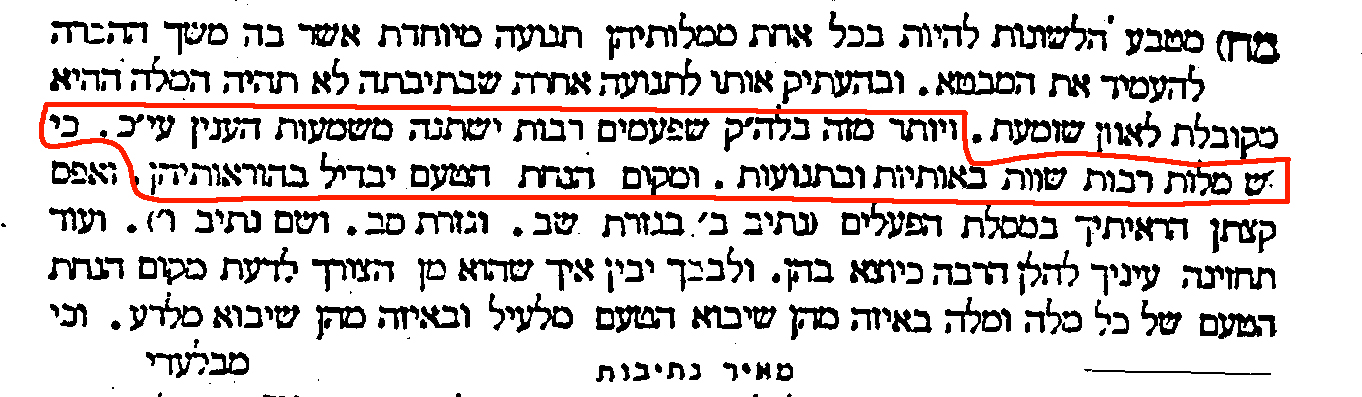
Ha-Gra, Vilna Gaon, for example, when he discussed the dageshim he first talked about dagesh hazak, then dagesh kal. In the section/paragraph about the dagesh kal he also talked about the dehik and ate merahik, which tell you that he might have seen that kind of dagesh as kal. While others saw that dagesh as a form of dagesh hazak.
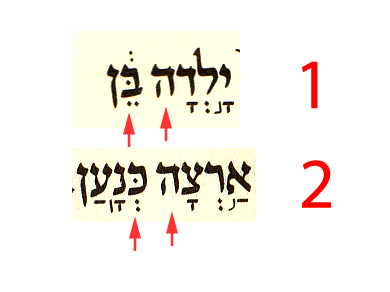
Let's see the Dehik in action.
The word בן has a dagesh even though the word before ילדה is ending in the letter he ה (this issue already was mentioned several times).
In other words, the dehik nullifies the rule which doesn't allow a beged kefet letter to have a dagesh after ahevi אהו"י letters. Is that all? Not quite. This dehik is marked when the first word ילדה has a mile'el stress because of the nasog ahor (=when the stress is shifted), and only if the stressed syllable could have light ga'ya.
Now the sheva is na or nach?
Prof. Dotan, like Prof. Rabbi Breuer and Prof. Yeivin articulated and formed different rules. Prof. Dotan, for example,is known for his rule about the nasog ahor: sheva after nasog ahor is sheva nach נח. So, the sheva is na or nach? Does the word have a *true* mile'el stress?
Another important aspect of the nasog ahor is that it is never shifted to a closed syllable. We said "never"? Well, not if we are talking about perfect verb forms with vav consecutive. Is this going to affect any marking e.g. sheva na? Well, the answer is very simple: there's no shortcut besides examining the Bible several times.
Here is one more example which shows that one time there's nasog ahor, and another time there isn't. Is that going to affect the sheva, or the rule that sheva is na under the first of a pair of identical letters?
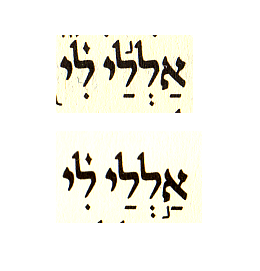
We know that in the Tiberian tradition a sheva after a long vowel was pronounced as sheva nach. Just a quick glance at the Tevir will prove that.
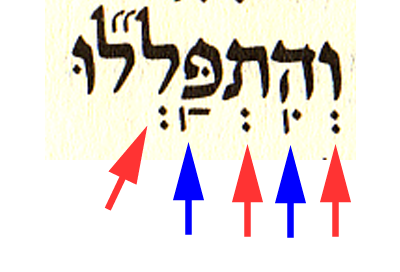
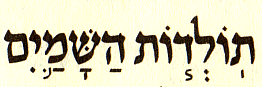
The rules of the Tevir (or the servants of the tevir) tell us that darga could be its servant only if there are at least two vowels/syllables or one vowel/syllable and sheva na between the servant and the tevir. That is why this sheva is regarded as na:
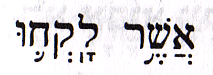
and this sheva is nach:
So, every sheva after a long vowel which is accented should be na, right? Well, we said before that the ta'amim has a great power.
The next example shows the letter dalet with sheva, and the vowel before it is long & accented, but this sheva is nach! Find any printed book, or bring any established opinion that will claim otherwise. I'm all ears.
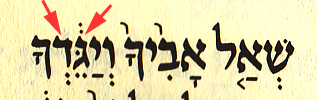
Moreover, the rules (or part of them) of the heavy regular ga'ya shows similarity (sheva after long vowel). Heavy regular ga'ya is marked in a closed syllable which is separated from the stressed syllable by another syllable which is marked by sheva na.
So, this is sheva na:
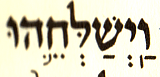
and this sheva is nach:
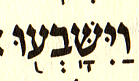
In other words, one can not ignore the ta'amim. They are going hand in hand with the nikkud. There is always a chain reaction -- one thing that is related to the other, and one thing that is affecting the other in certain circumstances. One should open his eyes and see that there are many changes to the nikkud (whether it is, or isn't related to the goal of marking sheva na, kamats katan etc. etc.) and should understand them. Copying marks from a siddur or chummash without understanding the basic, without exploring the text , is not going to help. Neither is Wikipedia, Wikishimiki .
Is it possible to find different points of view? Of course. So, the first task has nothing to do with VOLT, FontLab, FOG, OpenType etc. etc.
The first task is the understanding of the rules of the grammar, understanding the Bible, and understanding that there are different points of view that can't be bridged!
Part B: To Be Continued