
Some questions regarding diacritics, precomposed glyphs and Unicode, whose partial answers I found in other threads:
Unicode philosophy does not admits further inclusion of letters with diacritics if they can be achieved combining glyphs already coded. So glyphs like Yoruba's E acute with dot below will not be included in any future Unicode version: they must be mounted in client program (text editor) using base glyph plus combining diacritics.
The better way to get these combined glyphs without codepoint is mark feature. But this is still not supported by FontLab and most client programs. Even if we could do it with FontLab, there are kerning problems caused by some diacritics.
Let's say you use mark feature to build something like ï. Here, diaeresis go further than the base glyph limits so the kerning bust be adjusted.
(1) How to handle kerning issues produced by diacritics in a mark scenario?. The font needs to have specific kerning exceptions for each combined glyph whose diacritics produce this effect?
In other hand, you can simply ignore mark feature by now and add the precombined glyphs you need to the desired language support. Typed sequences are defined as substitutions in ccmp feature and no marks are necessary.
Anyway, these precombined glyphs have no codepoint as they are out of Unicode specification. Without a codepoint these glyphs suffer some limitations: they cannot be inserted by keyboard codes or Windows Character map, they cannot be used in replace commands (except ID CS4+) and they are not searchable in PDF documents. Even the keyboard layout editors cannot reach them as these editors work based on Unicode.
(2) Is not a reasonable idea to set codepoints from PUA to these precombined glyphs?. I see this is not ideal and far from Unicode original idea, but this method was adopted in some fonts. Although I understand this option has drawbacks, the advantages does not pays off?
Finnally, combining diacritics are used both in mark and as components to precomposed glyphs. They must have zero width so they are keep before the zero limit. I cannot find any instruction about the position for these diacritics within this negative space. What I conclude from some fonts: usual way is to put the combining diacritic aligned as if there is an o before zero point. If you have uppercase variants, align them with O. Like this:
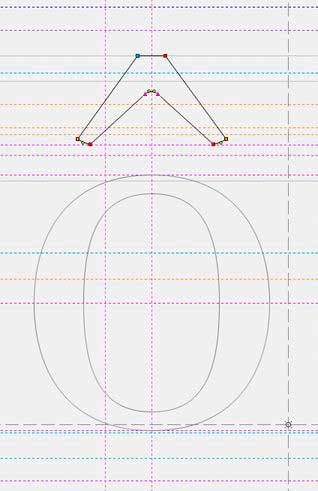
.
(3) Is this a correct criteria or there are other issues related with combining diacritics positioning? Actually, using anchors to handle components the position is not relevant. But for mark this seems to be essential.
Sorry for the long post, but I was not able to describe these details in a shorter way.

