Typophile

New typeface design program at Cooper Union

Nick Sherman

Cooper Union's new typeface design program, organized in conjunction with the Type Directors Club was just recently announced. It is currently a certificate program offered through Cooper's continuing education department. The new website has all the info on curriculum, faculty bios, and application details:
http://coopertype.org/

While there have been many type design workshops and classes offered in North America before, this is the first program of its kind to take place on the continent. Having moved to New York not too long ago myself, I must say I can't think of a better city to hold such a program in – if for nothing else than to have access to such a vast pool of talented type folks living in the area.

Furthermore, Cooper Union and the Type Directors Club couldn't be much better organizations to have involved. Among other things, Cooper has made typography a priority with their Herb Lubalin Study Center of Design and Typography, and the TDC's annual typeface awards are among the most notable in the industry. Plus it goes without saying that both have long typographic histories that include some of the greats of American type, lettering, and design.

The course list and roster of people involved for the first term alone is quite impressive (not to mention surprisingly diverse), and I'm sure the second and third terms will be just as good. More information will be posted on the site as it becomes available.

I apologize for shamelessly tooting the horn of a project I'm obviously involved with, but I'm really excited about it and thought some of you might be as well. As always, I'm appreciative of any feedback – critical or otherwise – and am happy to answer any questions.

Congrats to you, Jesse, and crew for getting this off the ground. Sounds exciting. If I were 25 years younger, I’d definitely be considering this.

Congratulations you guys. I am very excited about this program. I would love it if the brand new website might grow a blog like appendage that allowed the general public i.e. nosy me, to follow the ongoing projects. But first: Bravo again!

Looks great!

I'm considering taking part in this, or applying at least.

I'm moving to NY after this summer, so I think it would be a great opportunity to seize.

Just two questions: How long is the program, and are they evening classes?

This is wonderful news!

I hope this is just the beginning of a revolution and understanding of typography and design.

Much anticipated and way overdo.

I wish everyone associated with this new venture much success.

Congratulations!!! Very exciting.

PS—Maybe now someone will write an article: 'The benefits of type design in every aspect of our lives', instead of that dreadful article: 'Do typefaces really matter'.

> Just two questions: How long is the program

http://coopertype.org/
“Each of three terms (fall, spring, and summer) runs 10 weeks, starting with the fall term from October 4th to December 7th, 2010.”

> and are they evening classes?

“Core classes meet on Monday and Tuesday evenings plus one weekend per term, and elective classes meet on weekends during the day.”

More info: http://coopertype.org/curriculum/

I saw both of those, but I was looking for more specific info... is it just a 1 year program or will it extend? And what time in the evening? Thanks for trying, though :) I suppose I should have been more specific.

Very cool. Great to see something like this in the United States, and NYC in general and Cooper Union in particular are excellent places to do it. I'm looking forward to hearing more about this!

T

Steven,

> is it just a 1 year program or will it extend?

http://coopertype.org/application/
"The fall term runs from October 3 to December 7, and the program continues for two additional terms, Spring and Summer."

> And what time in the evening?

The times are given for each class on the curriculum page:
http://coopertype.org/curriculum/

Hope that answers your questions! If not, feel free to e-mail type@cooper.edu for more immediate and official feedback.

Congrats! Looks great!

ChrisL

This is good news indeed! Congratulations and all the best for success to Jesse, Alexander, and all the visiting people.

Typeface Design is growing as a discipline, and the spread of dedicated programs of study worldwide, as opposed to modules within general design courses, is a great indication of a maturing field (SCAD, Bs-As, Zurich, Barcelona, FADU, Amiens, Pueblas... I'm forgetting some, I'm sure). Well done to the CU for hosting the new programme, the institution has a great tradition to build on, and is a natural candidate for a full-length program in the States.

Awesome, thanks for pointing that out to me, Nick. Apparently I'm blind haha. Still weighing options on this, but keep an eye out for my application :)

Thanks for posting, Nick. And thanks, everyone, for the positive response.

Cara Di Edwardo, Alexander Tochilovsky, and I have been working with Cooper and the TDC to get this going, and we're pleased to be able to offer a more intensive typeface design program here in New York. We'll keep an eye on this discussion and are happy to answer your questions about the curriculum and admissions process.

As Nick pointed out, we are eager to maintain the diversity of our offerings through the course of the three terms. So we also welcome proposals from potential guest lecturers or workshop leaders.

Congrats on getting this course underway Jesse. I look forward to seeing the results from the course, and some of the guest lecturers and workshops you've lined up for the course sound great. It's really too bad I'm not in NYC anymore.

Thanks to all who are cheering us on and for all the support many of you have offered in the planning phase, especially Hannes who should be credited for the idea in the first place. Also to John for holding me to such a high standard.

Please direct the 'official' questions about the program through the type@cooper.edu website so we can centralize inquiries. We'll try and get a FAQ page up as we figure out all the questions people have. Already I've gotten inquiries about student visas for foreign nationals and I can't answer that one just yet, but I'm working on it so stand by. There's something on the State Department website that makes it very confusing so I have to seek a consult from our Undergrad admissions people. Standby for that answer.

I hope this turns into an MA program sometime in the next 4 years. That would be truly amazing to have an alternative to Reading and KABK in the States.

hope this turns into an MA program sometime in the next 4 years.

Given that Cooper Union is Cooper Union, I don't think that is going to happen.

@terminaldesign

I'm not following. I don't know much about CU, so excuse my ignorance haha. Explain?

.

>I hope this turns into an MA program sometime in the next 4 years.

It is our thought that as a certificate program, with a less demanding work load than a Masters program, Type@Cooper would appeal to many working designers, giving them the practical skills and a broad view of typeface design history and theory at an affordable price.

The format of having electives and guest speakers available to folks outside the program will allow graduates of the program to stay connected (beyond the one year) to both the offerings of Type@Cooper and the TDC.

I hope this turns into an MA program sometime in the next 4 years. That would be truly amazing to have an alternative to Reading and KABK in the States.

Why? It’s not like having and MA is a huge advantage in the design field. Sure it might make getting a type design job a little easier, but they’re still so incredibly rare that it’s a pretty big gamble. It makes sense to have another option for people who don’t want to put an enormous amount of time and money into what’s really vocational training.

Sure it might make getting a type design job a little easier,

Your kidding, right?

Your kidding, right?

I’m quite sure that on the rare occasions type design jobs come up preference is shown to people with MAs.

And I'm quite sure that the job goes to the people that show the best work with the best experience for the position. Regardless of degree.

I wouldn't necessarily be seeking an MA in type design to further my career. It'd be more for the immersive learning environment and the experience. To dedicate an entire year or so to type design is a pretty big undertaking with not too much reward. But the undertaking would be considerably less of a burden if the States had an MA program of its own.

Granted, you don't need an MA to be a successful type designer, but I don't think many people go into it with the impression it will make them one of the best.

cdiedwardo makes a great point though. the Cooper program may end up being just as popular, if not more than Reading and KABK simply for the fact that it is not as much of an undertaking. Also, with the location being what it is, that's an undeniable attraction since it will be so close to so many designers.

I think you may be overestimating the interest in type design amongst the NYC design community. There have been many Type Design programs offered via Continuing Ed, over the years in NYC, with very modest attendance.

I can understand someone making the commitment to a graduate program and moving to a location to spend a year involved in that course of study. A Continuing Education program by its part-time nature must draw on local interest. I just wonder how strong that local interest really is. Here's to hoping I'm wrong.

Why are you not teaching James? And what about Paul?

I was not invited to teach at the Cooper program.

I am teaching undergraduate type design at Parsons during the Spring semesters and Typeface Design in SVA's Continuing Ed program in both Fall and Spring semesters.

I do not know whether Paul was asked to teach at Cooper or not.

Wasted resources in NY! Well at least Parsons got you :-)

How there's room for ire in this conversation I do not know. This program is great news for everyone: foundries looking to hire (hello), type designers wanting to teach, Cooper Union itself, type education generally, and most importantly the students. It would have been fantastic to have such a program available when I was shopping for colleges, and it's a boon to the designers of today and tomorrow that it exists. Hats off to all involved.

PS: James, as an instructor you're more familiar with type offerings in NYC than I am, but the class that our own Sara Soskolne taught at SVA last month was packed, and sold out. People were e-mailing our sales desk hoping to find a way to sneak in; let's hope this bodes well for the success of Cooper's program.

That is good news Jonathan. I do hope that the program is successful. I do wonder if the attendance of a week-long workshop will translate to a semester-long program. Hoping it does.

Looks fantastic.

I have just asked by email whether the course will also be available by webcast and email.

>webcast

Nothing like that is planned, nor has it been discussed as an option.

Thank you for your encouraging words, Jonathan.

> a semester-long program

James, just to clarify, the program is actually three terms long, ten weeks per term. Students will be awarded certificates only after successfully completing the full three terms. I understand your concern—it is indeed a big investment of time (though far less than a full Master's program). In this uncharted territory, it's difficult to predict the student base. But we're optimistic, since we've received a substantial amount of interest already.

James... that was a compliment to you. And I intended no ire JH!

Jesse, it may be better to start with making a simple sans serif, to teach basic skills and principles, rather than a revival.

There are too many issues involving subtle drawing in a revival, especially, as is likely the case, if you are reviving a serifed face.

The fundamental principles are sidebearings, alignment zones/overshoot, vertical proportions and stem widths, and these are easiest to grasp in a plain sans serif.

Besides, starting with a revival sets a prosaic tone for a type design course.
It's overly academic, like art school in the 19th century, where the subject of drawing classes was a plaster cast of an old statue.

Jesse, it may be better to start with making a simple sans serif, to teach basic skills and principles, rather than a revival.

Don’t give him any idea! I’m going to have finished of a family of 24 sans fonts right before that class starts and I don’t want to start another one for a least a couple months.

I think you can teach basic principles and skills with any style of letter. It has been my experience teaching this that the best result comes from allowing the student to explore any style letter they choose (With some guidance).

Most people come to a type design course with an idea they are interested in exploring. Having different styles being developed in class adds to a certain visual richness, and allows the instructor to point out issues that emerge from the different styles.

I've had students start with blackletter, handwriting, sans serif, serif, historical revival, carnival/circus type, tombstone lettering, western lettering, various styles of formal calligraphy, and more. All of those styles, and the problems they presented to the student designers were great teaching opportunities for the entire class.

Thanks Michael, I did take it as a complement, and sensed no ire.

Jesse, I don't doubt that there is great interest in the program. I hope that interest continues after the first year or two. Time will tell. Good luck.

It will probably be harder to fill my Tuesday night SVA Continuing Ed type design course now that you guys are in town, but we will see!

Excellent initiative for type education! This will make type design more accessible to designers in the west, especially to designers in the Caribbean region.

Thank you, Nick and James, for sharing the benefit of your teaching experiences.

That's a good point, Nick, but I tend to agree more with James's sentiments. The basic principles can be taught with almost any style of letter, and the diversity of classmates' projects will be instructive to students.

Over the years in my undergraduate typeface design class at Pratt, I've let students choose between revivals and original designs. The most important thing is that students choose projects that can maintain their enthusiasm through many, many hours of potentially tedious work. But I've found that most beginner students reach better results when working from some kind of source material. Sources have ranged from a few words on a WPA poster to a full alphabet in a Deberny & Peignot specimen (with permission, of course), and interpretations have ranged from "recuttings" to "reconsiderations" (John Downer's terms). I encourage students to work on designs that fit their skill levels and interests, and a simple sans serif may be just the thing for some of them.

For students who are less familiar with type anatomy, working from a source provides the opportunity to learn, through critical observation and meticulous reconstruction, key principles like letter proportion, weight distribution, and maintaining/breaking a system. And since many variables have already been established in the sources, students are able to focus more attention on the fundamental principles Nick mentions.

It's true that a beginning designer may not be fully prepared to handle a revival with the nuance and care that it deserves. But the goal in the first term is to learn, not to produce the best possible product. (How many designers' first attempts at typefaces have been masterpieces, anyway?) We have the luxury of three terms, and the larger project in the second and third terms will provide the opportunity to design a more finessed finished project.

And James, I certainly hope Type@Cooper won't detract from your SVA CE enrollment. I expect the difference in time commitment makes your class far more feasible for some students. Let's hope there's room for both!

James (Dunwich), as a bona fide type designer and the proprietor of a type foundry, you can probably skip the introductory assignment :-)

James (Terminal), sure, you can teach skills from anything, but in my experience, having taught both ways, it's a more solid start to keep it simple.
If everyone is pursuing their own script or circus font or some such thing, many are going to have difficulty grasping the fundamentals around which most Type 1 fonts are structured.

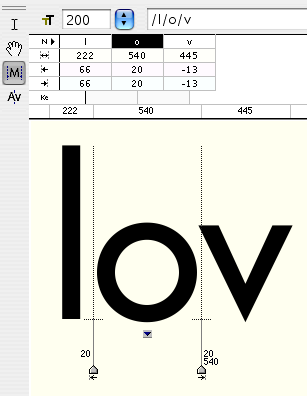
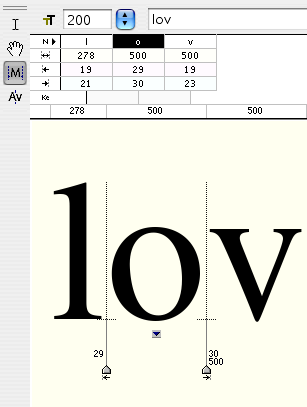
The basic principle of spacing/sidebearings is succinctly demonstrated in a sans serif, visually and numerically, but that is not the case with a serifed type:


They are going to get a chance to do their own thing in terms two and three.

If everyone is pursuing their own script or circus font or some such thing, many are going to have difficulty grasping the fundamentals around which most Type 1 fonts are structured.

Yes they are going to have difficulty, but they get a great deal of satisfaction when they do get it right.

And an entire class doing a geometric sans would be the kiss of death from a student enthusiasm point of view. Face it, type design is a tedious pastime and anything you can do to keep a student engaged in the process is a good thing. Everyone staring at one another's geo sans would not be a good thing.

Nice to see there are more type design opportunities springing up. Here's hoping interest eventually leads to a full-time Master's program at some point in the states.

I wish all my type peeps success in these great continuing ed options. Kudos!

And an entire class doing a geometric sans would be the kiss of death from a student enthusiasm point of view.

I've tried that, and was surprised at the individuality of student responses. This was in a general design course, and for such students, giving them all the same clearly defined project had many advantages, compared to the do-your-own thing approach, where the biggest problem, which always ended up confounding several, was that they didn't have an idea of what they wanted to do. After all, as 'designers' they were used to working from briefs, not creating their own.

But isn't motivation irrelevant here? As you yourself have often mentioned on Typophile, type design is indeed a "tedious" pursuit, so wouldn't one expect students of this course to be sufficiently steeled for that, and admitted to the course accordingly?

Jesse: The most important thing is that students choose projects that can maintain their enthusiasm through many, many hours of potentially tedious work. But I've found that most beginner students reach better results when working from some kind of source material.

But this is a specialist course for those committed to type design, not part of a general design course. Aren't students being admitted on the recognition that they are type-designer material, i.e. (a) they are suited to grinding out massive OpenType fonts and (b) they have some original ideas for typefaces?

As you yourself have often mentioned on Typophile, type design is indeed a "tedious" pursuit, so wouldn't one expect students of this course to be sufficiently steeled for that, and admitted to the course accordingly?

Students in Continuing Ed seem to know what they are getting into, but most undergraduate students have no idea what they are in for when they sign up for the course. All have told me that it was much more work than they expected. Some have admitted that they hated it and never wanted to do it again. I think finding out what you don't want to do as a designer may be more important than finding out what you want to do. And regardless of a student's expectation, isn't keeping a student motivated one of the key tasks of the instructor?

... isn't keeping a student motivated one of the key tasks of the instructor?

This isn't an undergraduate course: "The certificate program is designed for those with undergraduate or professional experience in graphic design, typography, or related fields."

I haven't seen the prospective students, but I would imagine that they already have plenty of motivation, given how overdue a course like this is in North America.

If they couldn't hack a first-term project making a sans serif font, they will find out in a hurry type design is something they don't want to do!

"I think finding out what you don't want to do as a designer may be more important than finding out what you want to do."

That is without a doubt one of the most salient points I have seen in ages! And so true. How many of us have shed those "don't wanna dos" as we plod forward!

If you insist on having everyone do a geo sans design as a first project, I'd suggest having them finish UC, lc, figures and basic punctuation in the first two weeks, after all they are highly motivated students who have waited their entire lifetime for a course like this to emerge in North America.

I think the least you can do is demand that they finish a simple geo sans in two weeks. Most professionals should be able to do one over the weekend. They might as well get use to the work load and time frame that is expected of them as professionals.

Two weeks?
Despite their commitment, it might take some students a few days longer longer to realize that the crossbar on "f" usually lines up with the x-height...

Despite their commitment, it might take some students a few days longer longer to realize that the crossbar on "f" usually lines up with the x-height...

Anyone who can’t get through Leslie Cabarga’s tutorial on drawing a geometric sans from stroked paths in two weeks really shouldn’t be in a type design program!

I think finding out what you don't want to do as a designer may be more important than finding out what you want to do.

Oh my Lord, yes.

Nick/James: I think the only way this can be settled is through...dun...dun...dun...

An Iron Type Designer competition! Students complete a 256 character font in a week. Go!

(Being facetious of course.) :)

No sense in that when JP can do it all and do it so fast :-)

I'm on the side of having people do something that will keep them motivated.

It's been a long time since I taught this stuff. When I last did, I had folks working on a revival of Radiant. But if I had it to do over again, I'd let them pick their own project at least to a significant degree. Maybe steering them away from circus lettering and script faces. :)

T

And James, I certainly hope Type@Cooper won't detract from your SVA CE enrollment. I expect the difference in time commitment makes your class far more feasible for some students. Let's hope there's room for both!

Well Jesse I hope you are right. SVA has posted my type design course for registration for the upcoming Fall semester

Hi Jesse, a bit belated: Very impressive! I particularly like that it is not about how to draw type alone but about type design in context as the variety of contributors suggests. This could be a great experience for participants.

The 4 Type@Cooper guest lectures are open to the public:
Turning Lead into Gold: 19th-Century American Type Foundries & Their Specimen Books by Stephen O. Saxe;
Type Design & Production, The Revolutionary Years by Mike Daines;
The Guardian Egyptian by Christian Schwartz,
Round Pegs in Square Holes: Developing Type for Screen-based Media by Roger Black are open to the public.

Program participants will have priority in reserving places in elective weekend workshops with Ken Barber and Mark Jamra
but any remaining places in these workshops are available to the public.

You must register by phone for these events. 212-353-4195
Admission for the lectures is $20, the workshops are $300, TDC 20% discount applies.

Hi Cara! Best wishes for a great class!

ChrisL

Thanks Chris!

Sounds like a great course.

Is there a similar course in the Boston area?

Thanks.

Cara, will the schedule of these events open to the public be posted on the Cooper Union website, or a facebook page?

William, everything under "Electives" and "Guest Lectures" on the Curriculum page is what will be open to the public, space-permitting.

> will the schedule of these events open to the public be posted on the Cooper Union website, or a facebook page?

Hi William. According to http://coopertype.org/curriculum/,

Turning Lead into Gold: 19th-Century American Type Foundries & Their Specimen Books by Stephen O. Saxe;
Monday, October 18
6:30 pm

Type Design & Production, The Revolutionary Years by Mike Daines;
Monday, November 1
6:30 pm

The Guardian Egyptian by Christian Schwartz,
Monday, November 15
6:30 pm

Round Pegs in Square Holes: Developing Type for Screen-based Media by Roger Black
Monday, November 29
6:30 pm

Concerning foreign students and visas, here is what I can say.

No one needs to have a special visa to apply to or attend Type@Cooper, immigration status is not a factor at all.

Cooper Union cannot help to get a student visa to study (which is good news and a little bit bad news) because the program doesn't require enough contact hours to qualify. This is only bad if you come from a country who's citizens must jump through hoops to get a tourist visa to the US. It's good because thanks to Homeland Security, schools now have to charge enormous fees to foreign students to offset the expense of doing the ten years of follow-up paperwork per student.

I am told that there are quite a few Brazilians who have come repeatedly to do the Architecture Certificate program in Green Building courses here at Cooper. They have all come on tourist visas.

The only difficulty is that a tourist visa limits you to a certain number of months visit. Still, the fees that get charged to foreign students are more than just about any round trip airfare in the world.

Bill,
Cristobal correctly lists the fall lectures. These will be held in an auditorium that can accommodate a lot of people.

The elective workshops will have limited enrollment, and priority will be given to those in the program as an optional course in addition to the core, but included in the price of the program. We expect there will be a few open places in these workshops for people outside the program.

In the fall 2 weekend workshops are planned; Drawn Letters with Ken Barber, and Experiment and Expression in letterform design with Mark Jamra.

Richard Lipton and John Downer have agreed to teach lettering/design workshops in the spring. We are still working out the details of a few more electives for spring on the technical end of font production. I imagine we can open those up to more people.

FYI, Cooper Union Continuing Education's website is set up in such a way that makes it impossible to list these options and allow people to enroll directly through the site. If you are interested in signing up to attend anything at Type@Cooper (other than applying for the whole program) you need to call them during office hours 10 am—6pm. The number's on the website.

Reminder: The deadline for this fall's Type@Cooper is midnight tomorrow,
August 31st.

We will run the program again next year with a more generous lead time.
I know this was short notice for many, especially those of you who expressed
interest from afar.

If I've confused you about the international student explanation that I posted a few days ago let me clarify that there is no extra fee for international students and Cooper doesn't require any particular immigration status or visa.

Hi folks: a bit late to this thread, I also want to wish the Type@Cooper program the best of luck and heartily agree that it’s about time this kind of comprehensive type education is offered on this side of the Atlantic!

For those looking for something a little lighter on the time commitment scale, due to the demand for my summer SVA CE workshop Turning Letters Into Type, I’m also scheduled to teach a semester-long version of it on Monday nights in both the Fall and Spring semesters (with more intensives planned for next summer as well, if as James M. points out there are enough students to go around). I believe the difference between my class and James’ is that mine is taught in a computer lab with TypeTool available to each student — for now, until SVA upgrades to FontLab for a more advanced version of the class — so it’s digitally hands-on as well as lecture/critique in format.

The fall class starts Sept. 20, and registration is available here.

NYC-area typophiles are suddenly spoiled for choice in 2010 — let's all hope they take advantage of it!

Sara,

You get the prize for "Best Job Title" Glyph Masseuse

Chris ;-)

I believe the difference between my class and James’ is that mine is taught in a computer lab with TypeTool available to each student

There is that difference, the other difference is your course costs almost than twice as much as my course.

So this is the thing that doesn't make sense to me.

Sara's course is being offered in a computer lab with access to TypeTool for $900 for the 12 week semester.

My course is being offered in a classroom for $470 for a 12 week semester.

Given that most design students probably have access to a laptop, a student could by TypeTool for $99 and put it on their laptop and bring it to class, and save a whole bunch of money.

SVA is charging an additional $430 for computer access to TypeTool. Really?

Smoke'em if you got'em.

Chris: it has been so long since I entered that I had completely forgotten about it!

James: agreed, I asked SVA about this as soon as I saw the disparity in fees assuming it was an error, but apparently that's how they price these things. I wasn't even aware there was another type design class being offered simultaneously with mine until I saw this thread, so I guess they're not too concerned about either the potential redundancy or the price difference. Institutions do work in mysterious ways, it seems...

I think this is an excellent example of how much more cost-effective it is for students to have their own computers than for schools to set up labs.

"this is an excellent example of how much more cost-effective it is for students to have their own computers than for schools to set up labs."

Or an example of how desperate schools are to get more income.

Or an example of how desperate schools are to get more income.

Computer labs are money pits for schools. The costs of space, hardware, software, printers, toner, networking, cooling, staff, etc. get really ridiculous in schools, especially when vandalism and theft get factored in. They’d probably do much better by just demanding that all students provide their own.

Taking 2 computer lab included courses at CU would pay for the cost of a laptop.

All Continuing Ed programs are essentially about making money. SVA books two type design classes hope one or both will fill. If they don't fill, no sweat, the class is cancelled and they try again next semester.

Cooper creates a Certificate Program to bolster its bottom line. Make sense for a university that doesn't charge tuition for its undergraduate program to generate some revenue somewhere. At least that is how it was explained to me when I sat in on meetings when Cooper approached the TDC to get involved.

All Continuing Ed programs are essentially about making money.

I get that—I’m just pointing out that charging more for the computer lab doesn’t mean that the class is any more profitable!

> They’d probably do much better by just demanding that all students provide their own.

Admittedly, that can work in the United States, where the students (or the parents) can afford it. But not every school in the world can demand to their students to buy a laptop. And we must not forget that it is not only about buying the computer, but about licensing the required software. But, on the other hand, I see your point and I agree: it is not efficient for the university to provide computers for the students that can have (and actually have) their own laptops.

In many colleges in the USA, laptops are required just like text books--and this is for all majors. There is a sort of quiet, behind-the-scenes thing that happens where students who show a great financial need, are given loaners by either the school or charitable minded corporate sponsors. I remember, what seemed to me to be an incredible financial burden in 1962, when I had to come up with the money to buy a Yashica-D for a freshman photography class at CMU. At least I was not in engineering where they not only had to buy a slide rule but books of log tables.

"Admittedly, that can work in the United States, where the students (or the parents) can afford it. But not every school in the world can demand to their students to buy a laptop. And we must not forget that it is not only about buying the computer, but about licensing the required software."

Thing is, the price difference is $430. Cost for a basic but functional Windows laptop with 4 GB of RAM: $400. TypeTool is $100. Total, $500. So, it's hard to justify the course-in-the-lab pricing from a student perspective, really. (Not that I'm denying all the expenses the school has in running the lab, which add up.)

Cheers,

T

>Computer labs are money pits for schools. The costs of space, hardware, software, printers, toner, networking, cooling, staff...

This is quite accurate. There is a trade off of luxury and efficiency vs. cost effectiveness.

Running a type design class in a computer lab allows students to scan and print and to use other applications to test a font in a layout), reliable access the Internet, and file sharing. Access to networked printers allows students to inspect their work on high quality print outs quickly and throughout class time and to get ready for critiques on the fly. Of course, there is a cost for this luxury.

Obviously, many serious design students already own a laptop and if money is an issue would better spend those funds on a laptop and legal licensing of software so they can obsess over BCPs at home.

For Type@Cooper, we're doing something in-between...we'll have dedicated equipment and AV support without the full lab environment.

Good thinking, Cara. There was no better learning environment than when your whole class was working at night on an assignment and you could interact with each other. Today, with all the isolation, there is not enough peer interaction.

Ken Barber's "The Drawn Letter" elective workshop is going to be repeated on November 6th and 7th and places are available for anyone outside the program to sign up. Ken has graciously agreed to come back to do a repeat performance in November since so many people expressed interest in the October dates. This workshop will be some mix of hand drawing and digitizing (optional).

"This workshop will investigate recent historical approaches to lettering, in addition to exploring various production techniques. Participants will refer to familiar typographic models and helpful specimens as they create their own hand-drawn wordmarks"

For a full course description look at coopertype.org. To register you can go to http://cooperunion.augusoft.net/index.cfm?method=ClassListing.ClassListi... or call the Continuing Education office if you're a TDC member to get your 20% discount: (212) 353-4195

The lecture series begins on October 18th at 6:30 pm in the Rose Auditorium in the New Academic Building at 41 Cooper Square.
Stephen Saxe will talk about design and production of 19th Century American Type. You can register online or by phone.

Monday, November 1st Mike Daines will give a lecture called "Type Design and Production, the Revolutionary Years" at 6:30 pm in the Rose Auditorium at Cooper Union, 41 Cooper Square. For full description: http://coopertype.org/curriculum/

Mike Daines is founder of Baseline magazine, Applied Graphics Limited, he co-founded Applied Arabic, an Arabic type design licensing company, and The Foundry, an early digital typefoundry.

Register to attend at 212-353-4195. This event is open to the general public.

@Cara, thanks for keeping this thread updated. I really wish I lived closer. So many of these lectures sound super interesting!

I just published a blog post about my awesome summer in the Type@Cooper Condensed certificate program at the Cooper Union in New York City http://www.kombinat-typefounders.com/store/news/article/cooperType_condensed_2012

Hannes – it was a pleasure studying along side you for the duration of the course. It was both captivating and a privilege to have access into your wisdom. Definitely a fine group of people with diverse backgrounds for this past summer's condensed program.

Captured from web.archive.org on 19 Apr 2015. view this capture