

Thank you, Nina. I wish you (and your Ernestine of course) a wonderful 2010!

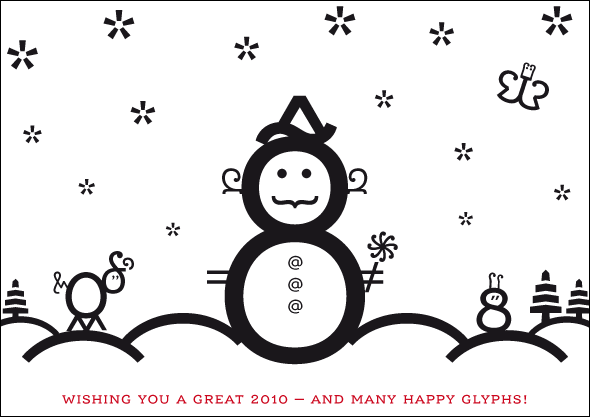
So, who can guess what character(s) the trees are? :-)
hhp
I'm guessing (a bit prejudiced probably) it must be some Armenian counterpart piece/glyph/component/character... or?

Guess those tough German butterflies don't migrate for the winter? :-)

Well done, Nina!
Wishing you a Happy New Year as well.
ChrisL

Although the year doesn't really start until February 14 (or was it March 21?), I too wish you all a happy, typophilic new year! ❄☃❅ :-)

The year 2010 has all-lowercase numerals! When was the last time this happened?
(Withholding the answer so people can have some fun.)
I remember a few years ago Kent pointed out to me that if I was serious about seeing an ascending oldstyle numeral "2" become mainsteam, I should really do it by 2010, otherwise we'd be stuck with boring-looking years for 3 years...
hhp
Thanks guys!
Jos, I'm afraid there's nothing Armenian about those trees at all…
And Craig: That's an 1E9E-fly – it was hibernating for decades, now it's not going to be quiet anymore! :-)
So, who can guess what character(s) the trees are? :-)
Looks like this was a *very* good question, Hrant!
I thought people might have seen a triple dagger before, or at least imagined one. :-)
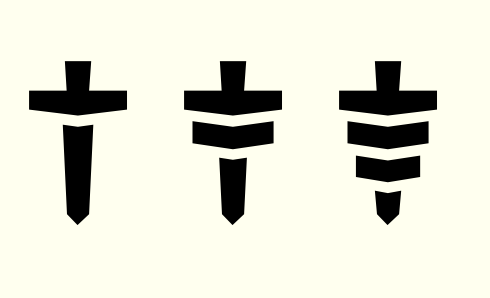
If you're going to stab somebody, do it at least three times.
hhp
And when I said "imagined one" I thought of efficiency and variety in annotating. Oh man. :)
I thought the progression would be something along these lines (which would not have been a good tree, but maybe one half of a snowflake):
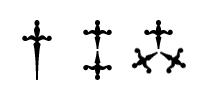
There are certainly different ways of doubling the dagger, and I think the «mirrored» one you show is the more common/classic variant. The one with two handles on one dagger seems more elegant to me, but mostly I prefer it because it makes for a nicely intuitive/«readable» sequence, in terms of the overall shape not changing so much, save for gaining handles. :-)
Patria's double dagger is also the rare two-hilted variety.
But I haven't been violent enough to make a triple. ;-)
Actually, come to think of it, multiple
hilts are for extra defense, not attack! :-)
hhp
Ah, they're both double-crossguarded.
Double-hilted looks a bit funny (SCNR) :-)
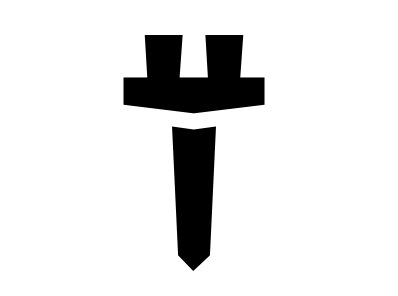
(Dagger terminology… gotta love Typophile.)
BTW Hrant, please feel free to make a triple too, I'd be happy to influence Patria back for a change :-)
The one with two handles on one dagger seems more elegant to me, but mostly I prefer it because it makes for a nicely intuitive/«readable» sequence, in terms of the overall shape not changing so much
Given the use of the glyph (at small sizes, as a reference point), shouldn't the difference between single and double daggers' shapes be a good thing?
But indubitably we need a Unicode point for the triple dagger! :-)
What I was trying to say is, I think a solution such as the one I posted above makes it more likely that all 3 of them are perceived as permutations of the same thing – as a linear/additive sequence of what are essentially daggers. The one you posted has a nice contrast between #1 and #2 (where the «doubling» is quite obvious), but between #2 and #3 the overall shape changes so much that it could almost be another character altogether (especially at the tiny sizes that this thing is going to be used in). Dunno.
On the other hand, yours nicely works the middle ground between the dagger and the asterisk! :-)
Captured from web.archive.org on 14 Apr 2015. view this capture