
Typekit opened the doors to the public...
http://typekit.com
Typekit opened the doors to the public...
http://typekit.com

Great.
Here's the first complaint :) I was staring at this list of Sans Serifs for a good minute before noticing the warning at the top. What's the point of showing this list to a site visitor if it's guaranteed that it will not show right ?
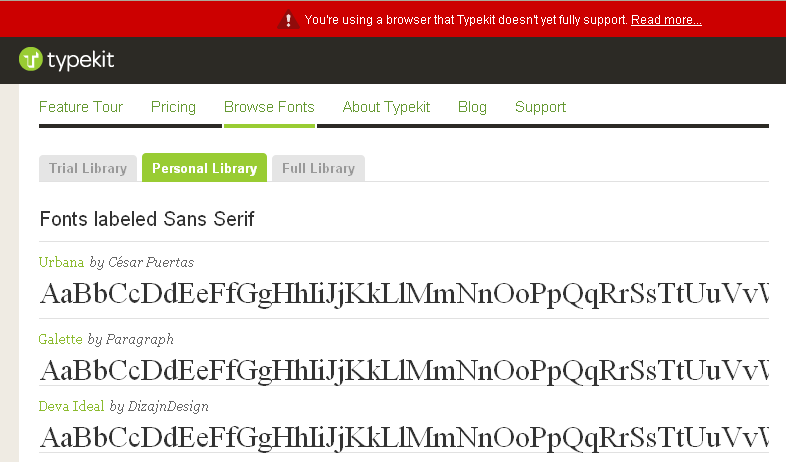

> What’s the point of showing this list to a site visitor if it’s guaranteed that it will not show right ?
Look — this @font-face thingy is not going to work at all on non-compliant browsers, or very well in user environs set to alias type. If one does not want to upgrade or poke ones preferences into line, one must read the bright red sign at the top.
Not showing anything is anti-web, and showing a completely different page is probably useless.
Cheers!

@epsilicon
I'm confused by the phrase "Typekit does not yet fully support".
Does the browser you're using support this @font-face thingy or not?
If it does, then Typekit gets a black eye.
If your browser doesn't then there should be a much larger alert to that fact. IMHO

I'll bet he's using Chrome.
Me too, but I flip the runtime switch to get it to read TTF/OTF fonts just fine, which works pretty well.
That being said, I've seen spotty behavior from TypeKit @font-face even in an environment where it ought to be pretty flawless: FireFox 3.5 (latest dot) on Windows XP. Not sure why, but there are plenty of subtleties in @font-face implementation, so I don't know that I should gripe too loudly when it doesn't work perfectly all the time, yet.
Cheers,
T
Nope, I am using Firefox 3.0, but that's beside the point. Including in the page elements that are known to not show correctly is like making the car mark its right turn if the left turn signal is burnt out. Is it blinking ? Yes, it does. Alright then, what's the problem ? :)

But what is being displayed is content, i.e text, and what you are getting is the expected fallback behaviour for text display in a browser that does not support served fonts. It is only the fact that in this case the content is also intended to be a specimen of served fonts that makes it seem peculiar. What you are seeing is normal, expected and a pretty good demonstration of what your browser will do when it encounters served fonts in the wild (only in the wild, you won't get any warning that the text is not displayed as intended).
Your car metaphor doesn't make sense to me. If the content of the text were being changed, then a parallel to a semantic distinction such as a left/right indicator would be appropriate, but the content is not being changed, it is only being displayed with a fallback font. The correct parallel would be an arm waved out the window in place of an indicator, with both the indicator and the arm indicating the same direction.

I'd say it shows the graceful degradation just fine. That's the entire point of @font-face...it doesn't interfere with getting to the actual text regardless of whether one can see the specific typeface or not.
@epsilicon
If you're using FF 3.0, then my quibble is with the ambiguity of the message.
Should be more like: "Schmuck, use a browser that supports @font-face if you expect to see anything useful."
The message implies that they have not "yet" found a way to make @font-face work in FF3. You'll be waiting a long time for that. ;)
rich
Captured from web.archive.org on 14 Oct 2013. view this capture