
Typophile
Gabriola: New Script in Windows 7
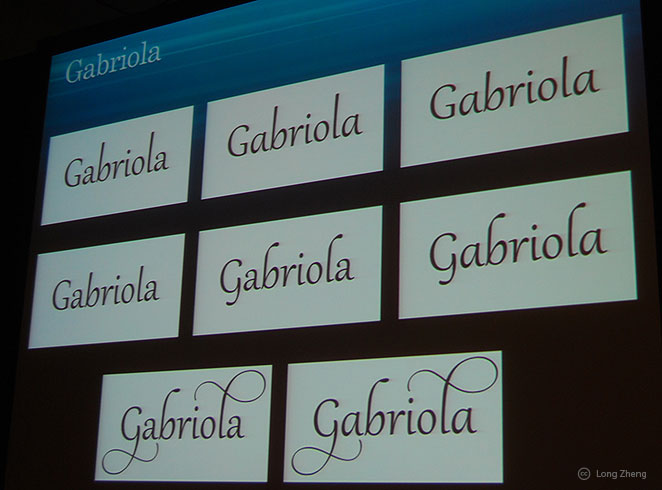

It’s an OT script design with Flemish roots by John Hudson, he gave us a preview at Typecon.

John is quite adamant that Gabriola is not a "script" font - but it seems as if that's what people are calling it (including us - something we need to fix). :-(
http://www.microsoft.com/typography/fonts/font.aspx?FMID=1741
So what is John calling it?
Will point him over here. Anyway here's what he said...
"For the record, I don't consider it a script typeface, since it isn't based on a handwriting model and the letters don't connect."

"Calligraphic font", maybe?

I personally wish (at least in the swash version) that the letters would connect as ligatures. The L and the I would look wonderful if they were connected.

I reserve the term ‘script’ for typefaces that deliberately mimic handwriting, usually -- but not always -- with connecting letters. Although the Gabriola letters have a lot of flow to them and a distinctive pattern of entry and exit strokes, I think of them as essentially typographic forms, not handwritten ones.
The ‘Flemish roots’ to which James refers are really a kind of visual inspiration rather than a model for the letterforms. I was inspired by the look of things like this (by the master Jan van de Velde):
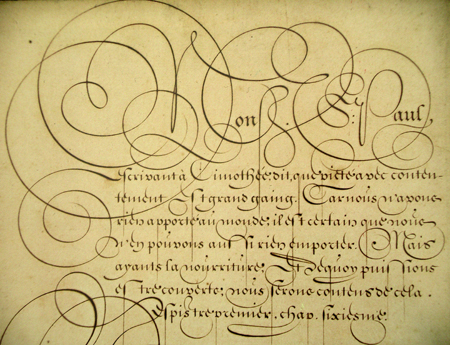
But both the shape of the letterforms and, crucially, their stroke modelling is very different. The Baroque Flemish writing masters used a broad nib which they rotated to produce a greater variety in the pattern of thick and thin strokes than had previously been done. Gabriola is based around an expansion stroke model, closer to that characteristic of a pointed split nib. I'll be talking about the reasons for this during my lecture at St Bride's later this month. The short reason is that the expansion stroke model is more flexible than the translation or rotation models.

Is there a PDF sample or somewhere online we can see Gabriola? Seems like a good reason to switch to Windows to me. ;^)
I've been meaning to make a proper specimen PDF, and I suspect MS would like some online specimen in the web-publishing-format-of-the-week. But I have not found time to do this and doubt if I will any time soon.
Here is a sample I made to show someone:
http://www.tiro.com/John/Gab4CH.pdf
And here is a showing on a local blog:
http://gabriolan.ca/2009/02/08/gabriola-font/
Ideally, we would be looking at Gabriola in Direct Write, which uses a combination of x-direction ClearType and y-direction greyscale antialiasing. This is how Gabriola was designed to be seen.

John:
Gabriola is a classic waiting in the wings. Just lovely!
Bravo and well done!
Off Topic... what’s the status on Plantagenet Novus, al least from what I remember from the specimen, also very lovely.
Mikey :-)

Браво совсем вокруг! Но серьезно славная купель.
Guerrizmo+Design
No man is an island unto himself_John Donne

The image in the previous post is greyscale antialiasing. Here is how Gabriola looks as intended, with ClearType x-direction and greyscale y-direction antialiasing. Unfortunately, I can't show OpenType alternates in this mode with my test tools.


[it] looks as intended, with ClearType x-direction and greyscale y-direction antialiasing.
Sure, it looks much nicer!
But this type of rendering – “ClearType 2” – was intended to be in Vista, but it was not included.* And looking to the screenshots of Windows 7, it is probably not going to be there either.
Web fonts are coming, and how will they look like in headlines? With jaggies (ClearType) or only with greyscale antialiasing. Both ways are certainly not the nicest.
* By included I mean at least a user preference to turn it on, like it was ClearType in XP. Strictly speaking, it is included in Vista, but it can only be accessed by programs which were written specifically with the setting for this type of rendering.
Yes, I wonder about this too. On the one hand, MS are pushing DirectWrite -- as well they should --, and I'm being hired to make fonts specifically with this technology in mind. On the other hand, even Microsoft's own major apps, especially Office, seem unlikely to be rewritten or replaced for DWrite/WPF. But perhaps Web browsers and readers are where we will see this stuff implemented first, since something like IE is a much smaller code base than e.g. Word and without the same backwards compatibility issues.

It's really beautiful and lovely! Good work!

Geraldine talks more about Gabriola on Channel 9
http://channel9.msdn.com/posts/LarryLarsen/The-Importance-of-Gabriola/
Gabriola is beautiful! Will Mac users get it with Office 2010?

Lovely blending of forms, John. It does have some calligraphic thick/thin movement going on in places, but most of it does seem more rooted in traditional typographic form as you pointed out.
Great job!

simply gorgeous

Very tasteful and accomplished.
BTW, what other new fonts does Win7 have?
hhp
simon asked a good question,
perhaps ascender will also sell it?

@hrant: New Fonts in Windows 7 Beta
With the C* fonts being the new Office defaults we felt that they should be made available to designers working on other platforms. You could make a similar, although maybe not quite as compelling argument around Gabriola. I'll run this idea up the flagpole and see who salutes.
@sii - thanks! if this means anything, i actually bought office 2008 for mac 98% just for the fonts. i don't actually use it. so i would be one of those who would upgrade for any new/updated typefaces.
on a related note, since there will be an expanded georgia and verdana soon, will the C* fonts also be expanded at some stage?
First job for the C* fonts was to have their character sets expanded. The Windows 7 versions have much broader coverage for Latin, Greek and Cyrillic based languages, essentially filling out the Unicode ranges for those scripts.
Would love to take the Verdana & Georgia strategy across other fonts, and work with the designers to let them expand the families to meet the needs of graphic designers. If and when that happens I'll be sure to report back.
thanks!
WOW!
digging this thread back up,
is there a reason why this font has a truetype file extension?
thanks

John-
Just beautiful. Forms are pretty much perfect. But I looked at your samples, and these came up:
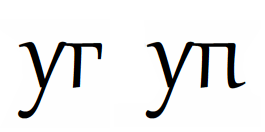
Would you consider ligating these, to loose the bumps?
I only suggest this, since the overall design is pretty much perfect, so these stick out. Probably wouldn't in my design…

Tomi from Suomi -- Probably wouldn't in my design ...
Haha. Yes. With a tiny glyph set of mere 240 glyphs that should not be too hard indeed. Gabriola with its 4500+ glyphs, however, is another league as you may have noticed.
“But perhaps Web browsers and readers are where we will see this stuff [DirectWrite] implemented first”
You were right, John!
Captured from web.archive.org on 18 Feb 2015. view this capture