
Is it illegal to download illegally uploaded fonts? And is it illegal to use them?
This thread ran to 5 pages of replies and only 2 were recovered, so replies are missing.
Is it illegal to download illegally uploaded fonts? And is it illegal to use them?

Do you like people to use your work or services without compensating or paying you? That's basically what it boils down to.
"Legal" as a definition really depends on the laws at a given location and time. But in most cases, yes, it is illegal to download illegally uploaded fonts. You could be found liable. But I'm not a lawyer.

Of course.

why would it not be illegal?
- Scott

I assume that Laurentius is hoping that only the anonymous person who illegally uploaded the fonts is liable, and the person who downloads them and uses them in a project is somehow absolved of any responsibility.
In my opinion in real life the opposite is true, the anonymous uploader stands little chance of being brought to justice, but the person who associates their name with a project that uses unlicensed fonts is 100 times more likely to find themselves in hot water.

To nit-pik, I'm not sure in what context it'd ever be illegal to 'upload' a font.
Putting a file on a server, in and of itself, doesn't typically have any 'illegal' connotations to it.
Now if this server happens to be public, and advertises the fact you can download copies of the file from it, then one could argue there was intent involved and said intent could be construed as being illegal.
Bottom line, if the digital files are protected by copyright or licensing or the like, then yea, any use outside of those parameters could easily be illegal.
Even if it is only for private, noncommercial use?

You are an accomplice. Anything you print can and will be used against you in a court of law.
Well sure, you can use a pirated version of Palatino to write your school paper if that is what you mean. If you want to know more about licencing and what you can and cant use legally and where I would recommend reading Pricing and Ethical Guidelines. Any other reads on this subject?
Movies, music and fonts are handled in different ways.
The reason I ask the question this way, is that I have been told, that downloading movies (from torrents) is not illegal; only uploading (I see no reason to put that in quotation marks) them is.
More practically: would anyone ever ask someone, who noncommercially, perhaps in an academic context, used a font, to shew his licence for it; could that (with legal force) be demanded?

If you know that what you're acquiring was stolen, then you are complicit in the theft.
> Is it illegal to download illegally uploaded fonts?
Generally speaking, you must distinguish two cases:
1) If the design for the downloaded font had been registered (e.g. at the design office in Alicante for Europe) and the registration was valid and is has not yet expired, then downloading of fonts whose design was registered is illegal, if the downloader lives in Europe or in the country where the font had been registered.
2) If the design for the downloaded font was not registered and if the downloader of the uploaded font never concluded any contract with the seller of the font, there does not exist any contractual (or EULA) link between downloader and seller of the font with the consequence that the downloader can only be sued, if the seller proves that the font is a computer program the source code of which was written by a natural person. Nobody can prove this, because fonts are not computer programs written by natural authors. Even Chief Justice Roberts (who was recently seen at the Obama swearing ceremony) would never swear that fonts are computer programs (see http://www.sanskritweb.net/forgers/publicdomain.pdf, pages 2). The fairy tale that fonts are computer programs or "software" was invented to cheat dimwitted font buyers. No sane person believes this rubbish, let alone the American Chief Justice Roberts.
Thanks. Are you saying that one can use any unpaidfor font for any purpose so long as one's computer is not seized and searched? With regard to registration, specifically speaking: Garamond Premier Pro in Europe (not EU, if it makes any difference) -- ?

If you use the font and the foundry happens to notice it and happens to decide to track you down and you don't have a license they can take you to court. It is a risk you take.
> Garamond Premier Pro in Europe
You can search for European font designs here
http://oami.europa.eu/RCDOnline/RequestManager?
For more information about registration see
http://www.sanskritweb.net/forgers/segoe.pdf
and the other documents mentioned therein.
"Are you saying that one can use any unpaidfor font for any purpose so long as one’s computer is not seized and searched?"
You rob a bank if you want.
You'll only go to jail if you get caught and convicted.
I'm still not sure what you are specifically trying to ask.
Uli,
Danke. Die Seite, die Sie mir gezeigt haben, scheint mir zu sagen, dasz die Schütze in allen Fällen nicht auszer der EC gelten. -- Oder habe ich miszverstanden?
Laurentius:
As you have a command of the German language, you should read this German document:
http://www.sanskritweb.net/forgers/eula.pdf
dealings with "The EULA Fraud and How to Get a Legal Remedy".
Since e.g. the German Fontshop (www.fontshop.de) claims that fonts are "computer programs" ("software") and sells "licences" to such claimed "computer programs", you may do the following:
Insert the name of the desired font into the German-language affidavit form on page 5 of the above document eula.pdf and send it to Fontshop in Germany for signing this written affidavit concerning the desired font.
If Fontshop refuses to sign the affidavit, you know that Fontshop falsely claims that fonts are "computer programs" and that Fontshop "sells licences" to non-existing copyrights.
It is evident that you cannot grant a copyright licence to something that is not copyrighted, as everyone understands who is "sane in the brain".
If Fontshop refuses to sign the affidavit, you know that the desired font is not copyrighted, and therefore you can do with this font whatever you want to do, as far as the copyright law is concerned.
This means that all this does not apply to fonts as far as the design law is concerned and which have been validly registered as designs as mentioned above in this thread, because the valid registration as font design protects all forms of the font, even font computer files which are no computer programs. It should be noted, however, that most registered font designs are invalid, because most font designs do not meet the requirements of novelty and individuality (see e.g. the Segoe-Frutiger lawsuit).

First of all: Excuse my English skills.-I know they are worst.
Dear Uli, I know that it isn’t up to you to justify this never ending European Union Regulations nonsense. Once again we are discussing about a »curvature of a cucumber« EC Regulation.
Refering to the Microsoft vs. Linotype (Segoe / Frutiger Next) case:
How can an EC Regulation determine that »similar« is »identical«.
Furthermore, if similar is identical; - how can a judge establish the criteria what is similar or identical in case of a typeface?
Perhaps a stupid example: I suppose everybody knows »Marilyn«, an artwork of Andy Warhol. My question: Is Marilyn 1 similar to Marilyn 2 or 3 or 4 …….. . If they are similar, they are identical (in the opinion of the EU). That means buying Marilyn 1 I bought even Marylin 2, 3, 4, etc. because they are identical. - »Good night Europe«
Another example: Personally I’m »forging« fleurons, ornaments etc. from old »Foundry Specimen Books«. Actually I’m »forging« calligraphic ornaments from Richard Gans Foundry, Madrid. If you look at this example from a Gans Specimen Book from 1922 you will note, that the ornaments are similar but not identical. Why should Gans map those similar ornaments in his specimen if they are identical? Because of their different size? -I don’t think so.
An additional point: It seems that no one in the EU knows the difference between a typeface and a font file. It’s the same difference as between a vector graphic and a .svg file. The graphic is artwork the .svg file is markup or better: code. And code is software.-At least in my humble opinion.
Vertex:
> And code is software
Da Sie Österreicher sind, zitiere ich das österreichische Urhebergesetz:
§ 2. Werke der Literatur im Sinne dieses Gesetzes sind: 1. Sprachwerke aller Art einschließlich Computerprogrammen (§ 40a);
...
§ 40a. (1) Computerprogramme sind Werke im Sinn dieses Gesetzes, wenn sie das Ergebnis der eigenen geistigen Schöpfung ihres Urhebers sind.
Damit gelten meine urheberrechtlichen Erläuterungen
http://www.sanskritweb.net/forgers/computerprogramm.pdf
auch für Österreich.
Verwenden Sie bitte nicht das unklare Wort "Software", denn das österreichische Urhebergesetz spricht von "Computerprogramm", nicht von "Software". (Das amerikanische Urhebergesetz spricht übrigens auch nicht von "software", sondern nur von "computer program".)
Umstritten ist beispielsweise, ob die Hints von PS und OTF fonts als Computerprogramm einzustufen sind. Aber selbst, wenn man sie als solche einstuft, scheitert die Schutzfähigkeit derselben daran, daß sie nicht "das Ergebnis der eigenen geistigen Schöpfung ihres Urhebers sind".
Wenn man z.B. Adobe-AFDKO startet und dann
autohint -a AGaramondPro-Regular.otf
eingibt, wird dieser OTF-Font automatisch gehintet. Aber diese Befehlzeile ist keine "eigene geistige Schöpfung ihres Urhebers", und folglich sind die Hints bei sämtlichen Adobe-Fonts nicht urheberrechtlich geschützt, weil sie allesamt automatisch generiert wurden.
Moderator?

Do any of our moderators sprechen sie argumentative bullschtt?
In TV the metaphor for going too far is called jumping the shark. At Typophile it's called Uli interprets the law.

Stumbling across this post counts as my weekend abroad. I "hear" foreign languages spoken with verbosity, I witness possible illicit activities and I enjoyed all while drinking.
Thanks for the trip, expect postcards.
> argumentative bullschtt
In order to prove that EULAs are "argumentative bullschtt" designed to deceive gullible font buyers, I sent various font orders to managers and lawyers of various font houses requesting them to fill in the accompanied affidavit form:
Affidavit:
This is to certify that __________, called "font software" in the EULA, is a computer program, i.e. a set of statements, as defined by the Copyright Law, that the source code of this set of statements was written by __________, and that this "font software" is protected by copyright.
I solemnly swear that the foregoing statements are true and correct to the best of my knowledge and belief.
Signature of __________
None of the managers and none of the lawyers of font houses certified that the "font software" is protected by copyright.
This means that the font EULA is "argumentative bullschtt" drafted by lawyers for the purpose of deceiving dimwitted, gullible font buyers, who are expected to certify via EULA that fonts are protected by copyright, while the managers of font houses and their lawyers would never certify that fonts are protected by copyright.
Definitively certifiable.
>Definitively certifiable
Good pun.
For example, the Linotype lawyers request "certifiable" font buyers to certify this legal "bullschtt":
"3.2 The licensee agrees that the Font Software and documentation, and all copies thereof, are owned by Linotype GmbH; and its design, structure, organization and encoding are valuable property of Linotype GmbH and/or its suppliers. The licensee agrees that the Font Software and documentation are protected by German trademark and design patent laws, by the copyright and trademark laws of other countries, and by international treaties. In addition, the licensee agrees to treat the Font Software and documentation in the same manner corresponding to other copyrighted and trademark-protected products, e.g., books. With the exception of the points explicitly mentioned here, copying the Font Software and documentation is not permitted. Any and all copies that the licensee is permitted to produce on the basis of this agreement have to have to contain the same copyright, trademark and other property clauses as those on or contained in the Font Software and documentation. The licensee declares not to modify, adapt or translate the encoding of the Font Software, nor reproduce, decompile, disassemble, change, modify or otherwise attempt to reveal the source code of the Font Software."
But the Linotype lawyers would never certify this legal "bullschtt".

There we go again (rolls eyes).

A non-freeware or non-shareware font is uploaded in violation of its user agreement, which prohibits illegal distribution. Similarly, when it is downloaded and used, the user agreement is violated.
No police or recourse will likely occur, unless there is substantial business being made.
Most designers and font makers make very little money with this kind of software. Such illegal action causes them to make even less.
In Orthodox Judaism, such illegal conduct has brought respondsa from leading Rabbinic authorities prohibiting explicitly this action. As a result, ones share in the world to come is jeopardized. Imagine for a $25 to $50 cost, the resulting transgression may cause a person to forego "heaven" and receive instead time in "hell".
Israel, very well put. A person's font sins will catch up with them in this life or the next. Those of us with font sins in our past make atonement by endlessly contributing to typophile threads like this one.

And if I release a sins serif design, will this assure my place in heaven?
@sii - endlessly? or needlessly?
@speter - shouldn't that be "sans sins serif"? I think "sins serif" would be a bit warmer!
Cool, I'm atheist. I wasn't going to heaven anyways. Off to download illegal stuff!...

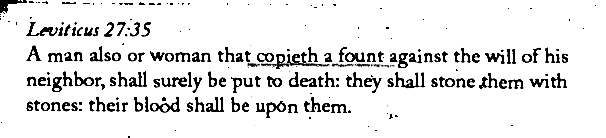
Ivan, your copy is surely suspect. I believe the original says: "...they shall stone them with Stone Sans..."
>Cool, I’m atheist.
I did say this life or the next. The type gods walk among us.
And as we stand on their shoulders we're somewhat in a precarious position.
Steve:
Depends on the translation. The twelfth ecumenical council passed a retroactive ruling that effectively removed all mentions of StoneSans, making any further (or prior) references to it tantamount to heresy.
_____________________________________________
Personal Art and Design Portal of Ivan Gulkov
www.ivangdesign.com

Uli standeth on the shoulders of a dwarf! A very small, diminutive dwarf of no particular influence whatsoever.
Here endeth the leththon! (fack-fack-fack-fack-fack! quack-quack-quack! Quack-facker. Uli need him a psyche doktor. Yah boo, we think yoo stink, hehe! And it vewy vewy funnaye.)
You have just witnessed an ad hominem attack.
Moo. I been entertained. Hello I must be going etcetera.
j a m e s
Perhaps I will publish my correspondence with major font sellers at my website. Look, for example, at Linotype and Monotype:
How come that neither Jan Kaestner as the "European Legal Counsel" nor Frank Wildenberg as the "General Manager" of the Linotype GmbH had the courage to certify what they expect font buyers to certify by way of EULA? The answer is quite simple: If Jan Kaestner and Frank Wildenberg certified that the fonts sold by Linotype and Monotype are copyright, they would commit the crime of false affidavit, and therefore they are frightened to make the false statement that the fonts they sell are copyright. But they still expect their font buyers to make this false statement via EULA.
Uli, what will happen to all the little people like me (independent type founder, designer of original typefaces) when you have blown down this house of cards?
If this happens, I suppose we'll have to stop appealing to non-enforceable laws, and concentrate on basic human decency, values of good craftsmanship and personal dignity. Yeah..that's gonna work...
_____________________________________________
Personal Art and Design Portal of Ivan Gulkov
www.ivangdesign.com

(sorry) get to repost.
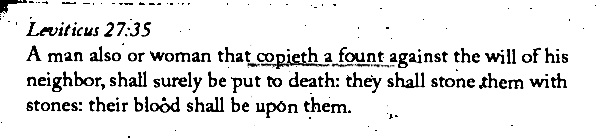

"they shall stone them with Stone Sans"
LMAO!

We'll never get anywhere arguing over the legality of piracy with people who believe the inherent basis of licensing is extralegal.
Why not use an ethical argument instead? For any even slightly ethically consistent human being, ethics are - or should be - INFINITELY more important than the legality of any particular practice.
If you think it's ethical to, for personal entertainment or material enrichment, take the fruit of another's labor without remuneration, then I'm afraid that you are a stunted and malformed human being who can never truly appreciate the work of another individual.

And if I release a sins serif design, will this assure my place in heaven?
Steve, I hear that indulgences are once again available... Much easier than designing a typeface sans sin. ;-)

Doritos, fonts, what's the dif?
.
-=®=-
jlt:
> If you think it’s ethical to ... take the fruit of another’s labor without remuneration ...
That's what's done by the major font sellers. Most font designers receive no royalties at all for the fonts sold by Linotype, Monotype, Berthold, etc. If fonts were copyrightable, then even decades after the designers's death, their heirs could claim royalties. But neither Max Miedinger nor his heirs receive royalties from Linotype for the sale of Helvetica. This means that Linotype, Monotype, Berthold, etc. "take the fruit of another's labor without remuneration", as you put it. There are exceptions to this rule (Adrian Frutiger, Hermann Zapf, etc.), but for more the majority of fonts sold by Linotype, Monotype, Berthold, etc., this rule is valid.

@Ricardo: "... indulgences ..."
What a hoot! Nearly spilled my morning coffee while laughing.

Laurentius,
The short answer to your question is, yes.
Using stolen property, transporting stolen property, or passing on stolen property is against the law. Like any lawbreaker, sometimes you get caught, sometimes you don't.
ChrisL
I feel like we are witnessing legal arguments between Perry Mason wannabees and the Cochran Group fan club. The legal brief sounds like a Uligy to me. :-)
ChrisL

U.S. Copyright Code, Title 17, Section 101 "Definitions":
A “computer program” is a set of statements or instructions to be used directly
or indirectly in a computer in order to bring about a certain result. (5)
[. . .]
(5) In 1980, the definition of “computer program” was added to section 101. Pub. L. No. 96-517, 94 Stat. 3015, 3028. The Intellectual Property and High Technology Technical Amendments Act of 2002 amended section 101 by moving the definition for computer program from the end of section 101 to be in alphabetical order, after “compilation.” Pub. L. No. 107-273, 116 Stat. 1758, 1909."
This is a moot point.
Many fonts with OpenType features have "proper" code written by the type designer, e.g.
lookup smcp_latn1 {
sub @smcp_latn1 by @smcp_latn2;
sub @figs_numr by @figs_sups;
sub @figs_dnom by @figs_sinf;
} smcp_latn1;
With that piece of original coding, I downsize fraction number glyphs for small caps--perhaps I should apply for a patent?
**
It's unfortunate for type designers, but most people don't understand that type design is not just about making attractive-looking letters, but concerns the visual mechanics of how letters fit with one another. Of course, if one looks at letters individually, they don't appear to have much originality--but the same could be said of the components of music or literature. The way type design is treated, it's like the only novel that could be copyright protected would be entirely composed of neologisms, or shizzolated, which would be the equivalent of the gimmick fonts shown in the Lipton tract.

In Canada, “every original literary, dramatic, musical and artistic work” is subject to copyright. "Literary work" includes computer programs, and "computer program" means "a set of instructions or statements, expressed, fixed, embodied or stored in any manner, that is to be used directly or indirectly in a computer in order to bring about a specific result".
However, in Canada, downloading for private study or other fair dealing purpose is not illegal even if the uploading was illegal.
The Lipton article is very interesting, albeit in need of much work. I want to give her feedback in hope of improving it, but a first pass suggests that writing up such feedback will be an all-day endeavor. :(
Cheers,
T
This debate about software and code is weird. Who writes assembly code (or Basic for that matter) by hand?
Who writes PostScript by hand? POP, anyone? Compilers of all levels have been in use for decades, and yet all resulting software is protected by copyright.
%%EOF
>Who writes PostScript by hand? POP, anyone?
Yes, Pop did write PostScript by hand for years. We miss him :-(
Goodonya, Sii :)
who said anything about writing by hand?
By studying the internals of “Benton Sans”, I came to the conclusion that no human being ever wrote any source code to this so-called “font software”.
...
When a real professional, for instance someone like Juri Yarmola, who is both a programming expert and a font expert, compares the internals of any letter from the version of 2003 with the internals of the corresponding letter from the version of 2008, for instance these two letter internals
2003: 68 CC B9 B7 76 D9 80 8B 05 E0 17 9B FD C3 47 EB 1F F2 2F E4 6D 79 15 31 91
2008: 68 CC B9 B7 76 D9 80 8B 68 11 BD BC BC D3 47 18 2C 5B 2E B4 6F C0 35 E7 2F 78 EA 93 34 4B 26 29 08 F5 E9 66
then he will recognize at once that nobody wrote the “source code” of the so-called “font software”, because completely different drawing sequences had been generated fully automatically by two completely different font generating programs in 2003 and 2008.
How about reading the thread?
Who writes PostScript by hand?
Anything is possible in the alternate reality known as "The Uliverse".
"Source code" of my comment:
http://www.sanskritweb.net/temporary/PostScript.ps
"Object code" of my comment:
http://www.sanskritweb.net/temporary/PostScript.pdf
PS: Mr. Berlow went into hiding, no?

@Phinney: "a first pass suggests that writing up such feedback will be an all-day endeavor."
All of an earth day, or you traveling on Saturn where you might have a chance to react in a "day"? ;)
@Uli: I apologize for making such rude remarks about Matthew, Mike and Roger, who are not here to defend themselves, and wouldn't even if they were here because I'm such a rude and verbosely argumentative person they couldn't stay long anyway."
Accepted.
@Uli: I'm also sorry I don't really know much about how all this works, I'm just trying to learn by making wild statements and seeing what happens.
That's what I thought! :) e.g. At the US Copyright Office nobody examines, whether that which you submit for registration is copyrightable or not. Lawyers should know how this works but since Lipton says it's an issue Uli must jump! I know how it works — class?
Cheers!
EK:
> who said anything about writing by hand?
Nowadays, it is possible to produce "computer-generated works" instead of writing works "by hand".
see www.law.duke.edu/journals/dltr/articles/2001dltr0024.html
A typical example of computer-generated works is the conversion of fonts from one format to another. Let's assume, you have 1000 fonts in PostScript format, which you want to convert to TrueType fonts. If you use a converter (e.g. TransType, see www.fontlab.com/font-converter/transtype), your only own "creative" activity will consist in clicking on the folder, so that the converter knows the fonts you want to convert. Then, it generates fully automatically 1000 TrueType fonts as computer-generated works.
Do you think you have become the author of 1000 copyrightable works?
I was just responding to someone's comment about writing by hand, since I didn't understand where it came from.
@people-reading-Uli: In the conversion example, it's a derivative work. Usual guidelines for derivative works apply.
@Dave Berlow: I finished writing up all my comments on the article today. I just need to write a nice letter to go with it, &c.
Mr. Thomas Phinney:
> @people-reading-Uli: In the conversion example, it’s a derivative work. Usual guidelines for derivative works apply.
This Being is Nothingness!
Copyright protection is only granted to authors of intellectual works. Copyright law rewards the creative intellectual activity of authors. A work of authorship is a work created by the own intellect of the autor. If a person does not exercise his own intellect, he cannot be the author of an intellectual work and hence cannot be granted copyright protection.
Here is a fictitious example, which is easier to understand than the above font conversion example:
At the website of Mr. Ricardo Cordoba, who uploaded above "Twilight Zone" picture, we learn that he learnt the English and the Spanish language so that he has the intellectual ability to create works of authorship in English and Spanish. But Mr. Cordoba did not learn the French and the German language, so that he does not have the intellectual ability to create works of authorship in French and German.
Now let's assume there is a copyright lawsuit, and Mr. Cordoba as a defendant states that he translated Sartre's French work "L'être et le néant"
www.amazon.fr/LEtre-N%C3%A9ant-Jean-Paul-Sartre/dp/2070293882
(For English see www.en.wikipedia.org/wiki/Being_and_Nothingness)
into the German language. The judge asks whether Mr. Cordoba can read and write French and German books, which is denied by Mr. Cordoba, who claims that no knowledge of languages is require for copyright protection, because he bought a computer translation program which made a fully automatic translation of the electronic file of the French work "L'être et le néant" into the German language so that he is the author of the German translation "Das Sein und das Nichts" as a derivative work of copyright.
Is this correct?
Who does not exercise his own intellect cannot be the author of intellectual works and therefore cannot be granted protection by the copyright law.
Another example: Mr. Thomas Phinney and Mr. Miguel Sousa repeatedly stated here and elsewhere that all Adobe PostScript and OpenType fonts are fully automatically hinted by entering a simple command line such as
autohint -a AGaramondPro-Regular.otf
Irrespective of whether hints of PostScript fonts are regarded as computer programs or not, they are generated fully automatically so that he who enters above command line does not need to have any intellectual ability whatsoever except the ability to enter the command line. But he who does not exercise his own intellect cannot be the author of intellectual works so that nobody can be granted protection by the copyright law for automatically generated hints of PostScript fonts.
But he who does not exercise his own intellect cannot be the author of intellectual works so that nobody can be granted protection by the copyright law for automatically generated hints of PostScript fonts.
Finally, Uli, you wrote something I agreed with. Let's both mark this day on our calendars, shall we?
Haven't heard back from Ms Lipton yet. If she's interested in it, it will be interesting to see how she reacts to my initial 1800 words of commentary.
Cheers,
T
> Let’s both mark this day on our calendars, shall we?
YES.
I have heard from others that you are a very fine chap, and I wish you were not my intellectual opponent in copyright law matters.
Mr. Nick Shinn:
> This is a moot point. Many fonts with OpenType features have “proper” code written by the type designer, e.g.
lookup smcp_latn1 {
sub @smcp_latn1 by @smcp_latn2;
sub @figs_numr by @figs_sups;
sub @figs_dnom by @figs_sinf;
} smcp_latn1;
I consulted the OpenType font format specifications here:
http://www.microsoft.com/Typography/otspec/chapter2.htm
If I understand these OpenType specifications correctly, then GSUB definitions, which at first glance look, as if they were the source code of an executable computer program, are not compiled into an executable program, but instead a non-executable lookup data table is generated on the basis of this pseudo code. If my assumption is correct, then OpenType features are not computer programs, but only binary data, i.e. binary lookup tables. But those who are more familiar with the internal structure of OpenType features may correct me.
PS: In the above chapter2.htm, the word "program" is used nowhere, and the word "code" is used in this chapter only in the sense of Unicode, character code etc.

Uli, if you read the definition Kent posted, above, in the US copyright code, a computer program (= software) is any set of statements or instructions that results "directly or indirectly" in bringing about "a certain result". In this case the result is the rasterized character. Thus both the sets of numbers representing nodes and handles--the code for the glyphs--and the open type code are software.
If I'm not mistaken, at the level of machine code, every statement is a number or set of numbers. The computer only knows numbers.
Mr. Berkson:
It is now exactly six years ago, that I studied the technical details of the data structures of OpenType feature lookup tables, so that I cannot answer your question exactly (this would require for me to study the data structures again in detail, and for this again I do not have enough time right now).
Who does not exercise his own intellect cannot be the author of intellectual works and therefore cannot be granted protection by the copyright law.
In "sweat of the brow" jurisdictions, this is not so clear.
It is now exactly six years ago, that I studied the technical details of the data structures of OpenType feature lookup tables, so that I cannot answer your question exactly
Not a question in question, more a statement.
Obfuscation, evasion, leaps in arguments, verbosity, scholarly jargon misused, pretentiousness, browbeating: what weaponry.
Wait, I forgot vomit.
Sent my thoughts off to Ms Lipton after a pleasant email. I should mention that she characterized the paper as "an early draft."
Cheers,
T
At the website of Mr. Ricardo Cordoba
Uli, I do not have a website... Maybe you were looking at my online portfolio, but that is not my website.
Also, I do not like the way you strike back at people who make a joke... You do not joke... ever. You are much too serious. Not to mention bitter, and retaliatory. Something is indeed wrong with your programming.
If I understand these OpenType specifications correctly
I seriously doubt you understand anything correctly. But what's worse, there are a lot of people here, patiently trying to reason with you, and you continue to be obstinate... extremely so.
Mr. Ricardo Cordoba:
> I seriously doubt you understand anything correctly.
I have written a lot of books, most of them reprinted in second and third editions, and the books written by me also include four books about computer programming.
But you may continue to seriously doubt that I understand anything correctly. I think that you yourself never doubt that you yourself understand anything correctly.
Ricardo, I think he mistook you for Ricardo Montalban, he has a website :-)
ChrisL

I was always under the assumption that 'software' can actually be anything which is not hardware.
So i.e. databases or libraries are to be considered software as well, although you would need a 'program' to produce any kind of result out of them. In this respect digital font files should be considered software as well.
Further, I find it hard to belief that digital font files that have not manually been written bite by bite can not be copyrighted.
This would mean that one also can not claim copyright for jpg files exported from Photoshop or pdf files exported from a lay-out application.
Best,
Artur
Mr. Schmal:
> This would mean that one also can not claim copyright for jpg files exported from Photoshop or pdf files exported from a lay-out application.
For you in the Netherlands, all creative "works of art", whether drawn or painted, whether a picture on paper or a picture file (jpg, tif, bmp etc.), are protected by copyright law, but you cannot claim a separate copyright for a jpg file of a painting. But since paintings in whatever physical form are copyright as "works of art", why do need a separate copyright for jpg files?
By the way, in the German Nazi era, a few "Nazi" typefaces had been regarded by the third "Reich" supreme court as "works of art". Some of these "works of art" ("kunstwerk" in German and Dutch language) are depicted here:
"Obfuscation, evasion, leaps in arguments, verbosity, scholarly jargon misused, pretentiousness, browbeating: what weaponry."
You cannot be talking about Uli the "humanist", can u?
"I should mention that she characterized the paper as “an early draft.”
Hey! that's what they called the Titanic too.
Cheers!
I think that jlt said it best, earlier in this thread:
The world is hard enough - why would you knowingly add to the amount of unpleasantness in it? Don’t you have better things to do with your existence?
a lot of fancy language here being used to justify unethical behavior (mostly blaming even more unethical behavior on foundries).
what is the point of living unethically? who really benefits? does it make the world better?
these are not questions for uli to ask the rest of us, but for him to ask himself.
nobody is being converted here. i think this would work better as an internal dialogue, a topic for meditation.

Well, skipping Uli and opponents, coming back to the original question:
No, it's not illegal to download illegally uploaded fonts. However it would be "illegal" to use them. So what's the point in d/l-ing them in the first place then??*
[Though if I understand it correctly, _technically_ it wouldn't even be illegal to use them, merely not rightful. (Or is it only me who understands the word "legal" as a public law expression, not applicable in civil law, where you might not have the right to do something, e.g. not the licence to use the font)].
Szabolcs
*) Of course there might be cases, e.g. as the abovementioned private study, etc.:
However, in Canada, downloading for private study or other fair dealing purpose is not illegal even if the uploading was illegal.

> For you in the Netherlands, all creative “works of art”, whether drawn or painted, whether a picture on paper or a picture file (jpg, tif, bmp etc.), are protected by copyright law
So how does this apply to type designs / typefaces / fonts then (in the Netherlands)?
I thought it also applied to these, but with all the vague debates about it, I don't know anymore.
http://www.wipo.int/copyright/en/
http://en.wikisource.org/wiki/Universal_Copyright_Convention_(Geneva_Act)
http://en.wikipedia.org/wiki/Universal_Copyright_Convention
I'm kind of surprised that a discussion about if it OK or not to use stuff somebody elses swiped would go on for so long. Maybe I'm missing something, but it dosen't seem like there is much of a grey area here.
Is it OK to accept a stereo that "fell of the back of a truck"?
Well... No. It's not, but if you are determined to do so any how, it's your conscience.
-=®=-
The analogy to a physical object fails (again). The owner of the stereo has been illegally dispossessed. The owner of the copyright may have lost a profit, but profits are only protected in part by the law, and the nature of the protection is fundamentally different.
Moreover, the creator of this thread asked if downloading and using is illegal, not if it offends anyone's conscience.
If you've followed the discussion here, you should have understood that there is nothing to prevent downloading of the fonts (certainly not in Canada) and that the legality of use is determined by the type of use, and not by the manner the fonts were acquired. Creators have rights, and so do users.
Come to think of it, I actually find it kinda funny to ask these kind of questions on Typophile. For all we know it the illegal fonts he is talking about were designed by one of the people posting in this thread. Which would basically change the question to "Hai gais, I found yer font illegally, can I haz it for free???/ I don't care if u dont get money!!1".
The idea that digital content, just because it is easy to copy, is somehow exempt from the rules that apply to physical content (an idea similar to the notion that "information wants to be free"), is at least partly to blame for the sorry state of the music and newspaper industries... and probably some other industries, too.
I'm afraid you have it all wrong, Ricardo. Suppose you open a business and do well. Suppose I open a competing business across the street and take away some of your business. I caused you economic harm. I may even took advantage of your efforts, since some of my clients only became aware of my business by coming to you first.
Yet, the fact that I caused you economic harm doesn't mean I took away your property. Your profits are not legally protected (unless I violated some other right of yours, e.g., your trade-mark, or by "passing-off").
The term "intellectual property" misleads you into believing that your economic interests are protected beyond the scope of copyright, trade-mark, unfair competition, and other recognized categories of law. The right to exclusive profit from your creative work is not a natural right, but one that requires legislation.
If you fix your creative efforts in a physical medium, your property rights in the tangible are protected. In addition, the law prohibits others from unauthorized copying, unless it is for a permitted use (e.g., private study). But you cannot claim more than that.
Yes, some creators deserve better, but it is not possible to build a theory of property rights based on stomping one's foot and yelling, "unfair!".
The right to exclusive profit from your creative work is not a natural right, but one that requires legislation.
I'm quite aware of this; thanks anyway. However, the law is what permits society to exist -- it's an agreement or a contract. I could go set fire to my neighbor's house, but I don't. Not only because it's against the law, but because I would feel bad if I did it. It would just be wrong, period.
As russellm said above,
Is it OK to accept a stereo that “fell of the back of a truck”?
Well... No. It’s not, but if you are determined to do so any how, it’s your conscience.
Actually you are right saying: it's law that makes society work.
However, it's equally true, that it's more often than not actual law and legal, juridical practice (which does contradict moral law and conscience) that enables profits. I don't want to point to Wall Street here, for a most obvious and current example. ;-) ——— and I think, that–partially–it's similar reasons that motivates Uli (when attacking business practices of "big" foundries–nota bene, never directly designers), e.g.
Szabolcs
never directly designers
Huh? I could not be further away from Wall Street in any terms, yet I rely on the copyright protection to derive my (meagre) income from my font's sales.
To see the illegal use (read theft) of fonts repeatedly and systematically promoted on a forum ostensibly dedicated to font design and typography makes me wonder. Wouldn't a warez forum be more appropriate for this?
@Ricardo: if everyone agreed about what's "ok", we wouldn't need the law, would we?
@Paragraph: you are still confusing theft with unlawful use, as theft leaves the owner without the thing stolen, while unlawful use does not. There are cases where the user believes he was entitled to the use and the copyright holder does not; sometimes a court finds for the former, sometimes for the latter, but there's no theft there.
@Paragraph2: And where did you see "illegal use promoted" here?
if everyone agreed about what’s “ok”, we wouldn’t need the law, would we?
It's a social contract. You can play by the rules or not. No one ever said otherwise.
But if someone doesn't play by the rules and gets caught, there are consequences. Just like there are consequences for playing by the rules.
EK, there are many threads such as this here, and they all revolve around using fonts without a licence. Anyone who argues for whatever reason that there is no copyright on fonts because they are not software or because they are not original enough is doing exactly that. I for one think that the original poster was having a bit of fun: why else put ‘illegal’ into the question three times?
Is it illegal to download illegally uploaded fonts? And is it illegal to use them?
As before, how about reading the thread?
I have to wonder at your question, since it's been dealt with extensively in this thread, including by some of your colleagues: No, the act of downloading is not illegal per se. As to the use, it may or may not be legal, regardless of the source of the font.
There is a fundamental flaw in your post, which you may refuse to acknowledge, but that's ok, since the law is the law no matter what you or I think, and the flaw is this: a licensed use is lawful, but an unlicensed use is not necessarily unlawful, since the law gives users rights, too. So, a creator might say, I don't allow my work to be used by X for purpose Y, and the law would answer that the creator's permission is not required. The fact that copyright exists in fonts, in countries where it does exist, does not mean that the rights of the copyright holder are unlimited, but that the font is property to the extent the statute says so and no more. If that is not clear to you, I can refer you to some good sources from Australia and other common law jurisdictions.
Oh please. Can we just settle on:
The fact that copyright exists in fonts, in countries where it does exist
and be done with it? That's actually all I'm asking.
Captured from web.archive.org on 17 Oct 2013. view this capture
