
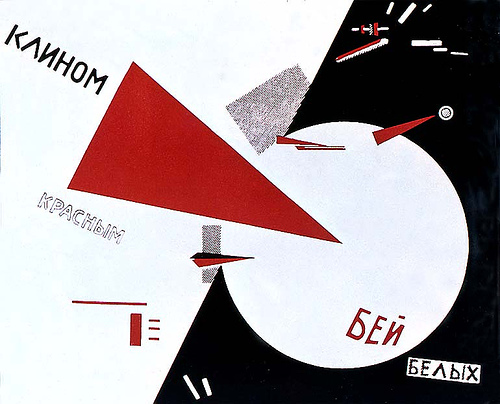
One Design Period that I found interesting was the period of Russian Constructivism. It aided the Red Revolution and brought in the Soviet Regime. It rejected the idea of "art for art's sake" and took more interest in function over form. Red, white, black, and yellow were mostly used. I also liked the use of arrows to make objects within a piece of work look like they were moving or breaking.
Bauhaus, formed by the school "Bauhaus", was directly influenced by Russian Constructivism and started in Germany with the abolition of censorship at the end of WWI. The most basic principles is that form and function are equal. You should not go out of your way just in order to make something of decoration, but at the same time, things should be practical and looking nice is practical. This is not art for art's sake. Art should meet the needs of the society it was made for, or be replaced. The picture that goes with this is that of the building that this school met in, which was also built for a specific purpose.

Post-modernism is my third and last chosen design period of the 20th Century. It's the complete opposite of Constructivism and Bauhaus. Post-modernism is art for art's sake. Anything from abstract expressionism to conceptual art to installations of sorts fall under this category. People really stepped out of the box during this period to do some pretty out there and different things.
