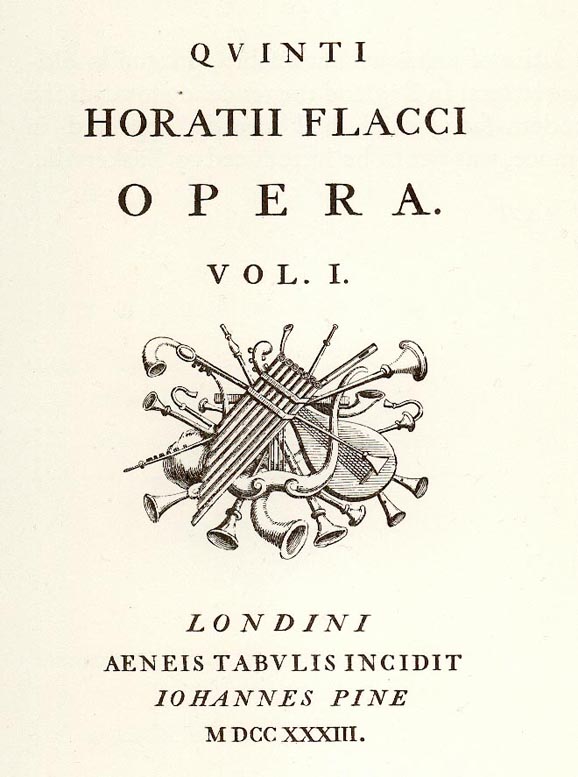
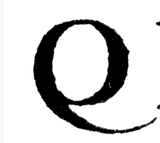
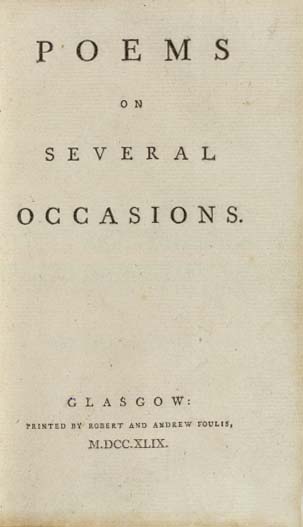
A few months ago, there was a lively discussion -- taking off orthogonally from a discussion of Noordzij's distinction between rule and law -- regarding the origins of the English neoclassical style of type associated with John Baskerville. During this, James Mosley brought to our attention a plate from George Shelley's Alphabets in all the hands of 1715, along with Beatrice Warde's observation that ‘Baskerville was only the first to admit into the typefoundry a type that had been clamouring outside its door for at least half a century.’
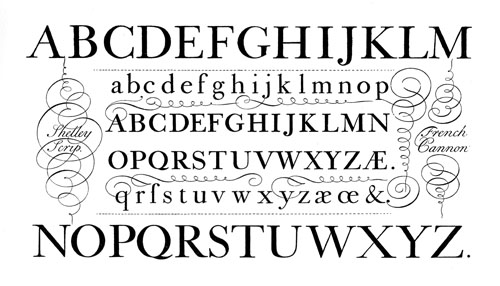
This sent me in search of other examples of neoclassical roman letters among the works of writing masters, and the earliest I found was in an earlier work by Shelley: Natural Writing in all the Hands, with Variety of Ornament of 1709.
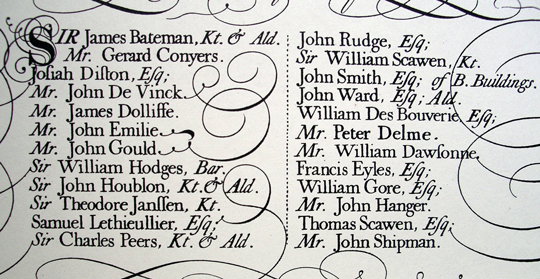
What struck me about Shelley's roman letters, even in the earlier, rougher example, is how mature the style seemed, and I wondered if Shelley could claim to have invented this form of written letters, or only to have perfected it.
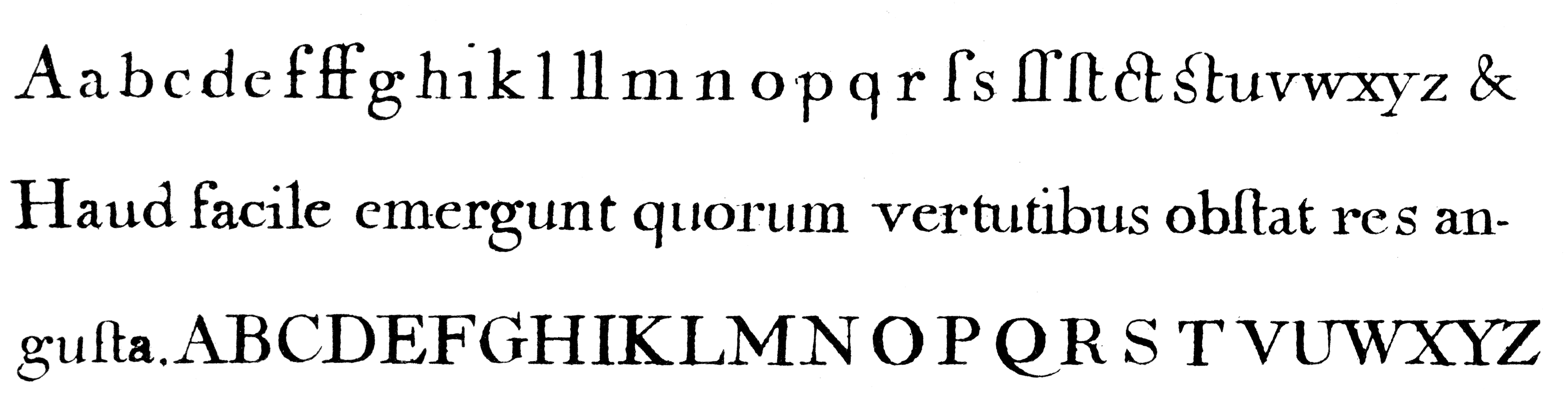
Recently, I came across The Pen-man's Paradise of 1695 by John Seddon (in a fine facsimile edition produced by Jan Tschichold in 1966), which contains these two examples of what I will call proto-neoclassical roman:
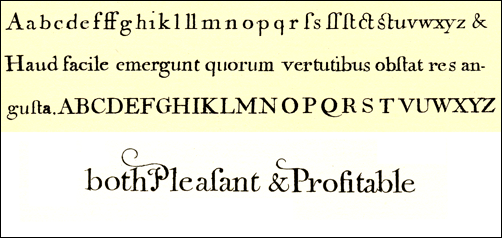
The larger example at the bottom occurs on the title page of the book, amid various other styles, and the specimen above in a plate dated 1695 (a few plates in the book are from the previous year or undated). There are many interesting aspects of this. I call it proto-neoclassical because some of the characteristics that we associate with neoclassical letters are only shakily present: the axis is predominantly vertical, or close to vertical, but is not consistent; the lowercase y is a form rejected from the mature style, as are the serifless descenders on p and q. On the other hand, if one looks at the lowercase a and g, one sees immediately the characteristic forms that we identify as 'Baskerville'.
Seddon was born in 1644 and died in 1700. He was a master at Sir John Johnson's Free Writing School at Priest's Corner, Foster Lane, London. The Pen-mans Paradise both Pleasant and Profitable was the second of three exemplars with which he is associated, the previous being The Ingenious Youth's Companion of 1690. The plates in both volumes were engraved by one John Stuart.
The third book bearing Seddon's name was published posthumously in 1705 under the title The Penman's Magazine, but what is most interesting and exciting about this book is that only the decorative flourishes were by Seddon: the writing exemplars were by George Shelley. The subtitle of the book is a new copy-book, of the English, French and Italian hands, after the best mode; after the originals of John Seddon. Perform'd by George Shelley. So there is a direct connection between the proto-neoclassical roman of John Seddon and the fully mature style written by George Shelley. Given Shelley's dates (c.1666–c.1736), we can assume that he knew Seddon personally; certainly he was familiar with Seddon's published works.
I hope to track down copies of the 1690 and 1705 books.