
This thread is dedicated to words, which, through no fault of their own, are interesting in print.
Words with holes, repetitive shapes, ambiguity, &c:
savvy
assesses
aggregate
modern
filling
Any others?
This thread is dedicated to words, which, through no fault of their own, are interesting in print.
Words with holes, repetitive shapes, ambiguity, &c:
savvy
assesses
aggregate
modern
filling
Any others?

banana
punctuation
filigree
graffiti
titular
boondoggle
representative
look
pool
room
marmalade
geostasis
...everything looks interesting now !

spoon
palpate
sportsl

illigitimate
assassinate

ignoble
narcissistic
atavistic
coterminous
arrogation
Yog-Sothoth
fabulous
Yog-Sothoth
careful…

buckety

«illigitimate»
Illegitimate—not quite as bad when you remove one of the i’s.
Most of those are ‘interesting’ in print more because they contain such very odd combinations (or repetitions) of letters than because of the shape of the individual letters, of course.

Frobozz Electric, Double Fanucci, and of course, the infamous Xyzzy!
_____________________________________________
Personal Art and Design Portal of Ivan Gulkov
www.ivangdesign.com
Helvetica

heavyweight
keyword
polyvinvyl
goggles

beijing

Obama (the answer is always Obama)
Cheers, Si

Suggested by the thread title, and probably more interesting (or rather disgusting) to consider than to see in print: Oceans of Lotions. There was a store with this name.
I dare some writer here to make a story out of all these words. What a hoot it would be.
Dan, go to bed. You are just getting squirrelly.

créée (French feminine version of "created")

bookkeeper
rhythm
unnecessary
aioli
teepee
minimum
oology
Hawaiian
huh
Ohio
suss
Qabalah
onomatopoeia

At the risk of sending this looping in the wrong direction, I think phlegm looks like a funny word.

commaaccent
I love typing that, even though I don't have to, when I'm generating glyphs.
Welsh for sure. They have caps in the middle of words.
Any word can look funny if you look at it long enough, even your name. My first and last names have a lot of repeating characters, tried to make a logo out of that once but it didn't look good.
perfidy
illicit
kreplach
accommodate
callipygian
…Oceans of Lotions…
Dammit Carl, I was just reading about Caligula and then you had to go and put Oceans of Lotions into my head. BLEAH!

vicissitude
Viridian
floor
monopod
alfalfa
Tennessee
fuddy-duddy
pop
Nietzschean
chichi
coccyx

asinine
waffle

Welsh for sure. They have caps in the middle of words.
What, like OpenType? :)
But seriously, I don't recall seeing capital letters in the middle of words when I was growing up in Wales, but I may have simply missed this aspect of the orthography. Can you give me some examples, Patricia?
Aiaia
Sometimes spelled as Aeaea. The name of Circe's island in Homer's Odyssey.
A lot of words in the 1969 Marshallese orthography looked really weird -- actually, they first looked like encoding errors to this non-reader -- because the ampersand was used as a vowel:
Yi'yaqey y&q! Yij yetal gan Hay&l&gļapļap. (Hello! I'm going to Ailinglaplap.)
Actually, 'Ailinglaplap' is a pretty fun word even without the ampersands.
In a more recent orthographic reform the ampersand was replaced by ę, presumably under the slogan 'Ogoneks. Not just for Poles.'
Oceans of Lotions. There was a store with this name.
Presumably they went out of business as a casualty of the new airline security cabin luggage restrictions that the Guardian diary referred to as 'The War on Hand-Cream'.
supercalafragilisticexpialadotious
parterretrap
or:
parterreserretrap
«But seriously, I don’t recall seeing capital letters in the middle of words when I was growing up in Wales, but I may have simply missed this aspect of the orthography. Can you give me some examples, Patricia?»
I think she might possibly be mixing up one Celtic language with another (well, two others): in both Irish and Scottish, when initial consonants are eclipsed, only the original consonant is capitalised, not the eclipsing consonant.
So, for example, bróg ‘shoe’, dlí ‘law’, grá ‘love’, poll ‘hole’, teach ‘house’, and cill ‘church’, if eclipsed and capitalised, would be written thus:
a mBróga ‘their shoes’
a nDlíthe ‘their laws’
i nGrá ‘in love’
i bPoll ‘in a hole’
i dTigh ‘in(side) a house’
i gCill ‘in a church’
Even if written in all-caps, it should still be A mBRÓGA, A nDLÍTHE, &c.
I can’t think of any instance in Welsh where a similar situation would arise, either. Eclipses (or soft lenitions, or whatever you call them in Welsh—Welsh initial mutations confuse me a bit) are, to my knowledge, capitalised normally in Welsh, on the rare occasion that they result in multiple letters. I have a song called Yng Ngolau Ddydd, for instance; not Yng nGolau Ddydd.

revving
anywhere
redivider
WAVY
LAVA
Oshkosh

in Swedish: lyxvillor
in German: Schneeeule, Sauerstoffflasche, Passstraße, Schifffahrt, Betttuch, Schritttempo, Kussszene, Bassstimme, Fetttropfen, Teeei, Kohlenstofffaser, Eisschnelllauf, Fußballländerspiel, Klapppult, Geschirrreiniger, Essstäbchen
It might have been Gaelic, not Welsh, where I saw those words with caps in the middle.
Also Turkish always looks like anagrams to me.

lyxvillor
this one must be somewhat famous as Gerard Unger has petitioned it to be removed from the Swedish language as it wrecks any attempt at typeface fitting with all those diagonals being followed immediately by three straight stroked letters.
A turkish poem. To my western eyes, this language looks soooo strange. Like the Scrabble board before you have started putting the letters into words.
Ben giderim adım kalır
Dostlar beni hatırlasın
Düğün olur bayram gelir
Dostlar beni hatırlasın
Can kafeste durmaz uçar
Dünya bir han konan
Ay dolanır yıllar geçer
Dostlar beni hatırlasın
Can bedenden ayrılacak
Tütmez baca yanmaz ocak
Selam olsun kucak kucak
Dostlar beni hatırlasın
Açar solar türlü çiçek
Kimler gülmüş kim gülecek
Murat yalan ölüm gerçekh
Dostlar beni hatırlasın
Gün ikindi akşam olur
Gör ki başa neler gelir
Veysel gider adı kalır
Dostlar beni hatırlasın
Oceans of Lotions is the best!!
Hot Pants & Coelacanths
Ill.
tchotchke
Ho-Ho-Kus
sexes
I like the x in the middle and the s as bookends. I want to see the last e and s as a mirror image of the first though.
Yes palindromes are nice, I already gave 2 Dutch ones.
What about a palindrome in a phrase like:
"Live not on evil."
Or a very long one from an old Donald Duck magazine (in Dutch):
"Koos Eekfeen keek door 't rood kerkraam maar krek door 't rood keek neef Kees ook."
:)
lyxvillor
this one must be somewhat famous as Gerard Unger has petitioned it to be removed from the Swedish language as it wrecks any attempt at typeface fitting with all those diagonals being followed immediately by three straight stroked letters.
Yes, indeed it is. What makes it even worse is the combination "ill" that follows, which tends to be relatively compact.

Froggy :-P
ChrisL
Actually, Mili should chime in with all those Finnish words with a bazillion double umlauted glyphs.
I also hate strings of i with diacritics all bashed together. I don't know what real words would have such things though and hope they are rare.
ChrisL

Cock-a-doodle-do

Patty, that's enough Scrabulous for you!
Great palindrome:
T Eliot, top bard, notes putrid tang emanating, is sad. I'd assign it a
name: gnat dirt upset on drab pot toilet.

Pizza.
I think it's fascinating that that is one of the first words that children learn to recognize.

I did a logo once for a company called Sahara and loved playing with the type. I think Honolulu is fun to type and say. And I went to High School in Tullahoma, Tennessee. All are places. It seems that places have more funky fun names than other things.
I was born in Quesnel.
«in German: Schneeeule, Sauerstoffflasche, Passstraße, Schifffahrt, Betttuch, Schritttempo, Kussszene, Bassstimme, Fetttropfen, Teeei, Kohlenstofffaser, Eisschnelllauf, Fußballländerspiel, Klapppult, Geschirrreiniger, Essstäbchen»
My German is quite bad, so I might well be wrong, but hasn’t the new(est) spelling reform done away with all those (except Schneeeule and Teeei)? I thought I’d read somewhere that in the new orthography, triple consonants were always reduced to double consonants.
There is of course always the lovely Welsh town of Llanfairpwllgwyngyllgogerychwyrndrobwllllantysiliogogogoch, which, quite apart from being ridiculously long, contains -(b)wllllan- with no less than four l’s in a row. And then goes on to end in -ogogogoch, which, in combo-Scandinavian, would mean ‘andandandand’.
Cauaiauaia (place in Angola) looks odd, too.
Kristina - ;-P
I can't get Scrabulous to load properly right now - maybe that's good cuz I have to do some work.

hasn’t the new(est) spelling reform done away with all those (except Schneeeule and Teeei)?
No, quite on the contrary, IIRC: while the old orthography only allowed triple consonants when they are followed by another consonant (‘Sauerstoffflasche’), now all the Duden has to say about this is to advise to separate compound words with a hyphen, in order to improve legibility (‘Sauerstoff-Flasche’). Triple vocals (‘Teeei’) always have been compulsive.
Additionally, a lot of new triples were introduced by replacing ‘ß’ with ‘ss’ in some words (Paßstraße > Passstraße, also all the other triple-s words that Tim has mentioned. It’s a ‘Missstand’!)
Btw, did you know that H&FJ did a ‘fffl’ ligature for Requiem, only to be used for that one word, ‘Sauerstoffflasche’? (and then they misspelled it in the specimen …)
I found another possible one in an old Duden: ‘Auspuffflamme’ [exhaust flame].
My favourite German triple is ‘Pappplakat’ [cardboard poster].
sexes...I like the x in the middle and the s as bookends. I want to see the last e and s as a mirror image of the first though.
Yeah, I always felt they missed the boat with symmetry. They should have called it moovoom or xiwix or wotow,...something like that.
To be honest, though … having xiw or wot with someone doesn’t sound much like a pleasurable activty.
Florian: H&FJ did a ‘fffl’ ligature for Requiem
As I understand it, German typographic convention is not to form ligatures across word-boundaries in compounds, so 'Sauerstoffflasche' would have a sequence of an ff ligature followed by an fl ligature.
I am currently collecting words containing four or more ascender letters in a row (full ascenders, so t is not counted). Can anyone here think of any, other than the German fffl examples already given and the silly Welsh llll sequence?

Auspuffflamme. Teutonic onomatopoeic genius.
How does one pronounce the triple f?
Actually, the form of the fffl ligature in Requiem is very good and arguably, by differentiating the descender of the third f, provides a nice alternative to breaking ligature formation across a word-boundary.

The coldblooded silkfly gallbladder
To be honest, though … having xiw or wot with someone doesn’t sound much like a pleasurable activty.
To clarify, I meant the word symmetry. Sex is fine as it is.
roooie: Dutch colloquialism for a 1000 NLG note.

Oh, to please Chris, some more Finnish:
ääliö (idiot)
määräilijä (bossy)
mämmi (easter dish)
kämmekkä (a plant)
Töölö (part of Helsinki)
vähälaktoosisia (low lactose, plural)
Ii and Yli-Ii (towns in Northern Finland)
tyylilyyli (stylish lady, a fun word)
tyynynpäällinen (pillow case)
Illi (surname)
ummetus (constipation)
uutuus (novelty)
John: As I understand it, German typographic convention is not to form ligatures across word-boundaries
Yes, you’re right; and yes, H&FJ seem to be aware of that.
four or more ascender letters in a row
Alkflasche coll. [booze bottle]
Fellkleid [fur coat]
Kaffklatsch – a synonym for ‘Dorfgeschwätz’? [jerkwater gossip]
Stoffblume [fabric flower]
Vollblut [thoroughbred]
One could make up a lot more compound words like these.
I found a great list of German triples, compiled by Konstantin Stephan.
Then there is the dazzling German language FAQL site by Ralph Babel. It provides us with four – at least theoretically possible – quadruples:
‘Raaaar’ – an eagle sitting on a rig, ‘Sanaaaal’ – an eel from Sanaa, capital of Yemen), ‘Unfalllloyd’ – a crashed vintage car) and ‘Zoooologe’ – an oologist working in a zoo (those words were found by Gerhard Horriar, Matthias Opatz and Martin Gerdes).
By the way, what do you think of ‘palaeooölogy’? It even has got a Wikipedia entry!
The FAQL site has even more ooddities to offer; see the ‘Rekorde’ page: For example, Richard Sokal made up a word with 15 consonants in a row, describing a combined Russian soup meal: ‘Borschtschschtschi’.
Textwrap: How does one pronounce the triple f?
Basically, not different than a single or double ‘f’. The vocal before (‘u’) is short, and one could insert a subtle pause between ‘Auspuff’ and ‘Flamme’, to make the compound clear.

Recently my favourite German word has been "Energieverbrauchskennzeichnungsverordnung".

THIS:
splatter
^ ^ ^ ^ ^ ^ ^ ^ ^ ^ ^
«By the way, what do you think of ‘palaeooölogy’?»
Good Heavens! I don’t think I’ve ever seen a word before that required the same phonomorpheme to be pronounced three times in a row (albeit allophonically so in English). In Danish (as in German?), it would have three completely identical vowel sounds right after each other. [pʰalɛ.o.o.olo'gi:] for Paläooologie in German, right?
Mili,
I hope I was not being too määräilijä because you actually are a tyylilyyli :-)
ChrisL
«kämmekkä (a plant)»
That’s some kind of orchid, right?
I always think of kännykkä (mobile phone) when I see that word.

gnawgahyde and zanzibar are two of my faves
Chris, lol, no problem!
Oisín, yes, kämmekkä is a wild orchid. Here's Maariankämmekkä:
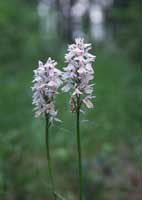

this efficiently concocts apricot cufflinks
Kamehameha
pod
dishonor
Mishap and misled have always bothered me.
I want them to rhyme with bishop and whistled.
nun
jiff
gyp
ingoing
edited
pygmy

balloon
zoom, boom
sound system
mini
deluxe
smooth groove

"... interesting in print."
Maybe σκουλικομερμηγκότρυπα (lit., worm-ant hole) fits the bill.
Or, for shapeliness, try this nonsensical tongue twister:
Ο τζίτζιρας, ο μίτζιρας, ο τζιτζιμιτζιχότζιρας, ανέβηκε στη τζιτζιριά, στη μιτζιριά, στη τζιτζιμιτζιχοτζιριά, κι έκοψε τα τζίτζιρα, τα μίτζιρα, τα τζιτζιμιτζιχότζιρα.
Awaiting an official Dezcom translation on that last item. ;)
I was thinking more of the kind of Greek words that would have "oodles" of (lower case) rho, omicron and sigma, or (capital) Alpha, Delta, and Lambda.
I bet there are some words in Cyrillic script that are pretty heavy on the fence-post effect.

Sex
Héctor
Rho, eh? Okay, try: ρερητόρευκα το ρερητορευμένο ρω (a phrase oft attributed to Demosthenes, meaning "I have accomplished saying the well-known letter rho").
HTH somehow.
Richard
"Awaiting an official Dezcom translation on that last item"
LOL! I believe that translates to: "Jack Sprat could eat no fat and his wife could eat no lean" :-) or else:
Όταν θα πάω κυρά μου στο παζάρι...
Όταν θα πάω κυρά μου στο παζάρι
θα σ'αγοράσω ενα κοκοράκι
το κοκοράκι κικιρικικι να σε ξυπνάει καθέ πρωΐ
Όταν θα πάω κυρά μου στο παζάρι
θα σ'αγοράσω μια κοτούλα
η κοτούλα κοκοκο το κοκοράκι κικιρικικι να σε ξυπνάει καθέ πρωΐ
Όταν θα πάω κυρά μου στο παζάρι
θα σ'αγοράσω ενα σκυλάκι
το σκυλάκι γαβ γαβ γαβ η κοτούλα κοκοκο το κοκοράκι κικιρικικιιιι να σε ξυπνάει καθέ πρωΐιιιι
Όταν θα πάω κυρά μου στο παζάρι
θα σ'αγοράσω μια γατούλα
η γατούλα νιάου νιάου το σκυλάκι γαβ γαβ γαβ η κοτούλα κοκοκο το κοκοράκι κικιρικικι να σε ξυπνάει καθέ πρωΐ
Όταν θα πάω κυρά μου στο παζάρι
θα σ'αγοράσω ενα προβατάκι
το προβατάκι μπε μπε μπε η γατούλα νιάου νιάου το σκυλάκι γαβ γαβ γαβ η κοτούλα κοκοκο το κοκοράκι κικιρικικιιιι να σε ξυπνάει καθέ πρωΐιιιι
ChrisL

Oh come now, anything in Basque if you want lots of the diagonals. It's chock full of z, k, x, and r:
Horren aurrean, alderdi ekintzaleak berari bozkatzeko deialdia mantendu zuen, nahiz eta bozka horiek legez baliogabeak hartu ziren
Granted, no word in particular is interesting, it's just all of them together. Wait, I take that back.
Garagardoa nahi nuke ("Can I have a beer?")
«El futuro es una línea tan fina que apenas nos damos cuenta de pintarla nosotros mismos». (La Luz Oscura, por Javier Guerrero)
Euskera mintzatzen det! (That’s all I know how to say in Basque, and I’m not even sure I’m remembering it correctly...)
I’ve also always thought the word ποιοι looks quite funny.
«Mishap and misled have always bothered me.
I want them to rhyme with bishop and whistled.»
I have that issue with ‘haphazard’. I always want to read it as ‘haffazard’ ['hæfəzəd], rather than hap-hazard ['hæphæzəd].

You might scan this previous thread for some interesting words, including sopravvivere (Italian); niilista (Portuguese); kijiji (Swahili); umhyggju, hrææta (Icelandic); süsüütés (Hungarian); and pretty much everything Polish...
Well, її is a pretty common word in Ukrainian (possessive pronoun "her"), so it's something to add to your kerning pairs in Cyrillic...
A semi-artificial word in Estonian: töööööök ("sickness of the working night")
Also Estonian: Õueaiaäär ("edge of a yard fence")
Roman numerals can form some interesting word forms with all their verticals and diagonals, like XXXVIII.
This is a very oooodly word (at least, in some fonts):
σφόδρα
Some round words in Finnish
poolopaita (polo shirt)
opo (short for opinto-ohjaaja, studies advisor)
kokoelma (collection)
mono (skiing boot)
loppu (the end)
yötyö (night job)
and just for fun
saippuakauppias (soap seller, a famous palindrom)
Typo: Philé-mon in 'Simbabbad de Batbad' (1974, Dargaud)
inchoate
klara

Paleontology.
Now, all we need is for somebody to put all of the words of each language into cohesive paragraphs to make typographic stress tests.
oh, my sister-in-law's name!
lana lamoureux
better still, she's a hair stylist, and her communications material was a dream to design.
Saw this on a side of a boxed wine: doppio passo
The designer took full advantage of the round letters.
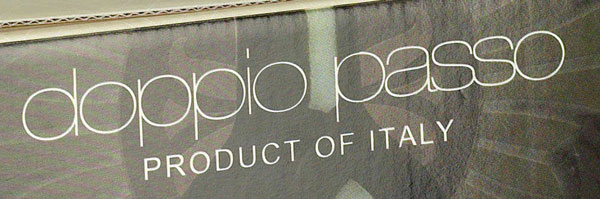

I am surprised nobody had listed these yet.
Poo-poo
Pee-pee
(Sorry, I had to do it)
Sneessensens (‘the essence of snow’s’ in Danish) just occurred to me some time before quite waking up this morning.
Mili, Your "doppio" post reminds me of Bloomingdale's from several years ago (done by Massimo).
ChrisL

"lana lamoureux"
This sounds so much like a Hollywood stage name from the 1930s. Quite a lovely visual rhythm to it though. I hope she had a performing career--perhaps in opera doing Lucia.
ChrisL
Now, all we need is for somebody to put all of the words of each language into cohesive paragraphs to make typographic stress tests.
Nick’s original post reads like a five-word, five-line poem.
My kooky neighbor, a neonatologist from Quebec with a penchant for Xanax and pepperoni pizza, had a hypothesis that Naval Jelly would remove rust most efficiently.
All of the alphabet is in there.
When I first read neonatology, I thought it was about neon.
My opo was annoyed to see me in class wearing a poolopaita so he kicked me with his mono. In loppu, I got a yötyö as a saippuakauppias because nobody cared if I wore something from my kokoelma of poolopaitas. This story was told to me by a tyylilyyli :-)
ChrisL
aachaa!
—“lana lamoureux”
This sounds so much like a Hollywood stage name from the 1930s. —
Chris, isn't it fabulous? 2 lines, no descenders and all those languorous vowels. and an 'x'!
She's a suburban mom from St. Boniface in Winnipeg. :)
But her kids get to say to their classmates, "My mom is the famous Lana Lamoureaux." :-)
ChrisL
Worst name ever: my mom's friend Barbara Fatt who married a guy named Heine. No joke.
My Grandmother had a friend with the maiden name of Strange who married a Mr How.
The newspaper announcement was, "How Strange".
Then there is the politically famous Hog family who named their twin daughters Ima and Yura.
ChrisL
A popular Vietnamese name is Ha. So it is conceivable that at some point there could be a Ha-Ha union announced in Garden Grove, CA.
Better than a Ho-Ho reunion at a 7-11 :-)
ChrisL
Ok, we are going totally off-topic but never mind:
This is the story of Mr and Mrs Peacock, who named their daughter Drew:
http://www.thesun.co.uk/sol/homepage/news/article95505.ece
Well, then, another one: Max Hell, 5, shunned by Catholic school …
Apparently, there is an actual man with the the birth (and current) name Max Flightmaster, and has the rank of Staff Sergent. So he's Staff Sergent Max Flightmaster.
Let's not forget Cardinal Sin, of the Philippines.
There is a gravestone for Dong Suck at Forest Lawn cemetery.
And I also saw a wedding announcement for Sascha Wiener marrying Harlan Wakoff. I hope she didn't hyphenate.
And for the record, Ima Hogg was a real person but she didn't have a sister Yura.
I took a class from Professor Dumm in college.
I needed medicine in Kansas once and was surprised when I was told to just go to the Damm Pharmacy.
Patty,
I can just hear the hostess at the big chain restaurant calling out over the loud speaker, "Dong Suck, party of six!"
ChrisL
Back to the ascenders John had asked for.
Today I saw this old blackletter street sign, and once more I was astonished to see how much more ascenders (and descenders!) we could have with a long s:
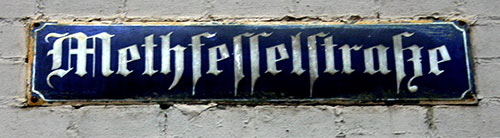
taramasalata: the Greek dip that also serves as a kerning string!
I am a big fan of HAVAWAVAYAVATAVAH for kerning caps but it makes a damn lousy hors d'oeuvre ;-)

MAMMA MIA

je
Chris, i thought that was a Jewish traditional song.
:-) No, Paul, you are confused with "Have a Mug o my eela" a song written by the mother of Jackie Mason's third cousin twice removed, "Ma Chuganah" ;-P

I rarely see these written, but it looks a mess when you do:
A's's
I'd've
I'd'ven't
1. The Oakland Athletics' pitcher - the A's's pitcher
2. I would have gone to the show, but I was ill.
3. I would have not gone, but I had too, it was a class requirement to see the play.

How about "fogeyfying"
I just saw this in one of Nick's articles. I find any word with v or y repeating or in close proximity to be mesmerizing.
"fogeyfying"
I resemble that remark "-)
I'd'ven't
Really? Never heard that one.
Some of my favorite words are in this list of short phrases for typeface specimens.
Aioli
Knurled
Quarks

Have these been mentioned?
Long German palindrome (attributed to Schopenhauer):
Ein Neger mit Gazelle verzagt im Regen nie
(no translation possible because Neger is a no-no word these days).
And the shortest English word with all vowels (if you do not call y a vowel) in their alphabetical order:
facetious
And the shortest English word with all vowels (if you do not call y a vowel) in their alphabetical order: facetious
Excepting the far rarer caesious.
(if you do not call y a vowel)
And if you do?: facetiously
Aeaea (mythological Greek island)

Weltschmerz.

This post just doesn't want to die! It seems to have taken a break between 2008-2010 and again from 2010-2013....and now it's making the rounds on Twitter again.
Has anyone suggested turning this into a Type Challenge for February 2013?.....Come on, throw-down! How about taking just one of the first 20 words in this post and trying to pick the most interesting text setting to submit?
The winner is picked based on choosing the face that best visualizes the inherent rhythmic interest in the word and showcases its own interesting glyphs, the most interesting interaction with the word's semantic meaning, and most refined aesthetic setting.
LIST:
savvy
assesses
aggregate
modern
filling
banana
punctuation
filigree
graffiti
titular
boondoggle
representative
look
pool
room
marmalade
geostasis
spoon
palpate
sportsl
......so as not to be one who throws down a challenge and then runs....
(but I'm not above picking the low-hanging fruit!)
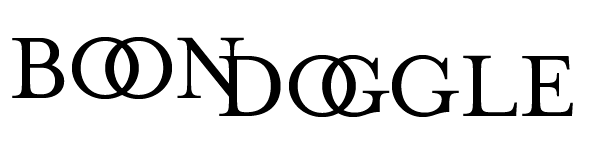

I've been wanting to compile a new list of kerning words. This seems as good a place to start as any.
But, as for my favorite interesting letter combinations:
marijuana
ixixatchil
basilisk
fussbudget
xvart
flumph
phthalocyanine

I've been working on a script font inspired by the word 'minimum', trying to reproduce the unreadability of that word in unical hands...
Captured from web.archive.org on 21 Aug 2019. view this capture