Typophile

Who pays for the font? And how to abide by license agreements.

JaneP

Hi.

Sorry for the double question. Could amount to a jumbled thread.

First: How are most of you handling a situation where you need to use a particular if you're following a client's design standards). Do most of you consider that a business expense or do you bill your client back but then you keep the font for your own use? Just a biz practice question.

The other is about license agreements. I do know they exist but I started reading some threads and was disturbed to find people questioning whether posting a pdf to a website is a violation of an agreement. I know it depends on the license but let's talk generalities.

For starters, back in the day when we didn't make pdfs for printing (I still don't unless asked) and we didn't have the option of NOT sending the font with the job to be printed, weren't we all violating license agreements? How does one get around it?
Expect the printer to purchase the font for every designer's job?

Is the question about pds, either posted to a website or given to a client for approval, a problem because someone could extract the font (I don't see how) or is the issue that they could edit and therefore "use" the font?

If the latter, they can't really create anything new with it so what's the big deal? Are people really having a workflow process where the constantly password protect pdf files?

I have a client who is requiring me to send my print-ready files to their client and they won't take print-ready pdfs that I know of. How do I get around this? Only use fonts that we both already have on our systems?

Any input would be much appreciated.

I consider all fonts licensed a business expense.

I only send PDFs to printers. It solves the problem of having to send fonts to printers.

I also only give clients PDFs as proofs. I never give the client the raw materials.

And, unfortunately, yes. We were all violating the EULAS to which we had agreed when licensing the fonts. O:^o

That is the rub. If you have to give the printer the files they must have a license to the fonts. The only other work-a-round is to only license fonts from foundries that allow this. There are very, very few of these foundries.

If you have to give the client the raw files then anyone who gets the file needs to have a license for the fonts. You can always build this into your estimate on the job and then license for them.

Most of the printers and publishers I know won't accept pdfs for the final job, they need the raw files either for last minute in-house changes or for back up. I think it's absurd that some foundries won't let you embed their fonts in pdfs and knowingly and willfully violate those EULAs.

I don't bill clients for fonts if I plan to keep them for my own use, that isn't right. If it's a font I need to use for a specific job (requested by the client) then I require them to license the font for me and I don't keep it except in the backup file for the job.

Bill clients for fonts that are likely one-offs...only usable for that client.

Otherwise, treat fonts as software--it's a business expense overhead.

Thanks all for your comments.

A couple things: I looked at a couple licenses and there are many options for additional computers at
the same organization. Do most foundries have an add-on license for a font the client already has for example.
Or is it usually necessary to purchase the font again for the designer.

I guess I'm wondering which is cheaper. I can either purchase it myself and use it just for that client.
Or they can add on a license.

Also, I'm still wondering about the past (even though it's better to look to the future). Did licenses change
over the years? I'm still wondering how any of us ever got a job printed before the days of pdfs. Do type
foundries not expect us to get jobs printed? Did they really think that commerical printers would spring
for the fonts used in every designers' job?

I'm not a newbie at this. But I've been breaking laws right and left for years I guess, just to get a job done.
It's just that now, different things have been coming up, like having to give some clients files.
And then there's the prevalence of pdfs. I don't password protect pdfs from editing. I guess I should start.
But then again, no one edits my pdfs. They're only for proofing.

In the past fonts were generally sent to the printer along with Quark files.

Printers would be hesitant to use any fonts they already owned to print your document, in case they were different versions - they might be for example slightly different widths and thus cause text reflow.

If asked the printer would generally claim they deleted your fonts immediately after outputting the job...

Was surprised to note that FontFont/Fontshop's licence actually allows for a copy of the font to be given to the printer for output, as long as the document is not modified.

Our EULA allows embedding in pdf for workflow issues and for sending jobs to the printer but not for commercial products like e-zines distributed via pdf. We also allow copies of our fonts to accompany jobs to the printer.

If any of you are going to TypeCon, be sure to ask me about a new licensing model we are beginning to offer to some of our clients.

James

Three cheers for FontFont and terminal design.

We've all been breaking laws left and right and that's because the EULAs are for the most part unnecessarily restrictive. It seems crazy to ask the printer to license the font for a job, and at whose expense? Just try getting a publisher to purchase multiple licenses for one job.

If there's an honor system, the printer will delete their copy of the font after the job is done, as will the client unless they have their own license. To expect everyone who handles a file to purchase a license seems excessive and impractical. If the client plans to continue to use the font after you deliver the file they should by law purchase their own license, and so should you if you plan to go on using a font given you by a client.

I didn't know the first thing about EULAs until I started hanging out at this forum and I still don't bother to read them line for line when I buy a font. I really wish the foundries would make their licenses more in line with how fonts are actually used (embedded in PDFs, sent to printers with the files) then we wouldn't all be criminals.

I have one publishing client who gives me a list of fonts they already have licensed. I can only use those - fair enough since it's a good list. If I don't already have the font they'll give it to me if I sign a document promising to delete it from my hard drive when the job is completed, but I still preserve a copy of the font in the archive for the job just in case. I betcha they aren't buying additional licenses for the printer.

I think most people want to do the right thing by the EULA but they also want to get their work done. There has to be reasonable EULAs written to make it work or there will continue to be willful countering of EULAs.

ChrisL

That's my point. There will always be piracy but most of us would like to abide by the EULAS. The foundries need designers and if they make their EULAs too restrictive, then either people won't buy the fonts or they'll just violate the EULA in the name of getting the job done.

And for the record, I do tell my clients they are legally required to license the fonts I use. But I don't police them.

I don't think anyone can expect a graphic designer or type user to be the police. Thanks Patty!

ChrisL

Patty, you've bemoaned House Industries's EULA in the past, but they recently updated it. Non-commercial embedding is now allowed.

That's a start. How about sending it to the printer along with the job?

Non-commercial embedding. That should be easy to enforce.

It's ridiculous. I just try to use my conscience and remember that there is someone like me at the end of the font chain - let me rephrase that - someone sort of like me - I don't want to insult anyone… :)

pbc

That's ok Paul, I know what a terrible insult that would be :-)

ChrisL

Thanks for the kindescension Chris! :)

Or is it the commiserableation?

pbc

Most EULAs allow you to sell your font licence (e.g. if you sell your business) and, presumably, also give it away, provided certain conditions are met, such as deleting the files from your own system. So if a EULA forbids sending fonts to a printer, or embedding them in a pdf for printing*, I suppose you could technically transfer ownership of the font to the printer for the time they require it, then have them transfer it back. That's the rationale I use for violating EULAs in this regard, though I don't actually go through these transfer steps.

*One major book manufacturer I deal with prefers jobs submitted as pdfs and actually offers a small discount if they are. I know they have the Adobe Library, but very much doubt if they have licences for the collections of the many small foundries whose fonts I tend to use.

I only send PDFs and haven't been in a situation in InDesign where it wouldn't let me embed - if a font every had it's permissions set so ID couldn't embed it - I would have to stop using it.

I wish there was a published list of such foundries so I could avoid them. If they are not embeddable they are not useful to me at all.

pbc

"I know they have the Adobe Library, but very much doubt if they have licenses for the collections of the many small foundries whose fonts I tend to use."

This is part of the problem. There was a time when the Adobe collection was a pretty big chunk of the PostScript fonts out there. Today, many more players are in the game. A printer who had spent the bucks for the Adobe collection figured he had made his type investment. He figured there would be plenty of repeat uses of most of those faces. Now, with many thousands more possible font choices, a printer isn't so sure he will get repeats from small foundry fonts so he is less likely to purchase them and depend on the customer to supply them for his print job. Embedded pdf files seem like the solution to the printer's dilemma. The trouble comes when clients require native files.

ChrisL

My clients nearly all require native files. It's extremely rare in book publishing to send pdfs to the printer.

Actually, it is more like 50% of all foundries allow transferring. It is dangerous to generalize about stuff like that. And, NONE of the foundries allow you to give the fonts away.

Foundries make EULAs that we cannot follow no matter what our intentions. It reminds one of the government.

Maybe your next book could be rasterized Patty. Maybe a hires jpeg? :)

Or is that against the rules?

pbc

My point is they are only hurting themselves. Until there is a way to digitally protect fonts - which I'm sure is in development - we'll continue to use them as we need to, whether it is in compliance with the EULA or not. If the EULAs were more end-user-friendly, everyone would benefit. If I'm going to pay for a font, I need to be able to actually do my work with it, not just admire it on my computer.

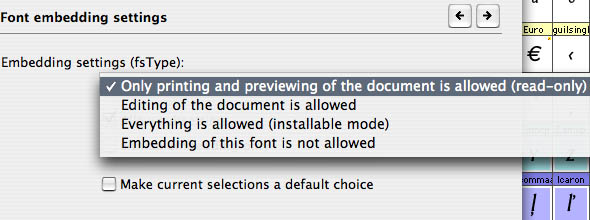
These are the options in FontLab.
Given the prevalence of the pdf workflow these days, many foundries choose option 1; I do.

Patty/Aluminum: I don't think it's wrong to bill the client for job related expenses, including font licenses. I see it less like the design software used to create a design, and more like royalty-free stock photography. If I license a photo for a job, and then find use for it again later, fine (assuming it's not rights managed). This is different than a PMS swatchbook. I won't bill (directly) for a swatchbook since it is a tool, like a printer, or a desk, or pencils. Those things you need to be in business. Fonts, you need for a particular job, so bill to that job.

Actually, I think this approach violates most EULA's less than having the client license, you use, then give to them at the end of the job (effectively a license transfer -- usually a no no). If the client also needs to use a font, we will each purchase a license.

JaneP: I think that if a client requires you to use a typeface for their branding program, they either need to have a license that allows them to distribute the font to contractors, or you should bill them for the license. Attn all New Yorkers (others, google): consider if Dr. Jonathan Zizmore (board certified dermatologist) was your client. You'd be on the hook for at least 50 fonts just to modify one ad. Dr. and Mrs. Z would then, of course, salute graphic designers for their courage! I digress.

Randy

Paul Cutler -- Foundries make EULAs that we cannot follow no matter what our intentions.

It is hard to formulate such that it is understandable and at the same time covers possibilities not anticipated by the author. Unfortunately, reading is a very creative process too. :)
Proof of this:

Gary Long -- I suppose you could technically transfer ownership of the font to the printer for the time they require it, then have them transfer it back. That’s the rationale I use for violating EULAs in this regard, though I don’t actually go through these transfer steps.

Transferring of usage rights (not ownership) most of the time requires that you let the foundry know.
By your rationale you could as well 'share' fonts with family and friends, claiming that you do not use the fonts at exactly the same time ...

My impression is that more and more foundries allow giving font files to the printer without need for an extra license (assuming fonts will be deleted if the job is done). I allow it, Village allows it, and the first foundry where I found this years ago was TEFF who had an agreement PDF to be printed out by the designer and signed by the printer -- a very nice way to remind the printer that it is not mere words but meant seriously.

Appologies, I need to read more carefully. The EULA queen says ~ 50% allow transfering, so it sounds like the "designer uses only for the project, then transfers to client" approach can work. But I still hold that it is ethical to bill font licensing to clients even if you may use that font on other projects later.

Stock photography is an interesting comparison. If a photo is purchased for a job, it "travels" with the job, from designer to client to printer. You don't need three separate licenses. HOWEVER, the difference is the photo is only used once, and you need to pay again if you want to use it again, while theoretically everyone who comes into contact with the font could potentially put it on their server and continue to use it. I'd like to see arrangements for font licensing that allow the font to travel with the stipulation that it be removed from servers and font management software upon completion of the job. I realize this is hard to enforce, but so are the current EULAs which is why we all violate them.

Anyway it seems more and more foundries are allowing both PDF embedding and giving the fonts to the printer so maybe this is moot.

To me, the driving point is that we should not handcuff our good paying and honest customers in an attempt to shackle font pirates. This is no easy task, granted.

ChrisL

Is there an overall figure for what economic impact piracy has on the font industry?

and

Have things gotten better or worse? Just wondering…

pbc

I don't think that there is a real reliable way to know piracy percentage figures. There have been estimates which differ with the sources.

ChrisL

Nevermind.

What constitutes draconian? A visit from Uncle Tony? :-)

ChrisL

A visit to Dr.Z? :-)

Randy,
Forgive this off-topic intrusion but I ressponded to your email a couple of weeks ago and it bounced back as undeliverable. Was that a temporary hickup? Should I just resend it?

ChrisL

Not so sure about the 10% commission, James.
How do design firms in the US usually charge for passing on third party costs (eg printing) -- markup or kickback?

I have usually charged the client a markup for printing if I paid for it and took the risk of repayment. I also provided a value-added service by getting bids, doing the selection and press check. If I did not procure printing for a client, I would charge hours for press and proof checks.
This may not transfer the same way with type purchase.

ChrisL

I charge an arm and a leg for anything that qualifies as "production" either procuring printing or handling it myself, mostly because I HATE that part of the job. In fact I charge so much that the client usually takes over the production process (finding printers, getting bids, etc) themselves. Luckily it's rare in book publishing. I don't take a kickback, but I know people who do.

" I really wish the foundries would make their licenses more in line with how fonts are actually used (embedded in PDFs, sent to printers with the files) then we wouldn’t all be criminals."

Book publishing is different, criminalality-wise. The:"Most of the printers and publishers [you] know [who] won’t accept pdfs for the final job, [because] they need the raw files either for last minute in-house changes or for back up," — are using the fonts to make final touches to the composition, and they should pay. The fonts that need be best meet the clients who need be cheapest, and I don't have a standard licensing answer for you beyond our 2-5 cpu.

The fonts are "actually used" in most instances when they are specified and fit to the spatial requirements of the composition. It was a long struggle to make it work, for both graphic and type designers. The decision for myself and other type designers, and we all agreed against most current practice, was that our license would be for a cpu, not a printer as is was most other places for a long time before, but not long after.

PDF embedding was introduced later, with what we considered a violation of the millennium copyright act, being that it treated legacy fonts with no embedding bit, our copyrighted font software, as editable embeddable. So we had no choice from the beginning but to control the embedding abilities of our fonts. We offer, in our basic license, basic, practical embedding rights and I've just requested a link to more rights when needed in our online eula.

...working to decriminalize type users, one type use at a time.

Cheers!

Or perhaps: "working to not prosecute all of the innocent just to get a few of the guilty."

ChrisL

the tone of this thread is really interesting; as recently as 2000 there would have been a lot more histrionics. the feeling at that point was that piracy was sinking the typographic industry, and coherent conversation was pretty difficult.

also, i don't think it was nearly as diverse then as it is now. the current playing field includes a lot more independent developers with great products than used to.

just to chime in on charging clients: i always wondered, if licensing is a usage fee and not a software purchase, why many foundries don't include a simple way on their sites to add-on to their licenses without actually buying a new piece of software or new license. it kinda seems like it would be desirable, once you've purchased your faces and passed them onto the client, that there should be a way to keep up with how many clients have x font.

terminal: would love to hear about your ideas on licensing models, and whatever new it is you have cooking.

I take it from your comment Patrick that things are getting better - a question I asked before and never got answered. I hope that is the case…

pbc

i don't know if they actually are getting better; i don't try to run a foundry as a business. i used to work with thirstype (which has since been absorbed by village). it was never a particularly swift business.

Captured from web.archive.org on 24 Jan 2015. view this capture