Typophile

Adobe CS3 Design Premium Fonts

Beta

Has anyone found the list of included fonts for the new CS3 packages? I looked around adobe.com and found only vague references to "over 100 fonts included".
In the CS2 copy, they refer to "over 180 fonts included". I do not know if this is just advertising copywriting, or if the fonts have been cut back. I am hoping to see Arno Pro in there.

I am a community college educator. Our lab really depends on the bundled fonts, as we do not have the budget for outfitting 60 workstations with a large font library. We have to get along on system fonts and whatever Adobe gives us with the CS.

You will get Arno Pro with CS3 ... If you have a serial number for CS2 you can download Photoshop CS3 beta which includes Arno Pro.

But the Arno Pro you get with the CS3 Beta is also a Beta font.....

Well, yes, that is true. :^] But I did say you'd get it with CS3 so I was just saying it was available now ... but yes, only a Beta Version.

Wow. I didn't realize that was included. What a beautiful type family.

All the various configurations of Creative Suite 3 will ship with Arno Pro and a medium-sized set of fonts. We'll be posting a list Real Soon Now. Hypatia Sans Pro will be available as one of the optional registration incentives, for the suites and individual CS3 applications.

More on these topics on my blog within the next week or two.

Cheers,

T

Thomas - I thought CS 3 was scheduled for spring release - it's spring!!! When will it be available?

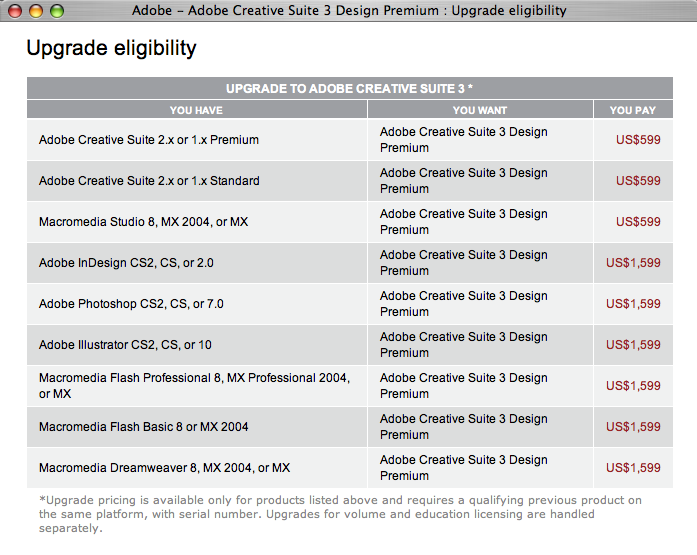
Now... tell me if I'm crazy. CS 2.3 premium retails for $1,199.00. CS 3 premium for $1,799.00. The upgrade from 2.3 to 3 is $440. So if I calculate properly it's cheaper for me to order CS 2.3 now and then buy the upgrade than to buy CS 3 from scratch?

Or, conversely, to buy CS 3 Standard for the $1199 and then add on Dreamweaver (I don't use flash).

I guess I'm pretty shocked at the $1799 sticker price for the Premium set! A pretty big bite for the freelance designer.

Why don't you just ugrade to CS3 for $599 Patty? Check Adobe's upgrade qualifications and see what is best for you.

ChrisL

Our lab really depends on the bundled fonts, as we do not have the budget for outfitting 60 workstations with a large font library.

I haven't done the math on this, but I suspect that your software would be less expensive from this company:
http://www.corel.com

Corel's applications come with fonts too, but you would have some money left over to let your students experience typefaces from a variety of foundries -- including Adobe. Surely working with faces like Gotham, Mrs Eaves and Chalet are an important part of a typographic education today?

Nick, I'm sympathetic to your arguments against bundling, and I license my share of type from independent foundries like yours. But suggesting that Bonnie's students forgo training with industry-standard tools from Adobe in favor of greater typographic variety is just silly. She'd be doing them a real disservice by following your advice.

>So if I calculate properly it’s cheaper for me to order CS 2.3 now and then buy the upgrade than to buy CS 3 from scratch?

That's what a lot of people are doing Patty.

peace

I'm on it. Glad this thread got started and I figured this out before CS 2.3 was no longer available. Found it online for a bit cheaper than at Adobe's site too.

Take a close look at this link before you jump Patty:

http://www.adobe.com/cfusion/knowledgebase/index.cfm?id=tn_19582

peace

Interesting. I already jumped, but I will have proof of purchase, in the form of a digital receipt and most likely a printed receipt when the product arrives.

But does this mean I might qualify to get the CS 3 upgrade for free? How do I find out if I'm eligible for this post-announcement upgrade? I can't find that info on the site. The other strange thing is they say "Upgrades from $599" but then also list the upgrade at $440. In any event unless it's free I'm not going to leap to it as my clients won't likely have it for months.

I had thought you only needed a valid serial # for an upgrade, not proof of purchase. But I guess proof of purchase is necessary for the post-announcement upgrade because it's date-sensitive.

Thanks for the heads up. Maybe I'll call Adobe tomorrow to figure this out.

Apologies for thread-hijacking.

but suggesting that Bonnie’s students forgo training with industry-standard tools from Adobe in favor of greater typographic variety is just silly.

Mark, your practice is impeccable, but I should point out that Bonnie identified herself as an educator, not as an Adobe software trainer.

Nick, you can't really suggest that she teach her students Corel over Adobe software? They'll never get jobs.

> In the CS2 copy, they refer to “over 180 fonts included”.

Each style (regular, bold, italic, light caption etc etc etc ) = 1 font.

Nick, if you're suggesting that there's more to a design education than just learning how to use software, or that great design can be created with products other than those from Adobe, then I'm with you. (Heck, I started out using Ventura Publisher and Corel Draw.)

But, in the U.S. at least, experience with some combination of Quark Xpress, and the Big 3 (InD, AI, PS) from Adobe is required for the overwhelming majority of design positions, especially those that require the typographic savvy you (and the rest of us) advocate.

"But suggesting that Bonnie’s students forgo training with industry-standard tools from Adobe in favor of greater typographic variety is just silly"

For a designer, I'd argue type is a much more important tool than any particular flavor of image editing/DTP software.

"Nick, you can’t really suggest that she teach her students Corel over Adobe software? They’ll never get jobs."

A good design education shouldn't consist of teaching software, but of teaching design. Students can learn software on their own.

So, can anyone recap the current deal? Does it make sense to purchase CS2 right now? Do we then get the free upgrade to CS3?

Darrel - I spoke to Adobe. If you purchase the full CS 2.3 premium right now (for $1199 + tax) you will get a free upgrade to CS 3 when it's released. It seems much easier to purchase it either from Adobe or a licensed reseller. I believe this offer is good for 30 days from the announcement date of March 27.

Back to the thread - yes, of course you need to learn principles of design and type if you're going to be a designer. But it seems nonsensical to have students work in a software that is barely used professionally. Given that Bonnie is teaching at a community college and not Pratt I'd guess she's teaching the students professional skills as well as the fundamentals of design and therefore is right to have them working in InDesign, Illustrator or Quark.

You'd be hard-pressed to find a design job description that includes Corel, especially at the expense of those other programs.

Added to which the latest version of Draw doesn't run on a Mac.
Game, set and match, Adobe.

Bonnie, if you have a few cents left over after you've obscelesced last year's Apple and Adobe product, as an educational institution you can get a special deal on fonts (which are considerably more durable) from most foundries, including my own. There have been several threads about this at Typophile, eg
http://typophile.com/node/29178

[Edit: This entire post was wrong. Mea culpa.]

Tiff,
I think you missunderstood Nick's post. The way I read it, he is saying that fonts (not just his) are more "durable" than the applications and computers that use them. I can still use my type 1 Adobe fonts from 1987 while my old Mac SE and Adobe Illustratoer version 1 are obsolete.

ChrisL

Ooh! :^( Dang!! I'll just edit my post and hope you, Nick, forgive me.

A good design education shouldn’t consist of teaching software, but of teaching design. Students can learn software on their own.

Good point. While you’re at it write drawing, writing, and history out of design education as well. Those subjects can all be learned with a few trips to Barnes & Noble. Design firms will certainly appreciate your sentiments, they certainly have nothing better to do with their time than teach the interns how to use popular software.

Aluminum - this is the kind of attitude that sends grads to me applying for a print job and when asked what ink density is - they stare at me blankly.

Are you saying that the technical aspects of what we do are solely the students responsibility?

I don't think it should be that black and white.

peace

I'd also argue (and I'm sure I'll be unpopular here) that design education is a waste of time. I learned on the job. As an employer I never cared whether an applicant had gone to design school. I'm for studying the ephemeral and impractical like philosophy or literature (or fine art!) and then taking a quick software class extracurricularly. Get an entry level job and you'll get your design education.

The problem is that design schools continue to focus on the portfolio and not on the real world. Not enough business side at all.

It is much tougher to talk someone into that "entry level job" these days though Patty. They want to make money on you right away and not take away time from other staff to train you.

ChrisL

Couldn't agree more, Tiff.

I'm a big proponent of (if you have the luxury) the real american university experience rather than going to trade school, which is what design school really is. And if it is trade school, it should be preparing you for the trade. Trying to make its goals seem any loftier than that is, IMHO, just pretension. And you cheat yourself out of a true well-rounded education. I don't know many people who went to design school - undergrad - who learned anything much about anything else. And design grad school - well why go into that much debt? Graphic design doesn't pay enough.

I should clarify that I don't think design classes are necessarily a waste of time. But why narrow yourself down to design school when you're way too young to know what you really want to be doing? I don't think it gives you any advantages in the working world.

And as long as I'm off on a rant, for any other job than entry-level I'd only hire someone with real work experience. For entry-level I didn't necessarily care if someone had much design experience, if they were creative and motivated they'd learn fast on the job. A lot of entry-level jobs require a good deal of grunt work before you get to really design anything and my experience was that design school grads were kinda expecting to be handed a nice juicy design to do on day one. I could live without the ego.

pattyfab: But it seems nonsensical to have students work in a software that is barely used professionally.

Agreed. Yet what 'used professionally' means may change during the course of a student life. When I studied, there was XPress and nothing else. At my university's design department, a single InDesign license was obtained upon my request and used by me and nobody else. Maybe two years ago they made a radical switch to Creative Suite. Today's students know of XPress by hear-say.
With a designer life in mind, maybe students should be trained to ride different horses rather than one which is considered standard here and now, so: InDesign and XPress, Illustrator and Corel Draw. Software 'used professionally' is a quickly moving target. Now I notice that Freehand wasn't even mentioned on this thread.

[edit: pattyfab, I saw your latest post after having posted mine -- in fact: a couple of latest posts ...]

Maybe students should use cheaper software that is less feature rich than InD & QXP. Because that way they would have to concentrate on the process of designing, instead of 'learning' software and overusing 'features' that distract.
There are some nice alternatives around, eg RagTime, Stone Create and VivaDesigner (VivaPress for the poor…).

Patty,
I don't know what you think happens in design schools or which one you have experience with but they are not the same and many are far more than trade schools. It costs the same in time and money to major in philosophy as it does in design. I am not saying attending design school is essential but it certainly is more advantageous than a liberal arts education if you intend to find a career in design.
There was no such thing as design software until I was in my 40s and I just picked it up on my own with no one to teach me. Anyone can learn it who really wants to. It helps if you know what it is for though.
Also, egos are not limited to design school graduates. They can be found in equal numbers among all distributions of people.

ChrisL

A short followup: VivaDesigner is very cheap and there even is a FREE licence:

http://software.viva.de/english/products/vivadesigner/

Can you beat that? A 1000 bucks plus left to buy fonts with…

Does anybody still use Freehand?

I was trained in Pagemaker (on the job). That went out the window. I think students need to learn what's in common use at the time and when that shifts they'll learn the new programs as necessary. Besides once you have basic familiarity with one or more of these programs it becomes easier to learn the others. Like languages.

Since I'm in print I wish that they would learn certain technical things about how to get print done effectively. It blows my mind that not one person straight out of school has ever been able to answer that simple question: What is ink density?

Unless you are some designer who is so fabulous that the technical quality of your work doesn't matter and you are surrounded by production folks and separators to fix your mistakes (I consider them mistakes) then these are things you need to know.

Should design courses not give some fundamental knowledge of real world conditions and technical problems?

I just think you need to be technically as well as aesthetically sound to be truly employable.

peace

"Hypatia Sans Pro will be available as one of the optional registration incentives,"

Hey! Can't wait! Thomas, can we get a tiny peek? We've seen and even used the early version of Arno. Just a snapshot, pleeease?

Paul: Agreed. Graphic Design curricula generally seem to lack a substantial print production base. Lots of graphic designers need production people to make their creations printable.

"Good point. While you’re at it write drawing, writing, and history out of design education as well."

No, that's all theory.

Listen, if you hire interns just to be production artists, fine, your argument makes sense. And students should DEFINITELY know the tools of the trade.

HOWEVER, tuition should go towards quality education. Experienced professors and instructors. Not simple how-to tech classes.

Our school, at the time, was big on this. Did a lot of kids graduate barely knowing how to use QuarkXPress? Yep. But they weren't great designers either. So, that just made it that much easier to cull them from the crowd. ;o)

"Those subjects can all be learned with a few trips to Barnes & Noble."

If you think learning a software program is as complex and vast as art history 101, then I guess you win the argument. Personally, my 5 year old can figureo out KidPix in 10 minutes, so I'm not too worried about upcoming genrations being able to figure out whatever software they have in front of them at the time.

"Design firms will certainly appreciate your sentiments, they certainly have nothing better to do with their time than teach the interns how to use popular software."

They certainly don't. They also shouldb't have to waste their time teaching their interns basic design concepts because they spend their classroom time learning InDesign QuickStart instead of proper type layout. ;o)

"Aluminum - this is the kind of attitude that sends grads to me applying for a print job and when asked what ink density is - they stare at me blankly. Are you saying that the technical aspects of what we do are solely the students responsibility?"

That's not quite the same thing. Learning ink density is a production concept of the media itself. And is important to learn. Learning a specific printing press? Not so much. The concepts are the same regardless of the printing press.

Trapping, overprinting, CMYK, spot colors, line screens, etc...these are all important technical issues students should underststand. The specific software? Not so much, as understanding the underlying printing and pre-press technology is more important than a specific set of keyboard commands.

I don't care you you use Adobe Illustrator, Freehand, Corel or inkscape to draw me a logo. If you understand the concept of printing, line art, and proper bezier curves, you'll do fine with any of them.

Maybe another way to say this: It's easier to train staff on a specific piece of software vs. teaching them the vast underlying concepts and history of the media overall.

Take web designers today. A lot of 'design schools' offer 'interactive design' which really is just a few semester's worth of Dreamweaver and Flash. These kids can't tell a UL tag from a MP3. As such, they really don't understand the medium they are working in. I'd much rather have a student that was tought HTML with notepad. I can teach them DW in a matter of hours if they fully understand the underlying concepts.

"Does anybody still use Freehand?"

I do. And it's like sticking with an abusive spouse. Yea, Freehand leaves us with a black eye every other weekend, but we love it so. Why can't I quit you Freehand!?

(And may Freehand RIP...you will be truly missed!)

I think it's limiting to go to design school. Period. In many countries you are forced to decide on a "trade" before entering university. America still offers the liberal arts degree. I entered college expecting to major in art, ended up majoring in... art. But along the way I took astronomy, intellectual history, dance, psychology, russian literature, etc etc. Those were some of my best classes. I'd never have taken such a range of subjects had I been in design or art school (and if I had, the profs would probably not have been as good.) I feel like I graduated a more well-rounded, better-educated person than had I narrowed my focus to what interested me at age 18. And that no doubt makes me a better designer. It's not just about design.

Or software.

Plus I think it broadens one's perspective to be around all types of people, not only designers or artists.

And yeah, I learned how to write, too. That has been an immeasurable help in publishing. It's amazing how illiterate some designers are.

Pursuant to the comment above mine - I think it's the responsibility of a design school to turn out designers who are employable. That means training them in design principles, current software, and in relevant technical issues. You can't cover everything, but the more a student is prepared to actually enter the profession, the better a job they'll get. Schools can't be asked to anticipate where the industry will be in the future, but they can do their best to prepare their students for the present.

For example too many design portfolios contain wildly impractical pieces such as books with 6 kinds of paper, metallic ink, die-cut, etc etc. This was my biggest problem with the design students I interviewed, many of them had little or no practical training. Design is an applied art, there is always a client, always a budget. Pretending that isn't so is foolish.

Back to the fonts.
Whether experience with specific tyefaces/fonts is considered intellectual education or software training, students are being short-changed if all they've worked with are the Adobe bundle, no matter how good or inexpensive those fonts may be.

Aluminum - the best way I know to train someone about ink density is to show them the Info Palette in Photoshop, show them how to read the density, and then show them how to achieve a given spec. It's a pretty abstract concept without applying it somewhere.

Once you know what it is and understand color management, then it is something you can implement.

And overarching all this since I'm an auto-didact - I agree with Patty and will take it once step farther. I don't believe in school at all, not one bit. I believe in studying what drives you, not following a curriculum. I have no degree.

So there are many ways to get where you want to go. My way is looked down by society and many on this board (I've had this discussion before).

Finally, I just wish the grads I interview had some clue about what it takes to print something correctly. Because so far, they don't. I have heard this complaint from many of my print colleagues.

peace

I agree with Nick if we are considering the larger picture. With student pricing in consideration -- as shown in the linked thread above -- it seems to me as if students should invest a little bit of that student loan money in a few non-bundled fonts.

"For example too many design portfolios contain wildly impractical pieces such as books with 6 kinds of paper, metallic ink, die-cut, etc etc. This was my biggest problem with the design students I interviewed"

I've found that there's 3 general groups of design graduates:

a) the group Patty describes. Comes from a respected design program, usually with a BFA. Work tends to be highly experimental and conceptual. Strong fine arts influence. Not necessarily practical. Student may or may not be technically savvy with the software.

b) Also comes from a respected design program, usually with a BFA. Work tends to be more assignment based using more pragmatic scnearios. More emphasis on problem solving. Student may or may not be technically savvy with the software.

c) The 2 or 4 year tech school. Might have a BS. Work tends to be quite bad conceptually and practically. Student does typyically have a solid grasp on the software.

Of those, people from A or B tend to be the best hires for design work. Both have slightly different strengths, but, in the end, tend to make solid designers.

Group C never quite catches up, as they simply haven't had a solid foundation of art and design theory and history courses. Their skillset ONLY encompasses the ins and outs of a particular set of software apps. They may make decent production artists, but not terribly great designers.

Of course, there's exceptions to all 3 of those groups, but, in general, that's how I see it...

"My way is looked down by society and many on this board (I’ve had this discussion before)."

I do mainly web work these days, and by far, the most intelligent, creative web developers I've met have had degress in:

- Classical Music Composition
- Painting
- Geology

One gripe I had in the past with a lot of design firms was their insistence that every hire have a minimum 4-year design degree. That really limits your potential pool. In the end, you want to work with good thinkers more than anything.

So, yea, I'm with you on that. ;o)

Adobe is clever. They practically give away fonts in the Educational pack (less than $1 a font, I think). Other foundries are offering 20 and 30% discounts for students. Not in the same league.

The result is that the graduating student thinks first of Adobe, having worked with quality Adobe products and crap (sometimes/often) free web fonts while in school. So where does he/she look first when later specing and buying fonts?

The independent font producers might be wise to collaborate on a $99 package with 100 or more quality indie fonts. Then a school can make that a requirement, perhaps for second year students, who will be ready to expand their typographic horizons a bit.

Suggesting that students buy individual fonts won't work. Good instruction works best if the students are on the same page with the same options. A teacher might assign a student to choose a good indie font, and 98% of students will come up with a web freebie, or a warez version of a commercial face.

Practically giving away the fonts to students now will result in sales later on.

Not a bad idea, Don!

> Adobe is clever. They practically give away fonts in the Educational pack (less than $1 a font, I think). Other foundries are offering 20 and 30% discounts for students. Not in the same league.

Please bear in mind that Adobe isn't like ITC, Linotype etc etc. That said -- Type Foundry. However, they need to be like ITC, Linotype!!! That said -- more fonts + huge type dept!!!

I just wanted to point something out about design school. I just graduated with a BDes from OCAD and had to take a full range of courses besides my main design ones in order to be eligiable for a degree as said by the government. I took geology, physc, history, english and math as well as several liberal studies courses.

My biggest gripe was not being able to take art/trade based classes such as letterpress because of the harsh distinction between art and design.

Also we were all trained on Adobe Software.

it's all very well to talk about design as problem solving, but it's hard to think with your hands if you don't get some real dirt on them.

http://www.marketingmag.ca/magazine/current/opinion/article.jsp?content=...

I completely agree with your comment.

Although it has nothing to do with Kazmer.
Allan Kazmer was going to retire at the end of the semester anyway and I like my degree fine. The student uprising that sparked his and the chair of advertising's throwing in the towel was about us not wanting to do a thesis. It had nothing to do with lack of studio time because of our degrees. I had enough time to take art courses, but it was the college who wouldn't let me.
I think Kazmer just wanted to make a point and used the situation in an opportunistic way.

(sorry for off-topic-ness)

Well, I'm only familiar with the situation through his comments, so thanks for the broader perspective.

The academicization of art education is a general phenomenon, and a sad trend at that -- it's the rock to software training's hard place. Erik van Blokland has the right idea -- make your own tools!

"it’s all very well to talk about design as problem solving, but it’s hard to think with your hands if you don’t get some real dirt on them."

I agree 100%. That said, I don't think tuition is best spent on teaching HOW to get your hands dirty, but, rather, it should teach the REASONS to get your hands dirty.

Perhaps a poor analogy, but if I was going to 'landscapers' school, I don't want to spend tuition and classtime on 'learning to use a shovel 101' but would prefer 'landscape planting and maintenance 101'. I can figure the shovel out by default while learning about the latter.

I am a student at a design university, and I think it's really interesting what everyone considers important in their experience. I have teachers who have worked with print their entire career, and others who have only done web design. Everyone brings their own perspective, and it is the student's responsibility to ensure that they are taking what they learn, from all of their classes and applying it to all of their projects.

I think that it is more based on the quality of the student than of the school. Some students refuse to sketch ideas. They just refuse. With out that step, the finished product is "done" on the first attempt and they are resistant to change. And it doesn't look as wonderful as those with real concepts behind/ supporting them.

But I do have some questions for you- What is ink density? Is there an answer other than the ratio of chemical to water in the production process of ink? Because that's all that I can think of. Is there an ideal density for production? And how much does it vary based on the material that you are printing on? Are there any sort of general standards?

> What is ink density?

My print experience isn't equal to that of others in here, but my understanding of ink density is the total value of ink that a CMYK image will have. 230% rings a bell as a common maximum ... which means that the total percentage of the four inks should not exceed that amount. It is press dependent, and too much ink will result in a crappy look.

In the old days things like GCR (grey component removal) and UCR (undercolor replacement ... or have I mixed up the Rs?) were used by prepress people to get the ink levels down. Now the artist has to be the prepress person. (And I'm not sure if you can access UCR and GCR in all DTP programs ... it is in Photoshop somewhere.)

"It is press dependent, and too much ink will result in a crappy look."

Also depends on the paper, how absorbent, how white, how opaque. If the paper is very slick and not absorbent then it's desirable to reduce ink density, so it will dry in a reasonable time. GCR (gray component replacement) can reduce the total ink density while maintaining correct tones.

Patty, I still use Freehand, but only when I have to. It has a very strong foothold here in Finland, it was practically THE all-purpose application for years. I've even seen annual reports done completely with Freehand. I have a client who has hundreds of regularily updated packaging designs stored, all done in Freehand (Mac). I did a design for them recently and asked if I could use Illustrator, but apparently that's a no-no. I don't know what they're going to do when their old PowerPC Macs need upgrading into Intel Macs and the old friend Freehand doesn't work anymore.
I started with Illustrator, but since Freehand was so popular here, switched over to it in early 90's. Then it was PageMaker and Freehand until InDesign came along – QuarkXpress was the expensive and less common option here. The final initative for me to get to know Illustrator again was the Adobe-Macromedia deal and the knowledge that Freehand will be forgotten soon.
I'd like to add, that one thing I really dislike in Freehand is that it doesn't support OT fonts. One gets spoiled with CS2.

> What is ink density?

In cmyk it is the total of the 4 inks. In grayscale it is the blackness of the black for lack of a better description.

It is also known as DMAX, TAC (total area coverage), Total Ink.

In glossy magazines it is almost always 300%.

In newsprint it ranges from 220%-240%. Usually.

So the default black in Photoshop if you are using SWOP (v2) in your colorspace it will be:
75-68-67-90

Add them together you get 300% since the ink density max in that profile is 300%.

It's a crappy black mixture but that is another topic.

It becomes critical in newsprint. The way to get there is color management.

To check it I set the second color readout in the Info Palette in PS to Total Ink. Running almost any tool then will give you the density in any given section.

Different media can accept different amounts of ink basically. If you short something you're not getting as much as you can from a print job - if you put too much ink you'll end up with a pile of mud. If you learn how to use color management and profiles printing quality stuff will be a lot easier.

It pays to learn some of this production stuff. More and more companies are cracking down on designers to learn this so they don't have to hire color correctors, separators, etc…

peace

The independent font producers might be wise to collaborate on a $99 package with 100 or more quality indie fonts. Then a school can make that a requirement, perhaps for second year students, who will be ready to expand their typographic horizons a bit.

This has been brought up previously; the big problem is getting someone to herd the cats into agreeing on a EULA. Still, it’s something I intend to pursue eventually—either this summer if my workload is light, after graduation otherwise.

Quote: "Now the artist has to be the prepress person."

Progress is our friend here. Adobe's new Print Engine technology will take care of that. Using an all RGB-workflow and the new PDF-definition will place all of the responsibility for plate and print back where it belongs: in the press room.

Paul,

Exactly why I like book publishing - even when they've decided the Art Director's position is dispensible they always have a staff production person. I've picked up a lot of useful production info over the years and certainly know how to set up a file, but when I have a client who asks/expects me to do that part of the job I automatically double my fee hoping to scare them off. Or at least bleed them dry.

Thank you for all of your thoughtful comments.

I agree that teaching underlying design principles is critical, but I do not think that devalues the teaching of the current digital tools of the trade. I require my Type I students to do concept development with pencil and paper. We spend a lot of time learning to draw type by hand, analyzing thumbnails and roughs, before going to the computer lab for production.

In my more software-oriented Desktop Publishing class, I integrate teaching software features with design principles and practices. Examples: setting up a well-constructed grid on a Master Page or using Style Sheets and Baseline Grid to teach the importance of consistent formatting.

I am happy if my beginners learn typographic measurement, terminology and can classify type into the major historical groups. If they can recognise Baskerville, they will be able to work with Mrs. Eaves when the time comes. With a little luck they will learn to see like artists, with even more luck, some of my love for the Roman alphabet will rub off.

The employment ads on the Creative Hotlist make interesting reading. We have limited time with our students, but the bar for entry into the better design jobs continues to be raised. We are teaching a new generation, more oriented to Google and MySpace than reading newspapers or textbooks.

Back to the original question, I often remind myself that we have more typefaces available to us than ever in the history of printing. The typographers of the past managed to do stellar work with whatever lead type was available. They could scarcely have imagined the riches we take for granted in our font menus.

Bonnie - totally agree with you. What good are principles if you can't execute them?

Patty - my stuff goes into hundreds of publications in America and Canada. There is no way I can have a relationship with all the different printers so I had to get good at establishing medians for different media. I have to know things like quarter tones will slaughter you in newsprint.

I enjoy this part, an endless slog but pleasantly arcane.

And bert - I hope you're right but the promised land has been discovered before - it was called color management and all it did was confuse most people. It's a messy affair.

I have a feeling it will just get more complicated.

peace

Captured from web.archive.org on 13 Oct 2013. view this capture