Typophile

Vertical distorsion in print (FOG)

Göran Söderström

OK, I was just sitting and proofing my font on printouts and suddenly felt everything looked strange and then I realized that strange things had happened.

Why is this happening? I’ve tried to read/understand the manual but am not sure on what to do to avoid this EXTREME problem.

Please note that this is happening when I print in high-resolution 1200 dpi, and with large point sizes (40 pt).

I’m working on Fontographer.

Many thanks in advance from desperate man …
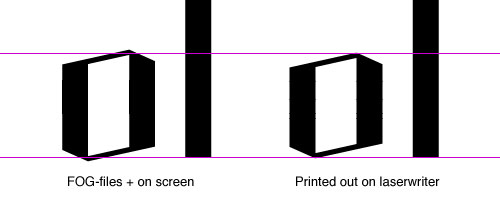
could it be a hinting problem ?

I could feel it has something to do with it (or these vertical alignment zones). But, when I got this effect, I was printing the type in large sizes. I thought that hinting was to compensate in small sizes, but I am definately no expert …

And on screen it looks good.

Hope someone could jump in here and help :)

I bet you're using a HP LaserJet.

The problem is not your font or its hinting, but that HP's PostScript interpreter doesn't interpret hints correctly. When making proofs, just generate fonts without hints.

Karsten

Yes (!) — I do use an HP Laserjet 1320, and just minutes ago I tested to generate the font withouts hints, and — Voila - it worked.

Thanks very much Karsten for you answer.

But now I am very disapointed of my printer. Any tips on what to use instead, a good printer that’s reliable?

I use the same one, which is my third or forth LJ. Nevertheless, I am quite happy with the printing quality, so I proof without hinting.
Btw, HP knows about the problem for years now, but obviously they have no intention to do something about it ...

As to other printers, there were one or two threads this year, but where? Maybe search for HP or Epson &c as keywords?

Best wishes, Karsten

Goran,
After you are satisfied that your font is just as you like it, find someone with an imagesetter (Linotronic, Accuset...) and get a proof run off. This can be expensive (about $30 per page) but this kind of proof gives you a real idea of what you have.
I also have an HP with the same result as Karsten. It is OK for the majority of your testing but after you are down to the final tinkering, you will need a typeset quality proof.

ChrisL

Chris & Karsten,

Thanks for good advice. I feel much better now :)
/Goran

Btw, wasn’t that line "I feel much better now" from some scary movie aswell? Was it Shining…

That is one of those lines :-)
It is like the line "Just have a seat" having a whole new meaning when referencing the Electric chair!

ChrisL

It was from 2001: A Space Odyssey. Audio here.

Well, yes of course! It was from that great movie.
Chris — exactly! :)

After you are satisfied that your font is just as you like it, find someone with an imagesetter (Linotronic, Accuset…) and get a proof run off.

A little update here, I’ve just printed out some type on a modern print proof machine called Kodak Approval. Similar to traditional imagesetters, it works with laser and films and outputs 2400 dpi, but with a modern technique. The result was stunning, and I believe it’s similar quality as with the old imagesetters, Linotronic etc. BUT, I will testrun one of those old Linotronics aswell :)

Please do keep us updated on this. Since the death of velox
some of us have been stuck between a rock and a hard place.

BTW, there are 2400dpi Brother laser printers for
ridiculous prices these days. What's the catch?

hhp

I will.

Btw, which models of brother laser printers are you talking about, that have 2400dpi? Can’t seem to find them, alla I see is 1200dpi.

I find that my 600 dpi Laserwriter II gives a pretty good simulation of printing on newsprint, in terms of sharpness (or lack thereof), if not tone.

Goran, a bunch of Brother laser printers claim 2400dpi, but I wouldn't be surprised if it's some technical trickery and in reality they're only 1200dpi, or maybe even 600dpi. Just like all the trickery with scanner resolutions we've all come to love... HP for one has some "1200dpi" laser printers that are actually 600dpi when you ask a human salesman (although they do have a true 1200 for less than $200 now). I'll have to get to the bottom of this, somehow (and calling Brother didn't work).

hhp

A Kodak Approval is a digital proofer, like a matchprint. It is not like an imagesetter. Actually the Approval among others (Latran/Polaroid Polar Proofer, Fuji Finalproof) are great because you can proof on the same stock which you will print and they have very high resloution 2,400-2540 SPI. For type I would think you could buy a L-300 or L-200 with a no frill L3 RIP and processor or a drysetter (imagesetter and film procesor with no chemicals to add) for far less than 10 or so Approval type of proofs. For intermediate proofs Xante makes the best graphic arts B&W Laserprinters.
Rodi

But buying and running a Lino is a pain, no?

1) How much is the Approval (or equivalent)?
2) How much is an Approval print?
3) Are they readily available at bureaus?
4) What's the de facto quality when printing small (let's say 6pt) text?

hhp

Hi Hrant,
You can buy a classic Approval for under a grand, but it is a little smaller than the 1984 380Sl my wife has. Approval prints run the gamut, but I think Tabloid should run $35.00 if you are not in a rush. They are pretty available, not everyone uses them for contract proofing and Inkjets are quickly biting away because of the cost per print. I've seen legal size (5 pt) type printing black on a yellow and it was indistinguishable from film output. I have had Latran/Polar proofs made and they were great too, with 7pt serif (Bemtus from URW) knockout type being sharp as a razor.
For line art an old lino(or Agfa or Monoype, or screen or scitex, or
Ripit/Exxtra etc) work wonders even at Level 1 postscript. You get a level 3 RIP just to be able to iron out any minor issues and Level 3 is where most output devices are so you can have predictible results You don't have to calibrate if you are going for line work and a desktop imagesetter (Ripit/Exxtra) are no larger (and lighter) than a tabloid laser printer. A roll of film has about 100' feet and can be had at around $80.00-$120.00.
I had great experiences with L330s, Screens (very expensive even used), and Ripit/Exxtras. What I liked best about the Ripits is Adobe based RIP and ingenious flexible Drum,very accurate and light.

Actually the problem that Goren describes is more of a Toner and SPI than any acutal laser issue, it is doing its best, but given the resolution and that the dots have to be made with Toner make it heavier. Have you ever noticed that type gets lighter and lighter when you go from Laserprinter to the actual printed piece? This is even more noticlble with inkjets on offset/copier paper too.

The Truth shall set you free

Some of those pseudo-2400 dpi laser printers use a "variable dot size" technology to fill in the jaggies. This would produce fuzzy-edged images were it not for the co-attractive properties of photostatic toner. If you're lucky, those partial pixels get sucked into the gaps by the larger toner mass's electrical field, creating a smooth contour.

But that's something I read about a long time ago. I don't know if currently available products use that or something else that's more reliable.

"If you’re lucky, those partial pixels get sucked into the gaps by the larger toner mass’s electrical field, creating a smooth contour."

How do you know if you have been lucky? The problem for profing type designs is that you are making one unit decisions based on proofs which may have gone one way or the other by luck. Sure wish I could afford the Xante :-(

http://www.xante.com/products/4g/

ChrisL

Rodrigue, I'll have a full reaction to your generous post next week, but for now:

> How do you know if you have been lucky?

You also make a lino output and:
1) You put the two next to each other and decide (loupe optional).
AND/OR
2) You scan them both in*, overlay a digital rendering, and compare real careful-like.

* At [at least] double the resolution of your target, so in this case 4800dpi.

hhp

A linoprint is about $30 and a Xante 2400dpi printer is about $4,000 so I can buy the printer for the cost of 133 lino prints. Oh well, still don't have the 4 grand :-(

ChrisL

As Karsten said, this is a huge bug in HP's PostScript emulation.

Fwiw, both Xante and Xerox use Adobe PostScript.

Cheers,

T

I have a Xante AW 1200. It uses PostScript and is true 1200 x 1200 dpi. When it is connected through an ethernet connection to the printer, one can vary the weight heavier and lighter in 5 steps. This way you can emulate the weight of an offset. It still doesn't have the sharpness of offset in the inside corners, etc, but you get a better idea.

I think printer is not being produced now, but I see on E-Bay stores you can get it for less than half price on a few remaining--under $500.

I talked to somebody very familiar with the Kodak Approval:
he assured me it won't do what I/we need for small hi-res type. :-(

hhp

Too bad. Maybe I was a little to fast to give the Approval approval ;-)
I have found a couple of places here in Sweden who can make linotronic settings on film and then expose on photopaper, I will compare them with my Approval, just to see and feel the difference.

>photopaper

Also here (Washington DC area) from a 'service bureau'--which I gather is a vanishing category--I can get print outs from a Linotronic on "RC paper", which I see is also sometimes called "velox".

Yes, any Lino can output either on film or on "paper" (which is actually much thinner than velox however). The problem is that since demand for paper is so low, and since the materials don't last in storage forever, in practice few service bureaus can actually carry out a paper output job, unless you're willing to buy a lino paper cartridge for them. And even then they have to be willing to swallow the overhead of switching between media (which is hard to justify with generally tiny margins).

hhp

Thomas, do ALL Xerox machines speak genuine Adobe PostScript?

A Lino330 just sold on eBay for $760 + $100 shipping.
Does anybody know if that's a normal price?

http://cgi.ebay.com/ws/eBayISAPI.dll?ViewItem&ih=016&sspagename=STRK%3AM...

hhp

I just had an idea.

Instead of outputting to lino RC paper (which is essentially impossible to find these days) you could output to positive film (~$15 per letter size) and have it laminated (~$5) to a nice white paper stock.

hhp

Or output to neg film and contact print onto photo paper.

ChrisL

Too expensive.
And not first-generation output.

But I'm working on some good news...

hhp

OK, I have some good news / bad news. I got a local shop to make me a Kodak Approval print of sheet one of my tabloid-size Nour&Patria specimen. Goran was right, and that guy was wrong - it's quite impressive. I can't find any of my old velox prints to compare it to directly, but to the naked eye it looks way crisp enough. Looking at it with my 35x loupe, I can see that the black is not extremely black however: it has faint whitish spots spread about. What's most interesting though is the lack of aliasing - instead the outlines are a bit coarse, basically what photo paper does I guess. Ironically, I suspect this might actually make the naked-eye result even better, at least in terms of fidelity to the -eventual- offset output, but possibly even in terms of readability (where I happen to believe there's such a thing as too crisp). On the other hand there's still much to be said for seeing what you've made as crisply as possible - especially when it comes to judging a font's color.

As for the paper stock used, it has a slight off-white aspect, but also has a nice gentle matte feel, and most of all it's luxuriously thick: I measured it at 9 mils* which is almost as thick as a typical business card. This is I think about 3-4 times thicker than lino "RC paper", and probably twice as thick as velox.

* With the Soviet micrometer I bought from Yerevan's flea market in October. :-)

The bad news: the stuff is very expensive, about $120 for a tabloid print! :-/ Which makes it not cost-effective for "internal" specimens, but -considering the superb paper- probably just the ticket for showing off your fonts.

hhp

Silas: I am not 100% sure - I *think* all Xerox printers use Adobe PostScript, but I could be mistaken.

T

I got a local shop to make me a Kodak Approval print of sheet one of my tabloid-size Nour&Patria specimen. Goran was right, and that guy was wrong - it’s quite impressive. I can’t find any of my old velox prints to compare it to directly, but to the naked eye it looks way crisp enough

That is interesting news. I havent been able to compare yet, but as I wrote, I got impressed by the Kodak Approval. I’m also a lucky guy when it comes to the Approval system – one of my best friends is working at a Prepress company where they have this machine, last time I did a print on it, I got away really cheap as it only costed me a lunch ;-)

Captured from web.archive.org on 3 Jun 2012. view this capture