
Here are a couple of words that push the envelope of hyphenation :-)
ChrisL
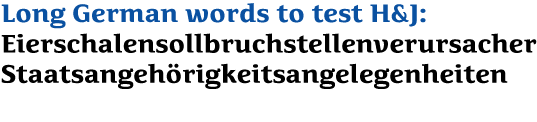
Here are a couple of words that push the envelope of hyphenation :-)
ChrisL
Here they are as text:
Eierschalensollbruchstellenverursacher
Staatsangehörigkeitsangelegenheiten
I am sure many of you can come up with other H&J teasers.
ChrisL

A nice Finnish word to keep you going:
lentokonesuihkuturbiinimoottoriapumekaanikkoaliupseerioppilas
unfortunately it doesn't have any of our umlauts, like this charming word: töölöläinen
Those are great! and they have just a few vowels--unlike the Czech words which could borrow some of your for sure :-)
ChrisL

I even had a project / platform named 'Eierschalensollbruchstellenverursacher', together with a few friends, several years ago. :)
( It mainly was a 'Designers Playground'. Sadly enough, the site itself is no longer alive. I think we even had the domain eierschalensollbruchstellenverursacher.com, for a year or so, back then. Aaargh, My memory. Its available again, by the way. :)
Dave,
I guess you could have made a font with now word spaces forthat site since none were needed :-)
ChrisL


Why yes, that is Action Jackson!
Forza Italia!
If I remember correctly, there was a word in a Finnish – German dictionary that went something like this: phonecallselectioncancellationpreventionbutton. A word.
And if I’m not totally mistaken the long word posted by Mili is in fact in use in the military.
The Finns win by a long shot!
ChrisL
To clear things out, it was a German word. ; )
Good for spelling contests!
ChrisL

phonecallselectioncancellationpreventionbutton would be translated as Anrufauswahlabbruchsvermeidungsknopf. Or what about the old classic Donaudampfschifffahrtsgesellschaft? ;o)
It sounds like the addawordadinfinitum syndrome :-)
ChrisL

Mili, is that the Finnish title for Tom Cruise's movie "Top Gun" ?
Nearly, it's a rank in the Finnish air force, as Grot Esqué already mentioned ;-).
In both German and Finnish one can make long words by just adding them together. Of course, ther should be some sense and logic in it.
One famous palindrom in Finnish is the soap salesman: saippuakauppias, but that's a shorty.
Or "pannomattosuora" which means something like "the crazy woollen cloth of the nun" in Italian.

And here‘s four (not as long, but anyway) in swedish =)
acklimatiseringssvårigheter
förtjänstutvecklingsgaranti
kontrollstationsförhandling
realisationsvinstbeskattning
Sorry, Goran, I forgot about the Swedish word combining systems! Any other languages like that? Danish and Norwegian surely, perhaps Dutch?
Alessandro, the "pannomattosuora" sounds like a Finnish word, although panno doesn't mean anything in Finnish (change it to "pannu", and it means kettle), but "matto" is a rug and "suora" is straight.
So “panna matto suoraan” would mean “to straighten the carpet”. “Pannomattosuora” sounds like some foreigner trying to speak Finnish.
“to straighten the carpet”
That is a fine kettle of fish :-)
ChrisL
antidissestablishmentarianism I believe is the longest English word but it is just childs play compared to the Finn and German example above. They say "the Greeks had a word for it" but the Finns have a gigantic word for it :-) And they say size doesn't matter :-)
ChrisL
Only one s in the disestablish part of that word ... so the English winner by one letter is ...
floccinaucinihilipilification - setting little or no value on something
Any advance?
Toby
Don't forget the Welsh classic:
Llanfairpwllgwyngyllgogerychwyrndrobwllllantysiliogogogoch
http://teachingtreasures.com.au/student-projects/Llanfair.htm
pneumonoultramicroscopicsilicovolcanoconiosis
Defined by the Oxford English Dictionary as "a factitious word alleged to mean 'a lung disease caused by the inhalation of very fine silica dust' but occurring chiefly as an instance of a very long word."

Sorry Toby, this is longer: Supercalifragilisticexpialidocious (and you can also sing it).
Chimney sweeps unite in song :-)
ChrisL

Not as long, but looks good in print--- The offical state fish of Hawaii:
humuhumunukunukuapuaa
DK~
Another very vowel-friendly language :-)
ChrisL

the only norwegian word with 9 vowels in a row:
"SAUEØYEEIENDOMMELIGHETER"
means "sheep's eye oddities'.

Tõõõõõõbik.
It's Estonian and means "Work-night nightingale".

Another possibility to find words is to search large texts for long words. http://www.gutenberg.org/ is a good source with texts in many languages. I thought Kant in German would be a good candidate for long words and came up with the following:
Annehmungswürdigkeit Anschauungsvermögens anthropomorphistisch aufeinanderfolgenden bewunderungswürdigen Bewunderungswürdiges Dynamischunbedingten Elementarwissenschaft empirischunbedingten empirischunbedingten Erfahrungserkenntnis Erfahrungserkenntnisse Erkenntnisprinzipien Erklärungsbedingungen Fundamentalerscheinung Gelegenheitsursachen Gravitationsgesetzen Grundbeschaffenheiten Intellektualphilosoph Intellektualphilosophen mathematischunbedingte Naturmannigfaltigkeit Paragraphenabteilung Parlamentsadvokaten: physikotheologischen physischtheologische physischtheologischen schlechthinnotwendig schlechthinnotwendigen schlechthinnotwendiges Schlechthinunbedingte Schlechthinunbedingten Unbedingtnotwendigen unbedingtnotwendiges Undurchdringlichkeit Unterscheidungskraft Unterscheidungsmerkmal verabscheuungswürdig Verbindungsvermögens Vergleichungsbegriffe Verhältnisvorstellungen Vernunftbearbeitungen Vernunftbehauptungen Vernunfterkenntnisse Vernunfterkenntnisses Vernunftuntersuchung Vernunftwissenschaft Vernunftwissenschaften Verstandeserkenntnis Verstandeserkenntnisse Verstandeserkenntnisses Verstandesgrundsatze Verstandesgrundsätzen Verstandeshandlungen Verstandesverbindung Vorstellungsfähigkeit Vorstellungsvermögen Zwischenempfindungen
T
I would like to see Tim's text above set justified with hyphenation turned off :-)
ChrisL
What was the contest held many, many years ago which involved Vana White with Hawaiians, Estonians, and Norwegians, vs Czechs and Slovaks? Somehow I think the Czechs and Slovaks never wanted to buy a vowel from Vana so everyone else got them? [Maybe the game was later called "Whll of MzFrchtzn" by Central Europeans] :-)
ChrisL

I think this one is the longest:
Rindfleischetikettierungsüberwachungsaufgabenübertragungsgesetz
And this one is long and also often used:
Betäubungsmittelverschreibungsverordnung
in english it would be called:
narcoticprescriptionlaw
or something like that!?!?
: )

When I was working on the history of the theory of relativity, I had to read about the velocity of light in three languages. This phrase really give the feel of the three languages. French: velocité de la lumiere. German: lichtfortpflanzungsgeschwindigkeit.
English: shortest. French: prettiest. German: most exact, but a mouthful.
I wonder: are German speakers (and those in other languages with a similar device) slowed down by the aggregation of nouns like this, with no word spacing?

I wonder: are German speakers (and those in other languages with a similar device) slowed down by the aggregation of nouns like this, with no word spacing?
You mean, they think slow? ;-)
I don't think so. The long words you found are the exception rather than the rule. As to philosophical or scientific texts -- once you figure out what someone means by a longer word (which has more to do with the interpretation of the text than mere deciphering of a single word), these words become variables which you just recognize. Whether they are shorter or longer doesn't really matter then.
Today "lichtgeschwindigkeit" is used which is literally the same as the English and French terms. Not that long.
[Glaube ich nicht. Diese langen wörter sind eher die ausnahme. Und in texten, in denen sie auftauchen, muß man sie nicht ständig aufs neue entziffern, sondern erkennt sie einfach wieder -- bloß eine variable, deren länge sich nicht direkt auf deren wiedererkennbarkeit auswirkt.]
Just an example. Not many really long words ...
Karsten
Don't confuse the fact that in German composed words are written in one word and the tendency towards longer words (written in one or not).
The fact that we write composed words in one word is necessary because the word order is not fixed like in English. Unfortunately, this principle is not followed by everyone anymore.
Most words are longer because of our naive way of describing things rather than using new words. For example, glove is actually Handschuh (handshoe) in German. This makes texts longer but on the other hand, many technical terms are easier to understand for laymen.
>Not many really long words …
Yeah but you occassionally get something like wiedererkennbarkeit = recognizable :)
The reason I ask is because of a question I have not related to this thread: whether the original absence of word spacing slowed down readers of Latin and Greek. It seems that semitic languages always had word spaces, but that the addition of vowels to the alphabet for Greek and Latin sufficiently reduced ambiguity that word spaces were not as needed.
There is a theory, of Noordzij and Saenger that the re-introduction of word spaces by Irish monks in the 8th century enabled silent reading and was a big breakthough. I am wondering whether native speakers of Latin and Greek could read just as quickly without word spaces. I know Latin is highly conjugated, and I've heard the same about Greek, so it may be that word endings are easy to recognize.
My guess is that the reintroduction of word spaces was because the Irish monks' Latin was not as good as their continental colleagues, so it was more difficult for them to read continuous texts; also they wanted to write Gaelic, which maybe has less end-of-word markers...
In English we also do aggretated nouns (eg. word spaces), but usually keep the words separate. Does the German practice reduce ambiguity and help readability? Or does the length of words reduce readability? Or is there no difference?
I also note that German is much more conjugated than English. Is this a factor?
the re-introduction of word spaces by Irish monks in the 8th century enabled silent reading
Prior to this, it would have been difficult to follow a vow of silence and work in the scriptorium.
@William
As a drastic example,
the term "Donaudampfschifffahrtsgesellschaft" - (very badly) translated in "Danubian steamboat-shipping corporation" - has several combined words (and stems) in it.
Donau (danube), Dampf (steam), Schiff (ship), Fahrt (ride), Gesellschaft (corporation) and "combined words", terms like Dampfschiff ("steamship", steamboat), Schifffahrt (shipping).
This example is hard to read for native german-speaking people too, but a "normal term" like "The declaration of independence" - "Die Unabhängigkeitserklärung" is easy to read for native germans. It depends how many words and stems are combined in one term... you got to be used to... that's all :)
Chris you might remember an issue of U&LC where the name of a Scottish train station was the longest word in the world. It means something like "The place over the hill by the church near the oak tree…"
Thomas,
Your example makes perfect sense to me. As an English speaker, I can read antidisestablishmentarianism or dichlorodifluromethane with no problem because I am familiar with those words. There are many other long (for English) technical and scientific terms which I do not know. I slow down reading those a great deal because I have to sound them out and ponder as to their meaning. Familiarity, as you said, is the key.
ChrisL
“The place over the hill by the church near the oak tree…”
I know that place laddie! :-)
ChrisL

I think that is the Welsh village already mentioned above by Mili, boyo.
I think the Maori have that beaten though Tetaumatawhakatangihangakoauaotamateaurehaeaturipukapihimaungahoronukupokaiwhenuaakitanarahu and you shouldn’t hyphenate proper nouns so maybe it isn’t the best test, wide measure too.
Tim
Tim,
Try that on a 12 pica measure :-)
ChrisL
I'm too annoyed by that widow:)
Does your search have a motive or is it curiosity?
Tim
It started when I was looking for text from foreign languages to test my typeface designs. I was looking for letter combinations which were not very typical in English. I started seeing these enormous words in some languages as well as concentrations of either vowels or consonants in other languages. This all made me quite curious why words got to be so big in some languages. From this thread, I've learned that it is normal in some languages to just combine words without spaces and that everyone is quite comfortable with it.
I am always on the lookout for intriguing texts to test type with in any language using Latin, Greek, or Cyrillic scripts. I look for subject areas which might match the face I am drawing--music, science, art periods, humor or abstract things like darkness and lightness.
ChrisL
Another good thing about testing type in foreign languages is that you look more at the letter combinations than you would in your native tongue since you don't get caught up reading the text.
ChrisL

Rauchgasentschwefelungsanlage
(Sulfur Dioxide Detoxification Facility)
Thanks John, doesn't sound like a healthy place to visit :-)
I wish there were a word that said:
Darkchocolateandhazelnutswithespressoeatingplace instead;-D
ChrisL
Thanks a lot Chris, now I got to go back to the store to get some ice cream.
Get some for me too Lari!
ChrisL
Dunkelschokoladehaselnußespressoschnellimbiß
Apologies to any German speakers if I have butchered your language:)
Tim
LOL!!!
Now we just need to market it! :-)
ChrisL
Michael Ende has written a book called Der satanarchäolügenialkohöllische Wunschpunsch.
This is obviously a nonsense play on words, in which the beginnings and ends of words overlap:
satanarchäolügenialkohöllisch =
satan + anarchie + archäologie + lüge + genial + alkohol + höllisch
However, it reduces the length of the word dramatically!
Maybe a model for a more far-reaching orthography reform?
Some compound words have already been split, by the way.
That looks like a fun link Tim! I will have to look at it more closely.
ChrisL
Okay, Chris, here you go. How about some typeiding? The picture is a bit blurry so it wouldn’t be too easy. ;)

Gill Sans at the bottom.
Tim
Lari,
The top one is Maple Walnut Fudge
The middle one is Vanilla Swiss Almond
and the bottom one is Rocky Road :-)
ChrisL
Tim, you’ve got a great sense of humour!
Chris, right on! A perfect triple identification! A hat trick!

i think the theory that native german speakers easily read longer words because they know them is right. i didnt have many problems even reading through donaudampf.. - you know the word :) - and i havent heard of it before.
now try chuchichäschtli - its swiss for «cupboard in your kitchen» but doesnt really get used at all in reality, its just the best known hard-to-spell word for strangers.
the two places with long names in wales are Llanfairpwllgwyngyllgogerychwyrndrobwllllantysiliogogogoch and Gorsafawddachaidraigodanheddogleddollonpenrhynareurdraethceredigion :)
Back to 7 July and the Irish monks ...
Bill wrote:
I know Latin is highly conjugated, and I’ve heard the same about Greek, so it may be that word endings are easy to recognize.
I also note that German is much more conjugated than English. Is this a factor?
For Latin this may be a factor, but conjugations are not that 'visible' in German.
Is your (implicit) idea that German with its longer words is halfway between word-spaced English and not-word-spaced Latin, so may shed some light on reading non-word-spaced Latin? Despite some longer words, German is still a word-spaced language. :)
Lari,
I just noticed that you credited me with your "quote"!
Gee, now I am a published author and a quoted source! :-)
ChrisL
>s your (implicit) idea that German with its longer words is halfway between word-spaced English and not-word-spaced Latin, so may shed some light on reading non-word-spaced Latin?
Well, I was wondering. I know that the very long words are unusual. I was wondering whether if when a long new word, formed by aggregation does apprear, whether the German reader can break it into into parts very easily. If so, yes, it would case some light on the ease with which latin and greek speakers could read old latin and greek without word spaces.
LetmeseeifinEnglishitiseasytoreadasentencewithoutspaces. Not so easy. Would it be the same difficulty in German if you run words together?
The longest official Dutch word stated in the Van Dale is "zandzeepsodemineraalwatersteenstralen" (37) en means "**** off".
But in Dutch every word can be combined and so you can have "hottentottententententoonstellingsmakersopleidingsprogramma" (59) and so on.
LetmeseeifinEnglishitiseasytoreadasentencewithoutspaces. Not so easy. Would it be the same difficulty in German if you run words together?
Definitely so.
Seeing your example sentence: it is possible to spot individual words, and maybe some training will even allow one to read this. (When writing German I capitalize as in English, so use fewer capitals. After some years, I am quite accustomed to this, but in the beginning this was irritating and -- my impression -- even slowed down reading speed.)
| a quoted source
Misquoted!
"Misquoted!"
So much the better :-)
ChrisL
the longest swedish word Nordöstersjökustartilleriflygspaningssimulatoranläggningsmaterialunderhållsuppföljningssystemdiskuss
onsinläggsförberedelsearbeten
a kind a useless word used in the army.
I like that one. What does it mean?
ChrisL

My guess, Chris, since it's an army word, would be "hurry up and wait." :-)
-=®=-
Probably true, Russ :-)
It does have some parts that look like "artillery flying simulator aligning material system disk" but the army never made much sense to me anyhow :-)
ChrisL
its a word that basicly means "prepering of an discussion about how to fix the system
so the material at the airplane simulator on the nort-east coats of sweden works properly"
some thing like that. it was hard to translate.
but that´s as close I can get to the real word for it

I work in the Abteilung fuer Quanteninformationsverarbeitung. Try writing that on a postcard!
Good thing these words don't appear on postage stamps :-)
ChrisL
Thanks Kim! So only the army in the north-east coast gets to use that word :-)
ChrisL
probably.. its really fun to say atsleast.
the longest swedish word Nordöstersjökustartilleriflygspaningssimulatoranläggningsmaterialunderhållsuppföljningssystemdiskuss
onsinläggsförberedelsearbeten
a kind a useless word used in the army.
:-) Yes, and if you want to create a longer "swedish" word than that just add some more words to it in the end or anywhere else. It will be just as "real" as this unofficial swedish word.
Similarly, the longest Danish word attested is landsbyskolelærerenkealderdomsforsørgelseskasseselskabsbestyrelsesnæstformandssuppleant, which could also easily be expanded even further.
This word has been used, though. By the local police in Horsens back in the 1940s. As a spirits test. If you were unable to say this word, you were apparently drunk.
I’m quite glad I didn’t live in Horsens in the 1940s.
«There is a theory, of Noordzij and Saenger that the re-introduction of word spaces by Irish monks in the 8th century enabled silent reading and was a big breakthough. I am wondering whether native speakers of Latin and Greek could read just as quickly without word spaces. I know Latin is highly conjugated, and I’ve heard the same about Greek, so it may be that word endings are easy to recognize.
My guess is that the reintroduction of word spaces was because the Irish monks’ Latin was not as good as their continental colleagues, so it was more difficult for them to read continuous texts; also they wanted to write Gaelic, which maybe has less end-of-word markers...»
A few points here.
Firstly, there are still languages that do not employ spacing in writing—Chinese and Japanese are prime examples, and I believe Thai is completely spaceless, too. It is only familiarity with the language that enables the reader to correctly separate words. Especially in Chinese and Thai, which are both completely analytic languages that do not inflect in any way (this is true of Chinese; my Thai is nonexistent, so I’m not entirely sure here, but I believe it too is purely analytic), this causes confusion and trouble for the foreign learner, but not for the native speaker. Even after nearly six years with Chinese, I still find myself often misreading things because I combine the wrong two characters and form words that make no sense in the context.
Secondly, by the 7th and 8th centuries, Irish was just coming out of two centuries of heavy linguistic turmoil, wherein the entire language had more or less fallen completely apart and created out of its own ashes an entirely new (and unbelievably complex) grammatical system. Part of this new system was the initial mutations, resulting from apocope of earlier word endings.
These were, however, not systematically indicated in writing at that time, so I can imagine it would have been quite useful to add spaces, just to know how to pronounce words. Especially since certain cases could be easily misunderstood if not separated; example: accat could mean either ‘at/by a cat’ or ‘their cat’, depending on whether it is separated as ac cat ( = Modern Irish ag cat) or a ccat ( = Modern Irish a gcat).
The structure of Old Irish made ambiguities like this one very common, and seem to me a good reason (in addition to your own guesses, which I think are probably also factors) to add spaces.
«the two places with long names in wales are Llanfairpwllgwyngyllgogerychwyrndrobwllllantysiliogogogoch and Gorsafawddachaidraigodanheddogleddollonpenrhynareurdraethceredigion :)»
Gorsafawddacha’idraigodanheddogleddol-lônpenrhynareurdraethceregidion went back to being just Golf Halt last year. ;-)

Korean uses spacing between words, but the system is a mess, mainly due to confusion over compound words and general apathy towards correct writing.
In South Korea, spaces are required at word boundaries (North Korea spacing rules are more lax), but there are a number of confusing exceptions and cases where spaces are optional. Rather than make an effort to understand these rules, far too many people disregard them and sometimes apply ad hoc spacing rules. Those in the legal profession are the worst offenders, especially when they write the names of laws without using spaces, ending up with monsters like this:
대한민국과아메리카합중국간의상호방위조약제4조에의한시설과구역및대한민국에서의합중국군대의지위에관한협정의실시에따른관세법등의임시특례에관한법률
(Daehanmingukgwaamerikahapjunggukganuisanghobangwijoyakje4(sa)joeuihansiseolgwaguyeokmitdaehanmingukeseouihapjunggukgundaeeuijiwiegwanhanhyeopjeonguisilsiettareungwansebeopdeunguiimsiteungnyeegwanhanbeomnyul)
Judging from this and their propensity to use as much hanja (Chinese characters) as possible, they must take perverse pleasure in making law inaccessible to ordinary Koreans. I'm guessing we can blame this on the Japanese.
I think that’s a common legislative trait to be found throughout the entire world, actually. ;-)
A wild guess: does the first part translate as something like, “The Republic of South Korea [and?] the United States of America” and then something with mutual help or something?
(You need to add some soft hyphens in that word!)
I think that’s a common legislative trait to be found throughout the entire world, actually. ;-)
True, but dispensing with word spacing? Use of Chinese characters whenever possible? Remind you of anyone? ;-)
Your guess is correct! I'm impressed. I had a headache just typing that out, so I'll have to gather myself before I parse it and translate it.
(takes deep breath)
Yes, I should have put soft hyphens in there, but since I don't want to edit it and mess up the chronology, I'll just write it again with correct spacing (with particles, which are like postpositions, separated by hyphens):
Daehanminguk-gwa Amerika Hapjungguk gan-ui sangho bangwi joyak je4(sa)jo-e uihan siseol-gwa guyeok mit Daehanminguk-eseoui Hapjungguk gundae-ui jiwi-e gwanhan hyeopjeong-ui silsi-e ttareun gwansebeop deung-ui imsi teungnye-e gwanhan beomnyul
Oops, I wrote gundaeeui instead of gundaeui in the previous post... I guess a typo was inevitable...
A rough translation: Law concerning temporary exceptions to customs law et al. following the implementation of the Agreement under Article 4 of the Mutual Defense Treaty between the Republic of Korea and the United States of America, Regarding Facilities and Areas and the Status of United States Armed Forces in the Republic of Korea

Does anyone now Turkish? They should have quite a few long words, in the style of finnish, since they also put all their personal, time-related and possesive suffixes in the back of the word.
Like (I think this is somewhat correct) "üzülmüyüorüm": 'disappointed' + 'not' + 'now' + 'me', or, 'I am not disappointed'. You see, this was a rather simple word (üzülmek), so we should be able to find an even longer turkish verb with tons of suffixes. Yay!
...okay, now back to work
– Malte
Captured from web.archive.org on 1 Sep 2010. view this capture