Typophile

Averaging and ATF optical scaling

raph

I’ve put together a webpage with some images from my study of ATF optical scaling.

http://levien.com/type/atf_bodoni/avg.html

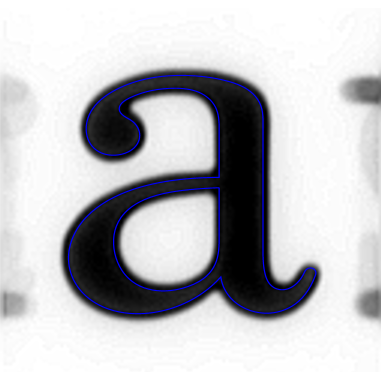
I’m in email contact with Patricia Cost, the author of the excellent Printing History article on the Bentons and ATF, and with luck and a little determination, something more fully fleshed out will come of this. In the meantime, I thought people might enjoy looking at the pretty pictures. Here’s one to whet your appetite:
Raph, I’m very happy that you’re pushing hard with this!
A juicy secret world lies within...

In the image, do you think that might be a trap
in the top-right corner of the lower counter?

hhp

In the interesting article on the Bentons you refer to, on p. 42 it reads:

“For example, News Gothic was cut exactly proportional to the pattern plate. Going down in size, the face was actually extended in width but not in height… In the 1940s …the normal practice at Stempel was to produce three sets of patterns for each typeface. Adjustments on the machine itself were only used to widen characters in the very smallest sizes.”

It seems from this there were different philosophies involved for using the machine. Also the article mentions that they drew a different pattern for each size of their Caslon.

Did they linearly increase the thickness and width, or was this much more pronounced at 6 point? Did thickness and width increase together or somethat differently?

Oh, and did they do anything about x-height?

hrant asks: In the image, do you think that might be a trap in the top-right corner of the lower counter?

No, it doesn’t look like one to me. I assume that by “trap” you mean a wedge taken out of the inner join to create a larger negative space on the inside, as in your trapping article. I see very little evidence for trapping in the ATF oeuvre.

William: I interpret that passage a bit differently (and am referring to my specimen book for further support).

Of the News Gothic, only the 36pt was engraved with exactly the same outline as the pattern plate. Smaller sizes were extended and heavier compared with the pattern plate, and larger sizes were condensed and lighter.

American Caslon, by comparison, is a fairly extended font already - the “o” is pretty close to a perfect circle. From my experimentation, if you extend an already wide font to try to make optical scales for smaller sizes, it looks wrong. And, indeed, if you look at Monotype (metal) Centaur, there’s little or no anamorphic scaling across the size range. They did use different pattern plates (I’ve counted four size ranges, as discussed in more detail in this thread), and the ’e’ is in fact narrower in the smaller sizes than the larger.

It seems from this there were different philosophies involved for using the machine. Also the article mentions that they drew a different pattern for each size of their Caslon.

Yes, there are different philosophies, but there is also a lot of commonality. The smaller sizes of Centaur, drawn from different pattern plates, show evidence of stroke offset-based weight gain (radius of curvature is larger on external corners such as the outer bottom of the ’v’, smaller on internal corners, than in display sizes), just as do the ATF Bodonis, all scaled from a single pattern plate. I think it’s likely that they used the stroke offset adjustments across the size range so that there wouldn’t be a noticeable jump in appearance from the largest size in one range to the smallest size in the next (12pt to 14pt, in the case of Centaur).

Most of the ATF fonts used a single pattern plate for all sizes, but there certainly are exceptions. The Garamonds used two, one for 6-12, another for 14 and up (more details here). Some of their fonts seem to use many pattern plates. I count at least four in the Baskerville: 6-10, 12, 14-24, and 30-up. Of these, the 12 looks a lot like Stempel (Linotype) Baskerville, the 30 and up is essentially Fry’s Baskerville. The other two are not as good.

Scotch Roman (pp. 394 and 395 of the 1912 book) also has more than two, but I’m unsure of the exact number (t

Captured from web.archive.org on 13 Oct 2008. view this capture