
Typophile
TrueType longevity?

OpenType is simply an extension of the TrueType format, adding some purely optional tables to the basic sfnt structure. To a system or an application that doesn’t understand the OpenType Layout tables, a TT flavour OT font is largely indistinguishable from any other TrueType font. The same rasterisers are used for TT and TT-OT fonts, so I don’t think you have to worry about TT longevity.
Also note that your comment about PostScript fonts is not accurate: it is specifically Type 1 fonts that are likely to be phased out and which are not supported in Avalon. PostScript CFF OT fonts are supported in Avalon.

I agree with John’s comments, with the caveat that the legacy Mac OS flavor of TrueType, with its resource fork and suitcase, may not be as long-lived (nor is it as versatile). The Windows flavor of TrueType and its descendants such as OpenType will be with us for the foreseeable future.
Now, of course it is easy to convert Classic Mac TrueType to the cross-platform .ttf variety, but that may or may not be allowable depending on one’s font licenses.
Regards,
T

Well, well. I really got it wrong when I said that Windows would support Type 1, including MM, for at least the next ten years.
So: cui bono?
First, let’s look at the history: Adobe’s so worried that nobody’s buying Type 1 fonts for Windows, and nobody’s buying ATM for Windows, that it gives away ATM to MS. And nothing happens. It still doesn’t make any money. So what choice is there but to do what everyone has always done in the past? Change the format and make everybody buy the base library again. I didn’t think it could be done. But it does mean that every graphic designer who is serious about fonts and licensing them, not to mention every service bureau, will have to ante up again, about $10,000 and up, for new font libraries. This will really benefit Adobe, Linotype, Font Bureau, and everyone else whose libraries are gold standards.
But that’s only on Windows. What if publishing people all stay on Macs? What if Mac market share increases? That seemed out of the question four years ago but it doesn’t seem out of the question now. Not when you have a computer company run by Walt Disney II, and that remarkable iPod success, and Intel chips.
Cui bono?
This could be rather painful for users but a lifesaving shot in the arm for foundries. Strange that MS is being so sympathetic to foundries’ existential grief all of a sudden. Or is it really that sudden?

I can’t speak for any other foundry, but I intend to modify my EULA to permit format conversion for personal and/or professional use, but not for resale: I don’t believe in punishing loyal customers.
It’s kind of a win-win situation, isn’t it?
Smaller foundries will gain customers’ hearts by permitting conversions or even supplying conversions. (Supplying conversions is probably a better idea, since homemade conversions could fail to work, which would reflect badly on the foundry. As well, consider that many users will be unwilling to do their own conversions for many good and bad reasons.) But that won’t affect the larger foundries, because if you need Linotype Janson, you need Linotype Janson.
But Nick, I think I might be reluctant to replace a font bought ten years ago. What do you think? After a certain number of years, doesn’t the foundry deserve a little more revenue? And isn’t it a little snarky of the user to suppose that after ten years of using your software, he doesn’t have any associated upgrade costs?
Well, then, the question arises, what constitutes the upgrade? One answer is, at the very least, cross platform compatibility and, theoretically, automatic cross-platform ligature support. I am assuming that at some point, applications will have uniform opentype support. But there is only fragmentary evidence to support that optimistic assumption.
May I ask, isn’t there a term that describes an upgrade that isn’t an upgrade and isn’t a downgrade, but is a ’same-grade’?

May I ask, isn’t there a term that describes an upgrade that isn’t an upgrade and isn’t a downgrade, but is a ‘same-grade’?
sure... a conversion.
After a certain number of years, doesn’t the foundry deserve a little more revenue? And isn’t it a little snarky of the user to suppose that after ten years of using your software, he doesn’t have any associated upgrade costs?
I suppose that, if you buy into the planned obsolescene model that underlies (American) consumer culture, the answer would be Freaking A Tweety!. Anyone who buys anything and expects it to be useful for more than a couple of years must be from another planet...or another generation. Show me the money, and show me the money again...and again, suckers!
However, I DON’T buy into that particular line of thinking. I have odd things like books, drafting instruments and vinyl LPs which I purchased twenty, thirty or even forty years ago which are still perfectly functional. I fact, I have a specimen page from a church missal that was printed in 1520 and, guess what: you can still read it WITHOUT paying a single extra cent to upgrade.
Personally, I think a company which sets a standard and then abandons it (because it will force it customers to buy more of its product) practices bad (American) business (as usual: bite the hand that feeds you, again and again). I am certain that Mr Phinney, as official Adobe spin doctor to this forum, will have a different perspective on the subject, as he is paid to do: I can’t wait to hear the rationalization for this bone-headed move. If Adobe gave a rat’s patoot about ANYTHING other than its bottom line, it would make sense for it to offer low-cost or no-costs conversions to its loyal customer base. Or, at least they would in a perfect world...

I have odd things like books, drafting instruments and vinyl LPs which I purchased twenty, thirty or even forty years ago which are still perfectly functional.
I have vinyl LPs as well, but if I purchase a new stereo, I don’t necessarily expect it to play them. It’s a feature that the stereo vendor may or may not build into new products.
It has been said many times before that fonts are software. The software originally produced, tested and sold by the foundries works and will continue to work with the software for which it was designed. In the case of Postscript Type 1 fonts, this means current and previous operating systems and supported applications. I don’t see why there is any obligation on the part of foundries to provide compatible font software, free of charge to run on a new system simply because the OS vendor has decided to remove support for older technology.
Consumers have a choice to purchase and use Microsoft Vista. However, if MS breaks backwards compatability I don’t see how this is the fault of a font vendor. Keep in mind that I don’t necessarily believe my own argument completely. It is a great opportunity for a font vendor to earn a lot of goodwill from loyal customers if they can ease an OS transition.
(Also: Where’s my OS X native PageMaker? I loved those “windowshades” on the text frames.)
Strange that MS is being so sympathetic to foundries’ existential grief all of a sudden.
I think it is myopic to try to understand the development of OpenType and shifts in font format support in terms of the economics or politics of the typical North American and European font foundry and its graphic design market. While Adobe obviously has some interest in this area, Microsoft has little or none.
Micrsoft invented OpenType because they needed to extend their existing TrueType format to support complex script rendering for their Middle Eastern and Asian markets. All the fancy typographic features of OpenType Layout are riding on the back of the complex script handling. OpenType is fundamentally an internationalisation technology. The impetuses for its creation are Microsoft’s international market, the character/glyph model and associated rendering demands of the Unicode Standard, and the massive increase in dynamic electronic text serving of the Internet (contrasted with the largely static print media of the desktop publishing revolution that gave rise today’s digital font business.)
Adobe’s reasons for signing on to OpenType are largely similar to Microsoft’s, although with a different set of priorities. The fancy typographic support that Microsoft saw as an added bonus of their complex script support is obviously of more immediate interest to Adobe. But the importance of electronic text serving to Adobe’s current strategy is obvious: PDF has become a viable web-publishing format, and this is only possible if the underlying text behind a typographically sophisticated document layout remains cleanly encoded, searchable, copyable, pasteable, etc. In short, when Microsoft were developing OpenType, Adobe were already well aware that the whole 8-bit ’expert set’ encoding architecture that had served the static media of desktop publishing was inadequate for the Internet. On the internationalisation side, Adobe have long been involved in the Far East market, especially Japan. More recently, though, they have begun to show their hand in other areas: Acrobat 7.05 includes support for Arabic, Hebrew and Thai, taking advantage of the complex script support of OpenType.
Regarding Microsoft’s decision not to support Type 1 fonts in Avalon (and bear in mind that Avalon will co-exist with the old GDI layout engine, which continues to support Type 1 fonts, and it is far from clear how many applications will actually make the switch from GDI to Avalon), I think the reasons are pretty mundane. Although they are both PostScript formats, Type 1 and CFF format fonts require separate rasterisers. There appears to have long been resistance from within the Windows core engineering group to supporting multiple rasterisers. Dropping one from Avalon, for what is clearly an obsolete font technology from the internationalisation perspective that is of most concern to Microsoft, is a no brainer. They save resources, simplify their layout and rendering, and at the same time encourage greater adoption of the sfnt font file format.

The impetuses for its creation are Microsoft’s international market, the character/glyph model and associated rendering demands of the Unicode Standard,
The OpenType format certainly has enough space for typographic subtlety — was this incidental? I’d be inclined to think not, as typographic complexity (the old “expert” sets) seems inherent in the character/glyph model.
As an aside, I think that the eventual transition from PS type 1 to OpenType will also change the way in which some designers work. Having slowly built up a rich and varied typothèque from select foundries, I do look with a little trepidation at this investment becoming obsolete. I believe that Lucasfonts, and Underware offer “upgrades” from PS to OT versions. And (I hope) that other foundries will provide this kind of offer too. When I am obliged by software considerations to move exclusively to OpenType, I will most probably buy OT versions/upgrades for my three most trusted and dearly loved fonts, and use these exclusively in the future. I might even offer myself two weights of TEFF Trinity at that point !! Replacing my entire type library would be financially impossible unless done, font by font, over several years.
Might anyone know whether Fontshop offer PS to OT “upgrades” ?? Has anyone complied a list of foundries which offer this possibility ?
pete

Many foundries that do not offer upgrade-pricing on individual fonts do offer such a deal for their whole-library collections.
Free upgrades on OT conversion doesn’t make any business sense for a type designer or producer. The process of making good OpenType fonts is very labor intensive, much more difficult than generating old Type 1 fonts. If OT conversion fonts were just given away to customers, this work would go uncompensated.
Also, in most cases, OT fonts have larger character sets than the fonts they replace. If I had just purchased Times Roman from foundry X, with a standard 256 character set, an free upgrade really wouldn’t be all that fair for foundry x if they decide to include CE characters, small caps, and old style figures etc. in the new OT version. I’d be getting all of these glyphs for free if I’d never licensed the old expert versions! And most foundries do release OT fonts with bigger character sets, because that is what customers want. Especially in Europe where heavy degrees of language support is a must. Many Americans just don’t see this. In the US, we can print products with instructions in just one (or maybe two) languages. In Europe, everything is printed in a gazillion languages. Even the money has two separate writing systems (Latin and Greek).
As a separate issue, I do think that it would be interesting for a foundry to offer a “lifetime upgrading possibility” price to fonts. The font would cost more, but you would always get the upgrades sent to you, forever! Bulk buyers could look at this like insurance… sure, some fonts might never be upgraded, but others definitely would be. Who knows what formats the future holds?
Free upgrades on OT conversion doesn’t make any business sense for a type designer or producer. The process of making good OpenType fonts is very labor intensive, much more difficult than generating old Type 1 fonts. If OT conversion fonts were just given away to customers, this work would go uncompensated.
I fully agree Dan. From the side of the individual user however, it is clear that some means of incremental upgrade would be really helpful. I will probably have to start thinking about this question more deeply before I buy too many more PS1 licenses !!
pete
I don’t see why there is any obligation on the part of foundries to provide compatible font software, free of charge to run on a new system simply because the OS vendor has decided to remove support for older technology.
Basically, I agree with this statement; however, the “fix” that I suggested earlier was modifying EULAs to allow for format conversion for personal or professional use (but not for resale). Allowing conversions involves no providing of anything, free of charge or otherwise, except a concession to economic reality.
Commercial printers, large advertising agencies and in-house shops of multibillion-dollar corporations can, of course, afford to upgrade and write it off as a business expense. As a vendor of typefaces, I wouldn’t turn their money down; however, a great many loyal buyers of my products are small concerns without the kinds of resources the big guys have. Frankly, I would prefer not to cash in on this deal by stealing people’s lunch money...
As a separate issue, I do think that it would be interesting for a foundry to offer a “lifetime upgrading possibility” price to fonts.
In the software industry, some companies offer annual service agreements (ASAs) to business customers. Generally that includes automatic upgrades when new products are released as well as top tier support. By using a flat fee, the support personnel aren’t in a sales role. They can basically recommend whatever configuration works best for the customer, without having to worry about whether they will pay for licensing.
For a company transitioning to OTF, some assistance from the font vendor would definitly add value.
Nick: The OpenType format certainly has enough space for typographic subtlety — was this incidental? I’d be inclined to think not, as typographic complexity (the old “expert” sets) seems inherent in the character/glyph model.
Insofar as any unencoded glyph variant of a character is an inherent presumption of the character/glyph model, yes. My take on this is that Microsoft were certainly aware of the typographic potential of OpenType when they were designing it, so it wasn’t incidental in the sense of a byproduct, but at the same time fancy typography wasn’t a driving consideration for Microsoft. The character/glyph distinction had been around for more than a decade, during which time it is notable that MS never once shipped anything like an expert set encoding or used PUA codepoints to access typographic glyph variants. Clean text encoding had always been more important to Microsoft than it was in the desktop publishing world, where any mechanism to get the desired glyphs next to each other was considered acceptable. Fine typography essentially requires the Latin script to behave as a complex script. This leads me to conclude that fine typography was not a driving consideration for Microsoft in the development of OpenType, because if it had been we could have expected OpenType, or something like it, much earlier. It is only in the context of actual complex scripts, i.e. scripts that require higher level protocols in order to display text in a readable way, that the impetus to develop the new font format and rendering engines emerges.

As an aside, a long while back I converted a number of QuickDraw GX fonts to PS1. The Mac OS didn’t recognize what GX fonts were. At least not without the attendant software and at the time there were no apps to run them with... Long story short, FOG knew exactly what they were. TrueType.
Of course, without the software they don’t sing and dance or extrapolate but. . .
Interestingly enough, I dragged the old unconverted GX fonts over into Tiger tonight and quess what, it knows what they are as well. It would be interesting if Apple would supply updated software to activate GX once again. Now that was a format that was typographically motivated. There was literally no other reason for the rationale.
I know, I know, we must all fall in line, and march to the same music. Embrace the new standard, it is in our best interests and for our own good, etc. But what if...
Gerald
Thank you for all the replies! My simple question turned into an impetus for quite a discussion. I ended up learning quite a bit.

Gerry, check this out:
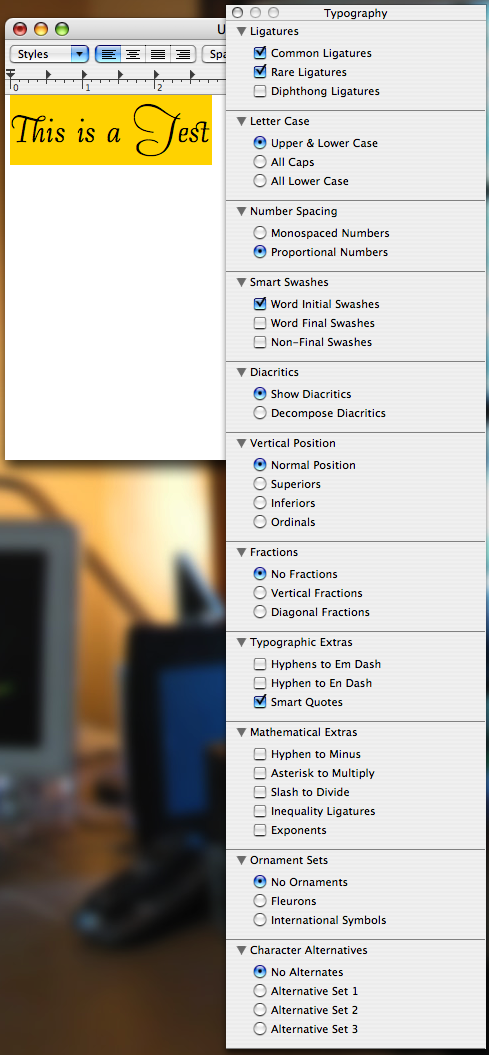
This is Bitstream’s Bernhard Tango GX, released in 1995, as seen in TextEdit.
(Nick S., if you’re reading this, check out the fraction options.)
I’m not trying to start any arguments regarding GX vs. OT. It’s not like anyone’s going to start making GX fonts again. It just rather sad that it’s taken so long to get this kind of functionality in fonts and it’s still not the norm.
The type aspect of GX is still supported by Apple as AAT (Apple Advanced Typography), and Apple make free tools available for defining and adding AAT tables to fonts. The big drawbacks to AAT are a) the layout tables are difficult to develop compared to OT, and b) support is limited to a very small number of applications on a single platform with a small market share. I’m not sure which of these problems is the chicken and which is the egg, but the result is that few people are inclined to invest much in developing AAT fonts. The most substantial and impressive AAT development has been done for Arabic, for which there is currently no other option on the Mac OS outside of Middle East versions of Adobe apps.
Hi Mark
Thanks for showing that. I’ve thought the failure of GX was not only tragic (for the typographic community) but quite revealing. I remember a visit to Adobe way back when and they had a number of them that they were working on (just in case). None were ever released (well, you can’t really count Tekton–which must have the multiple font format record—since Apple paid for it). It simply wasn’t in Adobe’s best interests. So basically, what, about a decade and a half of digital typography’s retardation?
But I know, let’s be quiet about that. OT will surely, surely, someday...
Gerald
The most substantial and impressive AAT development has been done for Arabic, for which there is currently no other option on the Mac OS outside of Middle East versions of Adobe apps.
John, Are you saying that Geeza uses AAT?
support is limited to a very small number of applications on a single platform with a small market share.
True. Currently, the only apps on my system that support the extra features of GX fonts are TextEdit, Pages, Keynote, iWeb, iDVD, NoteTaker, Freeway Pro, OmniGraffle, OmniOutliner, and Stickies. Obviously, none of these are cross-platform, and that’s no coincidence. You can also access the extra characters via the Glyph palette in Adobe CS apps, but nothing automatic like there is with OT fonts, and of course you may have trouble if you send such files to colleagues using Windows.
Still, it’s nice to know that all those cool GX fonts that I got on the Bitstream TypeShop Pro CD aren’t completely obsolete and useless. And it’s nice to know that Mac users (a tiny group of people who number only in the tens of millions) can still use them if they want to. Ironically, there are more apps supporting GX fonts now than there were at the height of Apple’s GX fling. I recall not having any apps that supported them when I bought the TypeShop Pro CD.
Not that I’m likely to start making GX (or AAT) fonts myself, but since the topic concerns the longevity of a font format I thought it was worth mentioning.

”...Mac users (a tiny group of people who number only in the tens of millions)...”
;-)
ChrisL
PS: ...but who buy many more fonts per person than typical majority platform users.
John, Are you saying that Geeza uses AAT?
I don’t know, but if it is an Apple system font, then almost certainly yes.
By the way, I should have mentioned in addition to InDesign ME the very good Mellel word processing program, which also uses OpenType.
The most impressive use of AAT I’ve seen is in the Diwan Mishafi font designed by the Iraqi calligrapher Hamid Al-Saadi.
Captured from web.archive.org on 29 Sep 2008. view this capture