Typophile

Price notations

Martin Silvertant

So, I keep seeing different price notations on posters at the metro stations and they often frustrate me. Now I just want to verify that there is logic behind my frustrations, in that I want to verify whether the other notations are simply incorrect or perhaps the rules to the notations differ per country, but I suppose all the same I shouldn't be seeing different notations in the same country. Here's an image to illustrate the different things I've seen:

The first notation frustrates me because a hyphen is used, the second frustrates me even more because the hyphen is spaced in such a way that from a distance it looks like a semicolon; the third is correct and the fourth frustrates me because I just don't understand why the dash needs to be spaced over the comma. I suppose it's not necessarily a rational objection but an emotional one.

I have absolutely no idea how those 56s slipped in; I was using 75s before. Einstein might call it spooky action.

The third is correct, yep. Never seen the kerned ones before. Somebody wanted to save space there. Hyphen is defintely wrong.

Maybe it's an issue of not understanding the history of the notation? As a child, it took me ages to realise that the Swedish equivalent of this (75:–) was a shorthand for 75:00, and I'm guessing it's even more opaque now that the subdivisions of the krona no longer come in coins.

Am I wrong to think it's sort of exciting, the different variants? Hand drawn shorthands are, after all, the source of a lot of interesting symbols, not least the amersand; I can well imagine the last variant turning into a ligature at some point, especially as subdivisions grow rarer with inflation.

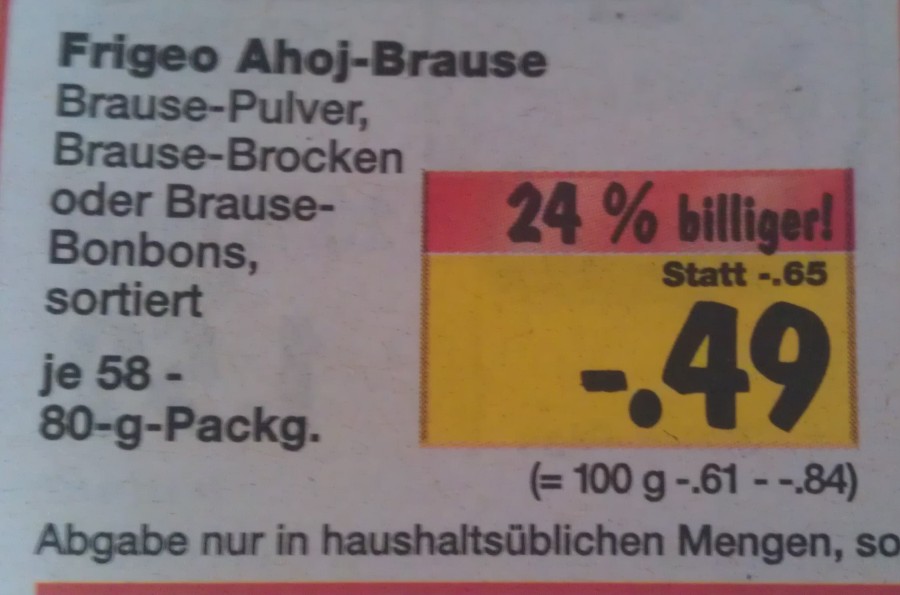
Here's some craziness the Germans are doing:

So many hyphens used inappropriately.

Traditionally, an em dash (or two en dashes) was used to replace zeros in printed price lists:
10,— for 10,00
—,90 for  0,90
In metal fonts, (tabular) figures typically were half an em in width.

Jürgen is right in that the modern (German) practice uses en dashes. Price notation styles are different from country to country, though. See also these pictures.

Why they use hyphens is pretty obvious (http://twitter.com/baldcondensed/status/525631405251125248), but I think Florian's images shed a light on the origin of the kerned comma/dash pair too.

The Germans get more and more stupid … You would wonder where they all put an apostrophe for a genitive where there is no genitive at all. If there is a shop sign with a name ending with s they put an apostrophy (if they’re lucky –most of the times they use ' or ´.

Captured from web.archive.org on 14 Apr 2015. view this capture