In a recent paper [ “How Does Arabic Orthographic Connectivity Modulate Brain Activity During Visual Word Recognition: An ERP Study” Brain Topography, April 2013 ] Haitham Taha, Raphiq Ibrahim and Asaid Khateb show “that instead of slowing down reading, orthographic connectivity in Arabic skilled readers seems to impact positively the reading process already during the early stages of word recognition.
The practical relevance of this for typographers and type-designers working on Latin-based scripts might be in the realm of ligaturization and contextual alternatives. It also has a bearing on discussions of how reading works. A good theory of how reading works should explain why or how connectivity has a positive impact on processing. It should explain why ligaturization and devising contextual alternatives might be beneficial.
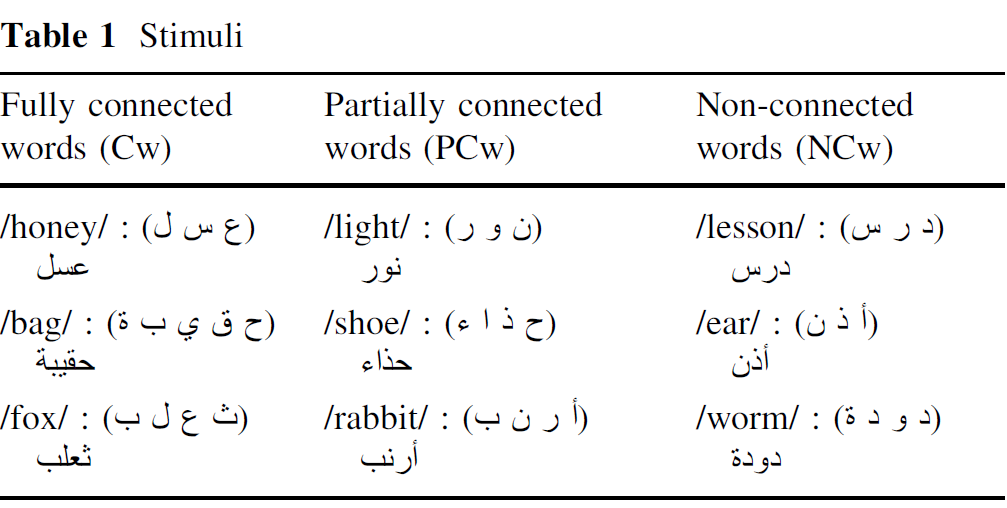
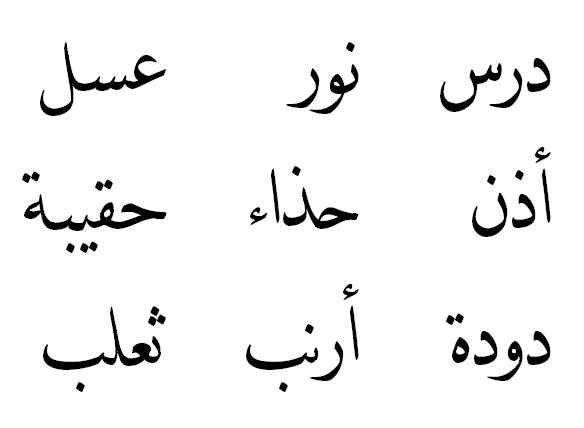
Abstract One of the unique features of the Arabic orthography that differentiates it from many other alphabetical ones is the fact that most letters connect obligatorily to each other. Hence, these letters change their forms according to the location in the word (i.e. beginning, middle, or end), leading to the suggestion that connectivity adds a visual load which negatively impacts reading in Arabic. In this study, we investigated the effects of the orthographic connectivity on the time course of early brain electric responses during the visual word recognition. For this purpose, we collected event-related potentials (ERPs) from adult skilled readers while performing a lexical decision task using fully connected (Cw), partially connected and nonconnected words (NCw). Reaction times variance was higher and accuracy was lower in NCw compared to Cw words. ERPs analysis revealed significant amplitude and latency differences between Cw and NCw at posterior electrodes during the N170 component which implied the temporo-occipital areas. Our findings show that instead of slowing down reading, orthographic connectivity in Arabic skilled readers seems to impact positively the reading process already during the early stages of word recognition. These results are discussed in relation to previous observations in the literature.
Available for a fee online at: http://dx.doi.org/10.1007/s10548-012-0241-2
While seeming to adopt the ‘parallel letter recognition’ based orthographic processing framework implicit in the “Interactive Activation Model” of Rumelhart and McClelland and in the “Local Combination Detection” model of Stanislas Dehaene as their starting point in their “Introduction,” the authors use ideas that appear to be at odds with such accounts in their “Discussion,” specifically the idea that “N170 ERPs could represent a logographic processing strategy in visual word recognition,” which is the result of more frequent exposure to connected words. The authors draw this explanation from: G. Simon, L. Petit, C. Bernard and M Rebai, “N170 ERPs could represent a logographic processing strategy in visual word recognition.” [ Behavioral and Brain Functions, 3:21, 2007 ]. For the authors of the Simon, et.al., paper, a logographic processing strategy is “a more holistic process where words are processed as a global visual pattern [ rather than on an orthographic basis as a string of letters ].”
For my part, I'm not convinced the N170 ERPs actually represent a logographic processing strategy in visual word recognition. For typophiles, conceiving of word recognition in “more holistic” terms might seem attractive, but it’s unclear what “processed as a global visual pattern” means. Currently prominent developmental theories of reading acquisition distinguish three phases, 1) a pre-alphabetic logographic phase when readers recognize words (for example, those appearing in their everyday environments, such as the names of restaurants, brands of candy, their own or friends’ names printed on cubbies at school) on the basis of salient or distinctive visual cues and contextual features in or around the written words; 2) an alphabetic phase when readers use spelling-sound rules to read words; 3) an orthographic phase when words are recognized by larger spelling patterns, especially morphemic units. [ This description is freely adapted from the work of Linnea C. Ehri. ] The idea that in skilled readers the N170 ERPs represent a logographic processing strategy in visual word recognition doesn’t seem to recognize the perceptual learning in early visual cortex which takes place during and after the orthographic phase.
My alternative to the “global visual pattern” idea is an “intrinsic integration” account. I think the facilitating effect of connectivity actually has to do with the fact that connectivity frustrates the channeling of feature (closure, aspect, extendedness) and role-unit or glypheme (stroke and counter) level information into independent letter slots, as the Interactive Activation Model assumes. In an script system characterized by connectivity, feature-analytic processing encourages an holistic or across-the-word gathering of fine-grained, location-specific role-unit level information. A re-coding of words at this more elemental (than letter) level, and more fine-grained than “global visual pattern” level probably represents a 4th phase in reading acquisition, and is the result of perceptual learning at the neural level during phase 3.
So connectivity through ligaturization and contextual alternatives in the late-alphabetic and orthographic phase might actually facilitate the emergence of the rapid automatic “visual word-form resolution” capabilites fundamental to immersive reading of extended text.